
What Google boss Sundar Pichai's warning about AI stock market bubble could mean for your pension
Exposure of pension funds to AI-related stocks is cause for concern

Anyone who regards artificial intelligence as an unwelcome, harmful or unsettling technological development may have skipped over the thinly veiled warning issued this week by Sundar Pichai, chief executive of Alphabet, the parent company of Google. In a BBC interview, Mr Pichai conceded there were moments when the industry would “overshoot” in its investment cycles, with a degree of “irrationality” evident in the current AI boom.
Were the AI bubble to burst, as many economists and market analysts are predicting, Mr Pichai said it would not just be the Californian tech giant and its competitors that would be impacted. “I think no company is going to be immune, including us,” he said. Such remarks have raised eyebrows among tech experts and investors, given the extraordinary sums of money being committed by Alphabet and other firms to bankroll AI infrastructure.
Shares in US technology firms are already seeing their sharpest pullback since US President Donald Trump announced a sweeping tariffs package in April, amid fears that a crash comparable to the dot com implosion of the early 2000s is imminent. The repercussions of that, as Mr Pichai admits, would be enormous. The so-called ‘Magnificent Seven’ – a cluster of AI-focused firms including Alphabet, Nvidia and Microsoft – have a collective market capitalisation greater than the Chinese economy.
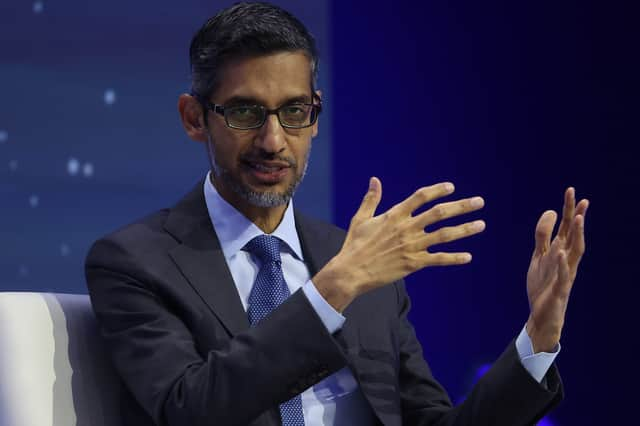

But it would be remiss to suppose that only those who deal in blue chip stocks have reason to be unsettled. If boom turns to burst, it will have a ruinous effect on economies the world over, and Scotland is no exception.
Unbeknownst to many ordinary households, their month-to-month pension contributions are helping to build the AI house of cards. Strathclyde Pension Fund, one of the largest such schemes in the UK with close to 300,000 members, holds more than £104 million worth of stock in Alphabet, and over £220m in shares in Microsoft, which has invested billions of dollars in OpenAI.
Then there is the £189m it has in Amazon, whose AWS subsidiary is rapidly expanding its development of custom AI chips and applications. Or the £136m it holds in Meta, which this year alone, has funnelled around £54 million into AI infrastructure. Or the £176m stake in Nvidia, a key player in the AI marketplace thanks to its powerful graphics processing units.
There is further loose change staked in the AI game, such as a £17m holding in Broadcom, a firm that has partnered with OpenAI to produce its first in-house AI processors, and £3m in Mobileye, an Israel-headquartered firm building AI driving systems. And Strathclyde is not alone.
The North East Pension Fund’s AI-related interests, for example, include a £106m stake in Amazon, Microsoft shares worth £50m, a £47m holding in Nvidia. In fact, once you factor in the more modest shareholdings of the Lothian Pension Fund, the three entities have invested almost £1.25 billion in software and tech firms that are among the AI market leaders.
If the value of those holdings plummet, the repercussions will ripple through household wealth, credit markets, and currencies. Mr Pichai is right to caution that no company will be immune if the dizzying AI boom crashes and burns, but the reality is that the consequences could be even deeper and costlier than he is prepared to admit.
Comments
Want to join the conversation? Please or to comment on this article.