
'We're all Jock Tamson's bairns': How far-right thugs are betraying Scottish values – Sahaj Kamra
Racist demonstrations, anti-refugee protests, and increasingly hostile rhetoric are causing life-blighting fear among minority ethnic communities in Scotland
Over the past year, anti-immigration rhetoric has escalated fast in Scotland and we have all witnessed it. I have heard more racist language, been told to “go back to your own country” and experienced fear when walking in the street.
Having lived in Glasgow for many years now, I know this city by its better instincts. ‘People make Glasgow’ is stitched to its branding and, somehow, it really is true. I felt it in the welcome that was extended to me and in the old Scots saying, “We’re all Jock Tamson’s bairns” – cut from the same cloth and owed the same respect, regardless of our backgrounds.
That idea is not incidental to how Scotland sees itself – it is the foundation. But now it is cracking.


Attacked because of their skin colour
It was naive to think when Tommy Robinson’s call to attend a ‘Unite the Kingdom’ event in London was answered by thousands of people that this could not happen in Scotland. In June, a similar scene played out in Glasgow, sharper and uglier, with officers assaulted. Police Scotland later confirmed that at least one member of the public was attacked in the street because of the colour of their skin.
And grimly, we saw it happen again in Glasgow under the banner of ‘Unite the Clans’, with 15 arrests amid significant disorder that suggests this is becoming a pattern and is not merely an aberration.
The latest ‘incidents’ of hate and division are very much a threat to Scotland’s political and cultural image as a progressive and multicultural nation. And the dangers are not just reputational.
It is what this rhetoric does to marginalised communities who were already carrying more than their fair share of this country’s hardships before a single placard went up. Scotland cannot ignore the effects of this toxic political rage on existing and widening inequalities among minority ethnic communities and refugees anymore.
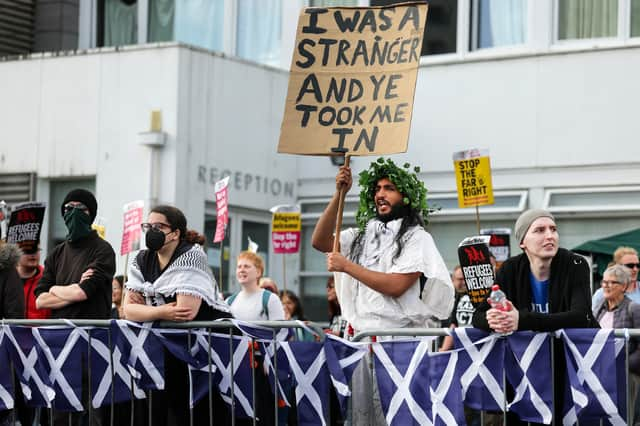
Scared to walk home
These demonstrations are reported, debated and then the cameras move on and the last flare burns out. What remains is the fear that blights the lives of minority ethnic communities. It lingers – in a family going for their prayers and in a nurse who is scared to walk home after a night shift.
Racist demonstrations, anti-refugee protests, Islamophobic narratives, and other increasingly hostile rhetoric provide constant reminders for minority ethnic communities as they go about their lives in their neighbourhoods and workplaces, and it can determine access to health, safety, housing and employment.
These ‘protests’ aren’t merely expressions of prejudice. They are also displaying the structural and institutional cracks which result in disadvantages affecting marginalised communities, where people were already feeling less safe, less represented, and less economically secure.
This isn’t just about belonging or otherness, but basic rights. Let’s face it, the scales are tilted, steeply, by racial discrimination that long predates the racist marches. Misinformation propagated by the far-right – and some in the media – has suggested that minorities are getting ‘special treatment’, but these are people for whom equality is still to be achieved and these protests have caused further harm, exacerbating the inequalities.
Twice as likely to live in poverty
The statistics speak for themselves: Scottish government data shows minority ethnic groups already face disproportionate levels of poverty and disadvantages in the labour market, with huge effects on families and children.
Research from Joseph Rowntree Foundation has found that children in black and minority ethnic families are almost twice as likely to live in poverty than the national average and are 60 per cent more likely to live in Scotland’s poorest areas.
And, despite achieving higher levels of educational attainment, minority ethnic adults face discrimination in employment and receive lower pay. People with non-British sounding names have to send far more applications than everyone else to get the same number of callbacks from employers. Joblessness among minority ethnic groups runs at double the rate of their white counterparts.
Economic insecurity and national identity
Having worked in healthcare for some time now, I find it striking to observe that when communities experience racism in the sector, the primary explanation for this is often that they were “reluctant to seek help", with too little effort to examine how racism within the system is creating the barriers. These inequalities persist in the face of all this evidence.
These problems are lived experiences of real people, and not theoretical political squabbles in Holyrood or Westminster. This is not neutral territory. Yet this is the ground that the far-right are attempting to claim as their own.
It would not be far-fetched to say that immigration has become an escape exit for wider anxieties about economic insecurity, lack of housing, healthcare pressures, national identity, and cultural change. Ethnic minorities are the ones conveniently targeted.
Ultimately, the true measure of a society is not how it responds to questions of equality during moments of stability, but how it does so during periods of anxiety and division. Scotland's commitment to its own identity depends on whether it chooses solidarity over the scapegoating of minorities and genuine structural reform over ingrained racism.
These ‘demonstrations’ may claim to defend the nation against ‘others’ but, in reality, they deepen existing inequalities while profoundly threatening the fabric of society.
The situation calls not just for condemnation of the damage that has been done, but for real, measurable action – on poverty, housing, healthcare and the wage gap – because warm words will not fix a housing system that pushes minority families into the most deprived postcodes or address the wider inequalities that they face.
The social landscape is shifting in an alarming direction and Scotland’s political leaders must now invest in the communities which are bearing the brunt of it and living in fear. We need real action and effective policies, not just platitudes.
Sahaj Kamra is a health inequalities practitioner, researcher and changemaker working to address health, education and social inequalities
Comments
Want to join the conversation? Please or to comment on this article.