
Waiting for Dad: A Venezuelan earthquake story – Gianni Mastrangioli
Gianni Mastrangioli, a Venezuelan historian who has studied the social effects of earthquakes, tells of his desperate attempts to discover the fate of his father in the recent disaster


Just as I was about to settle into bed, having opened the windows and pulled the blinds down to cope with a seemingly unbearable Scottish heatwave – one of the few First World problems I currently have – a message from my sister, who also lives in Edinburgh, came through on WhatsApp: “Hey, are you awake? There’s been an earthquake back home, and I can’t locate dad.”
“Surely it was just a wee shake, and the wifi was down,” I thought to myself while staring at my phone, noticing how my insides stretched and contracted like chewing gum.
Resisting the urge to reply immediately, I went on Instagram to look for evidence that my sister’s worry was nothing but a byproduct of her own imagination. What happened next made my skin feel as though the temperature in my room had suddenly risen: video after video, I watched buildings fall to their knees; I watched faces, transfixed with horror, running through the streets of a dusty Caracas – streets that once shaped my own existence.
“Let’s not panic. He’ll reach out soon,” I messaged back; my senses refusing to accept the fact that Venezuela had just been cracked open – and so may have been my family – in a way from which we may never fully recover.

Unanswered prayers
On Wednesday, June 24, two earthquakes exceeding magnitude 7 struck my homeland within seconds of one another as the afternoon turned to dusk. With the country located along the boundary between the Caribbean and South American tectonic plates, Venezuela is no stranger to seismic activity.
Prior to last month’s events, many recalled the devastation experienced in 1967, when a 6.6-magnitude quake hit the same areas now affected, or the pair of powerful shocks that took everyone by surprise on that fatal Holy Thursday of March 26, 1812.
However, as a historian who has previously studied the social impact of earthquakes, I knew straightaway that the aftermath of these recent ones presented unique challenges.
As every June 24 , Venezuelans celebrate San Juan, that Wednesday was no ordinary day. Most people were off work and gathered in different parts of Caracas to dance to the rhythm of traditional drums; others headed for La Guaira to chill on the beach – all unaware that, on this particular occasion, San Juan wouldn’t listen to their prayers.
Both Caracas and La Guaira were severely impacted by the shaking; the latter, a beautiful, busy coastal city, now reduced to rubble. To put it into context, travelling from Caracas to La Guaira is like going for a jolly to North Berwick from Edinburgh. Therefore, it is pretty common for those who live in the capital to visit La Guaira to escape the hustle and bustle wherever they can.

‘My daughter is trapped’
A sea of questions started to flood my social media feed as people wrestled with frustration, their minds picturing the impossible: “Has anyone seen my brother? He was with his wife and kids at Catia La Mar beach”; “My daughter is trapped on the tenth floor, can anyone help?” A state of complete powerlessness dominated the scene due to the lack of answers, especially amongst those abroad like my sister and I, whose dad was nowhere to be found.
More than 7.7 million Venezuelans now form one of the world’s largest diasporas as a result of decades of corruption and relentless triple-digit inflation. Will you believe me if I tell you that my monthly wage as a lecturer, when I used to teach history at the Central University of Venezuela in 2015, was just a few pennies? Not enough to buy a breakfast roll, is it?
Venezuela is being held hostage by a regime that knows nothing but to watch from afar, with its hands clean, as their citizens throw themselves into the rubble to rescue their loved ones; by the greed of Trumpism and its intention to suck every drop of oil out of our soil. Earthquakes don’t kill people – government failure does.
’It was horrific’
“Hello, I’m OK. We’re safe here but we don’t have much signal. I’ll turn off my phone to save battery in case we lose power. It was horrific, it really was,” I read on the family WhatsApp group. It must have been about 3pm here.
It was from dad.
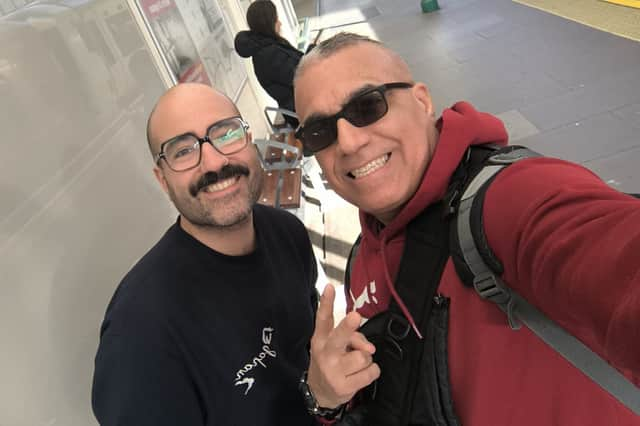
My father, who lives in London, happened to be on holiday in Venezuela when it happened. He managed to return last week, and although his arrival has allowed our nervous systems to breathe again, grief feels like an evil and corroding thread.
My social media tells stories of dead mothers who were found hugging their children to protect them from collapsing buildings, of siblings who never got to make up after a fight, of stories that make problems like the heat or the monotony of life fade into insignificance.
However, I’ve also seen accounts of hope, of students joining international rescue teams, of a woman being pulled out of the rubble and asking for a Coca-Cola because she was “thirsty”, of surviving kids giving press conferences and speaking with great confidence, of trucks and trucks of food donations in a country where eating three meals a day is never taken for granted.
If this isn’t an incredible act of resilience, Ah dinnae ken what is, really.
Gianni Mastrangioli is a Venezuelan historian and writer from Caracas. While in Venezuela, he worked as a researcher at the Venezuelan Foundation for Seismological Research. He now works in communications and public relations at the Scottish Youth Parliament.
Comments
Want to join the conversation? Please or to comment on this article.