
The Scottish Enlightenment genius whose views and values have stood the test of time – Colin Campbell
James Hutton ranks alongside James Clerk Maxwell as one of the most important scientists Scotland has ever produced
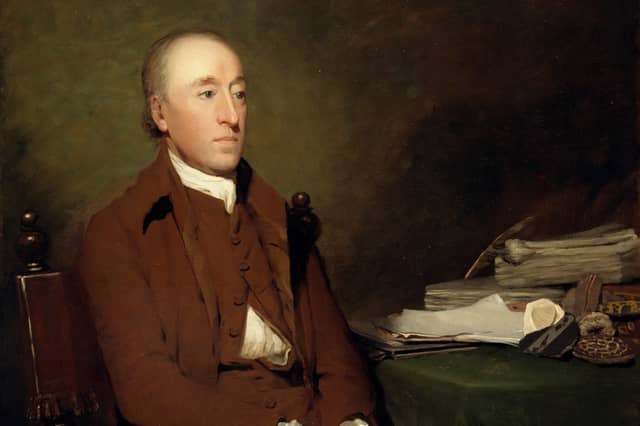

Today marks three centuries since James Hutton was born in Edinburgh. Across the country, a year of celebrations are already well underway to mark this anniversary, organised by institutions and people for whom he is one of the most important scientists in history – and yet, most Scots have no idea who he is.
Despite the fact that he changed our understanding of the very creation of our world forever and now lends his name to Scotland’s largest independent scientific research body – the James Hutton Institute – the ‘Father of Geology’ seems to play second fiddle in the Scottish Enlightenment orchestra.
In my view, Hutton stands alongside James Clerk Maxwell as one of the two most important scientists this country has given the world. Maxwell was the lightning rod between Newton and Einstein; Hutton did something equally profound for our understanding of the planet.
His work laid the foundations for modern geology, reshaped scientific thinking and influenced theories from continental drift to evolution. Yet, unlike other Enlightenment figures, he never became a household name.
Remarkably progressive views
Part of the explanation lies in the man himself. Though admired by his peers – Adam Smith, Joseph Black, David Hume and others – Hutton never sought fame. Instead, he chose the humble life of a farmer, living modestly and writing with a precision that could be, frankly, impenetrable.
His Theory of the Earth and Principles of Knowledge and Reasoning were monumental works, but dense ones. It was only when his friend John Playfair translated Hutton’s ideas into more accessible prose that they gained wider acceptance. Even in death, Hutton’s humility persisted. His grave at Greyfriars Kirkyard lay unmarked for nearly two centuries.
For me, however, the deeper issue is cultural. Scotland has an uneasy relationship with its Enlightenment heritage. Some figures of the period held views that are intolerable today, and this has made public celebration cautious. Yet this should not obscure the fact that many Enlightenment thinkers – including Hutton – held remarkably progressive views for their time.
Hutton had no involvement in slavery. His writings show a deep respect for labour, shaped by his own experience of back-breaking agricultural work.
Raised by a widowed mother and surrounded by three sisters, he was acutely aware of “the wasted talents of women”. His reflections on the rights and responsibilities of workers, landowners and the state were strikingly modern.
No evolution, no Gaia theory
Another reason for his relative obscurity is that Hutton was, in many ways, ‘of the people’. Like Robert Burns – a fellow farmer – Hutton spoke and wrote in Scots throughout his life and never took elocution lessons to smooth his accent for polite society.
Yet the irony is that Hutton’s ideas were anything but modest. His ability to read rocks and landscapes like books led him to a revolutionary conclusion: the Earth was far older than anyone had imagined.
The processes shaping the planet – erosion, sedimentation and uplift – were slow, cyclical and continuous. “No vestige of a beginning, no prospect of an end,” he wrote, capturing in a single line the concept we now call “Deep Time”.
This insight changed everything. Without Deep Time, Darwin’s theory of evolution would have been impossible. Without Hutton’s rock cycle, plate tectonics and James Lovelock’s Gaia theory could not have emerged.
His study sites – Arran, Glen Tilt, the Borders and, most famously, Siccar Point – are scientific landmarks. Siccar point is number one on the list of global geological heritage sites published by the International Union of Geological Sciences. It will see a new interpretation trail opened this year – created by the Edinburgh Geological Society, the Scottish Geology Trust and the James Hutton Institute – where you can stare into “the Abyss of Time”, to use Playfair’s words.
An inspiration for Robert Burns?
Hutton’s ideas have long inspired artists and writers. This year alone, exhibitions at the Royal Botanic Garden Edinburgh, the Royal Scottish Academy and Blair Atholl, as well as a ‘Hutton 300’ concert at Greyfriars Kirk, will explore his legacy. There is even evidence that Hutton influenced Robert Burns.
The famous lines “Till a’ the seas gang dry, my dear/ And the rocks melt wi’ the sun” echo geological conversations they likely shared at the home of their mutual friend, Adam Ferguson. Burns even wrote about granite, probably sparked by Hutton’s obsession with the material.
Despite all this, Hutton remains better known in the United States than in his homeland. When Senator John Kerry visited Scotland, he described Hutton as “probably the world’s first climate scientist”. American schoolchildren learn about the Scottish Enlightenment as part of their curriculum.
In Scotland, it is an optional topic for sixth-year history pupils. To me, this is a missed opportunity. Our young people deserve to know that Scotland once changed the world – and can aspire to do so again.
The best of Scotland
The James Hutton Institute reflects the enduring spirit of Enlightenment science: rigorous observation, critical reasoning and a commitment to applying knowledge for the public good. Like Hutton, we work across soils, crops, climate, land use, communities and understanding systems.
With around 550 staff and collaborations in more than 50 countries, we contribute to science and the economy, returning £15 to the UK economy for every £1 invested. Although based in Scotland, our impact is global.
As we mark Hutton’s 300th anniversary, we have an opportunity to elevate a figure who embodies the best of Scotland: curiosity, rigour, humility, creativity and a belief that understanding the world is the first step to improving it. Hutton did not seek fame, but he deserves recognition.
Perhaps the greatest tribute we can pay him is simple: tell his story, celebrate his achievements and remind ourselves that Scotland’s past brilliance is not a relic, but a foundation to build on.
Professor Colin Campbell is chief executive of The James Hutton Institute
Comments
Want to join the conversation? Please or to comment on this article.