
The scandalous ageism that sees thousands of Scots with dementia forced to pay for care
Social care is treated as a poor relation of health care, with devastating consequences for some who can face losing their homes and pensions
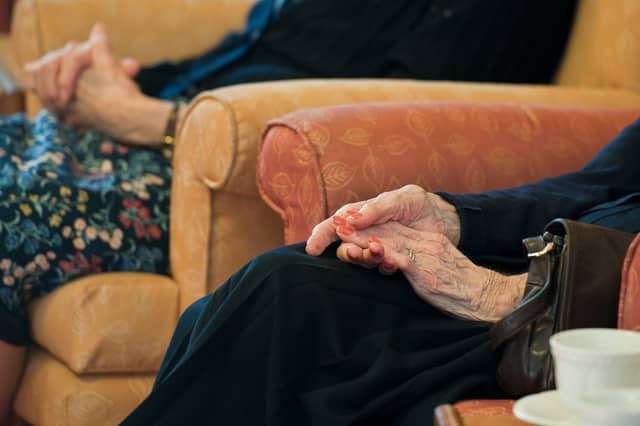


As First Minister in the early 2000s, my push to introduce free personal and nursing care in Scotland received overwhelming support from the public and, despite fierce resistance from colleagues at Westminster, became a popular Act of the Scottish Parliament.
But even then, there was obvious confusion, concern and doubt about the role that adult social care – which includes help with everyday tasks – should play in a modern society, contrasting sharply with the public and political embrace of the NHS.
Free personal care was important but only as a first step towards a comprehensive service more in tune with the “cradle to grave” and “free at the point of need” approaches taken by William Beveridge, who was instrumental in creating the health service.
READ MORE: Why Scotland must get a Minister for Older People and stop ignoring the demographic time bomb

Riddled with anomalies
But this vast, complex area of public policy has never been recognised as a priority and we may face another decade of inactivity. Social care lacks political commitment. It remains vastly underfunded, totally fragmented in its coverage and consistency, and riddled with anomalies, with an over-reliance on shrinking private investment alongside rapidly diminishing financial support from government and local councils.
The medical establishment has ensured social care remains in the shadow of the NHS, and seems reluctant to use its cash or clout to get this Cinderella service to the Ball. The Health Foundation has identified over 25 reports, inquiries and commissions into social care since 1997 with successive governments kicking the can down the longest road they can find.
Twenty-five years on, and now an ambassador for Alzheimer’s Scotland, my disappointment has only deepened. Adult social care is in crisis and will face more serious challenges in the coming years. An ageing population, cynical ageism, underlying health conditions – especially acute in Scotland – and a chronic scarcity of public funds are creating massive inequalities.
Personal wealth will largely dictate access to care with less fortunate others depending on council providers currently being starved of resources. This mix of public and private provision isn’t working.
Postcode lottery
The criteria used to access financial help varies enormously with a postcode lottery for people in desperate need. The funding crisis, rather than need, dictates what is on offer. In her book, Labours of Love, The Crisis of Care, journalist Madeleine Bunting wrote: “Care for older people has suffered from a toxic combination of chronic underinvestment and politicians’ reluctance to spell out the need for more money.”
Despite high expectations, the new Labour government has scrapped the idea of having a lifetime cap on care costs, which was a key recommendation from Andrew Dilnot’s landmark commission report in 2011.
As a result, people experiencing acute social care crises will continue to face losing their homes and pensions because of the massive costs. Equally worryingly, “adult social care” did not receive a mention in Chancellor Rachel Reeves’ recent spending review, despite an avalanche of cash for the NHS.
The decision to remove visas from foreign care workers will not help as we remain dependent on migrant labour, especially in Scotland. Social care work is rightly described as low paid and a low priority for politicians but is wrongly characterised as low skilled.
Lack of urgency
There seems little prospect of any change in attitude. Another review for the UK Government is to be undertaken by Baroness Louise Casey, undoubtedly the best person for the job, but this will be conducted in a political vacuum created by the lack of a substantial financial pledge to fund its recommendations or any sense of urgency, while hopes of an integrated National Health and Care Service appear to be receding.
We don’t need another inquiry. The problems are well understood. But are there deeper philosophical or psychological reasons behind our inability to prioritise social care despite public concern?
The difference between caring “for” someone and caring “about” them may be distorting the debate. We have an idea that we all care “about” people, as we do, but forget this is different from actually caring “for” them – an important distinction raised by academic Emma Dowling in her book, The Care Crisis.
People might think, why should social care be conceived as similar to health care, as we are all carers now. The deliberate downplaying of social care and the idea that it is not as worthy as health care have fed into government indifference and public acquiescence.
Unfair treatment of people with dementia
However, most would be shocked by the most egregious example of failure – the 10,000 people in Scotland with advanced dementia, out of 100,000 with the disease, who are forced to pay for care even though their condition is completely health related. If they were suffering from cancer, there would be no cost.
This is not fair. It should be free at the point of need. Especially when dementia, including Alzheimer’s disease, is now the leading cause of death in the UK.
Social care is in need of urgent attention. Under difficult circumstances, excellent work is being done by local government, the private sector, the third sector and trade unions but governments are consistently failing to accept the need for investment, coordination, leadership, justice and equality.
The struggle for recognition may be the result of a fundamental misunderstanding of social care and its inability to compete with the easily understood idea that health care must be free at the point of need.
This may persuade people that health is more important than care and deserving of a superior status. The lack of positive messaging remains a real obstacle to the much-needed raising the status of social care in public discourse. It’s time for a new ‘Beveridge moment’.
Henry McLeish is a former First Minister of Scotland
Comments
Want to join the conversation? Please or to comment on this article.