
The extraordinary story of how Lachie Stewart became a Scottish national hero
Lachie Stewart’s unorthodox training methods, which included racing Glasgow buses from Anderston to Shawlands, made him an unlikely medal contender

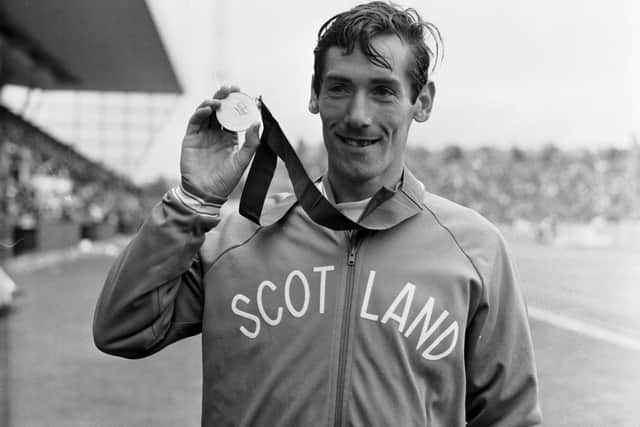
For all the majestic and, at times, inglorious moments that defined Scottish sport throughout the 20th century, the crowning achievement of distance runner Lachie Stewart is too often forgotten. He was, and remains, one of Scotland’s greatest ever athletes, and the sad occasion of his death last week at the age of 81 is a chance to revisit the moment he became a national hero after claiming gold in the 10,000 metres at the 1970 Commonwealth Games in Edinburgh.
No one, except perhaps Lachie himself, considered such a feat realistic. He was a gifted runner, for sure, but found himself up against a talented field which included Dick Taylor, the British record holder, and Kenya’s Naftali Temu, the reigning Commonwealth champion. Above them all towered Ron Clarke, the revered Australian who had set no less than 17 world records during a gilded career. Having taken silver at three previous iterations of the Games, Clarke was widely expected to go one better in Scotland.
Lachie’s talents had been recognised at numerous Scottish meets and Amateur Athletics Championships, but in truth, he was viewed as an outsider, and even in an age when athletics remained a strictly amateur pursuit, his training regime was unorthodox. Although he joined his local running club in Alexandria as a teenager, and progressed to the Shettleston Harriers, he was a self-taught runner who seldom took to a track, preferring to mark out 800 yard and 400 yard repeats in a local park.

Out of sorts on big day
His great virtue, however, was hard graft. Every weekday, the young Scot would run to and from his home in Rutherglen and his workplace at Glasgow Dental Hospital. If ten miles was insufficient, he would give up his lunch break to pound the length of Sauchiehall Street and its surrounding thoroughfares. On occasion, he would even accept the challenge laid down by a bus driver, racing them all the way from Anderston to Shawlands.
Come a dreich July day in the shiny new Meadowbank Stadium, the 27-year-old faced an even greater challenge. Lachie had felt a little out of sorts on the day of the biggest race of his sporting life, and had just a few tea biscuits for breakfast. The discomfort was the result of a peptic ulcer – not that he or the thousands of home supporters cheering knew it.
‘An idol of mine’
With just 200 metres to go, he was in third place, tucked in behind Taylor and Clarke. But buoyed by the crowd’s cheers, he kicked on, passing a tiring Taylor and overtaking a grimacing Clarke on the home straight to secure Scotland’s first flat race Games gold.
The dogged, wily performance had already secured Lachie’s place in Scottish sporting history, but what happened next revealed to the world the true character of a champion, as he walked over to Clarke, shook his hand, and told him: “I’m sorry to be the one who had to beat you. You’ve always been an idol of mine.”
It was a class act from a modest man who inspired a generation of athletes, and with the Games set to return to these shores next year, wouldn’t it be nice if the organisers could pay tribute to the wee dental technician from the Vale of Leven who could outrun the best of them?
Comments
Want to join the conversation? Please or to comment on this article.