
SNP once again show how they're constantly meddling while achieving little – John McLellan
The SNP’s new Programme for Government is a thin one but it still shows little sign of accepting that there are limits to political intervention

The Festival fireworks are history, but with dropping temperatures and lengthening nights, for the past 19 years the SNP’s Programme for Government has been a sure sign the hazy days of summer are over.
There might have been a time when they hoped it would lift the national mood, to make us realise the potential of this great wee nation of ours, but that too, it seems, is history. After the initial flurry of giveaways like free prescriptions and the end of university tuition fees after the SNP’s 2007 breakthrough, it has become a gloomy list of things we’re doing wrong, of problems in need of solutions, but which our political masters are almost powerless to fix without the “full levers” of independence.
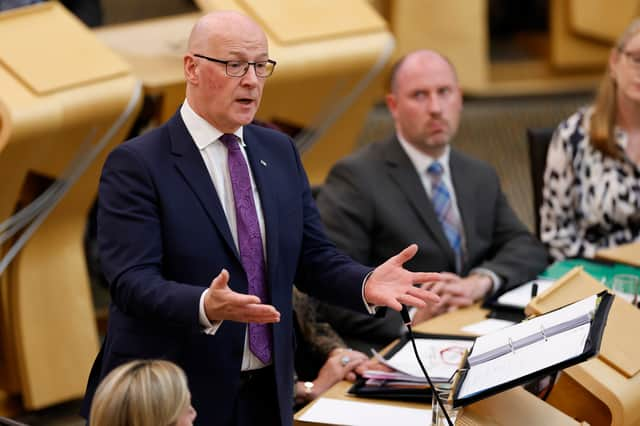
Few governments preface their list of priorities with the warning that they can’t fully address pressing issues without a revolution which half the population opposes and, from that starting point and set against a grim background of tightening financial constraints and a track record of underachievement, this year’s edition, unveiled by First Minster John Swinney on Tuesday, was particularly bleak.

Paid to pay golf
Most of the previous 18 SNP Programmes for Government have been full of promises which were never delivered or targets which could never be hit (closing the educational attainment gap anyone?) and it’s arguable that such achievements as they can claim have made little tangible difference to the majority of lives.
Even the vast sums now being spent on welfare are not getting close to “ending poverty” because, when measured in relative terms, as it always is, the goal is always out of reach.
Can anyone genuinely say they feel safer because there is only one national police force and not eight? Do we therefore expect treatment waiting times will tumble because there will be two mainland NHS boards instead of 11, as Mr Swinney announced? No compulsory redundancies in the NHS will just mean highly paid managers can sit in a redeployment pool rejecting vacant posts as unsuitable and doing nothing except gardening and playing golf.
Do we think cutting the number of public bodies but introducing more regional government will do anything except add to bureaucracy and confusion, as the unloved social care Integration Joint Boards, set up to coordinate social care between councils and the NHS, have done?
Just eight bills
Apart from the annual Budget Bill, only eight new bills have been proposed, not including the retread Independence Bill, and of those the Football Banning Orders Bill will take up valuable parliamentary time for something which will only affect a handful of neds. By contrast, the Misogyny Bill could end up criminalising thousands of men, be weaponised by political campaigners, and run into freedom of expression problems.
The real lulu, the Food Prices Bill to impose maximum prices on some essential food items, is set to follow the Circular Economy Act into a mire of unworkability and unintended consequences, the product of an electoral wheeze in which the credible professional warnings in the subsequent five months of consultation have been dismissed.
It may, of course, all work out in the end, but the care system was supposed to have been reformed and that went nowhere, largely because of an inability to challenge the same vested interests which will set their faces against any public service reform which delivers meaningful savings and efficiencies.
Simplifying the planning system sounds good, but who’d bet against it just producing a different set of complications, however unintended? Legislation to reform the compulsory purchase system sounds worryingly like paving the way for politically driven land grabbing, not the euphemistic means to “support more effective delivery of development, regeneration and infrastructure projects”.
There is evidence of a willingness to take forward infrastructure investment, but this is a re-hash of previous commitments, like dualling the A9 and supporting the Clyde Metro project. A suggestion of “empowered regional economic partnerships” may well have good intentions, but alongside a regional shake-up of local government it sounds like a recipe for bureaucratic sludge.
Unfortunate timing
Just repeating the amount of money invested in the City Region Deals smacks of space filling, and a new “Major Projects Office” to boost investment in significant capital projects like housing and energy, sounds off the pace.
Not Mr Swinney’s fault, but unveiling the Scottish National Investment Bank’s Scottish Innovation Fund for university spinouts the same week as the collapse of Edinburgh University start-up tech company PureLifi, with the lost of 40 jobs after it had received a £15 million SNIB investment, was unfortunate timing.
But credit where it’s due, and Mr Swinney’s 80-page brochure does contain some important pointers. With pressure mounting to halt all data centre planning applications, there is a clear promising of “a strategic approach to attracting and securing responsible green data centre investment in Scotland”.
While maintaining an absolute commitment to the 2045 deadline for reaching net-zero carbon, the accent is on offshore renewable energy while focusing on efficiency like heat in buildings – fine as long as it doesn’t include pre-war domestic properties − and on investment in emerging industries like carbon capture.
Notably, there is no promise to expand onshore wind, the source of so much unhappiness in rural communities fighting to preserve their landscapes against developments which cost taxpayers millions in compensation for wasted electricity. No promise of a moratorium, as demanded by scores of community councils, but no emphasis either.
Government intervention is not always unwelcome, but it’s not in the DNA of your average politician (and there are plenty of those in Scotland) to know when to step back. What politicians don’t do is as important as what they do, but the latest Programme for Government shows little sign of accepting political intervention has its limits.
Comments
Want to join the conversation? Please or to comment on this article.