
Scotland’s Brexit referendum result shows how rejoin EU campaign can be won – Martin Roche
In 2016, Scotland’s political leaders made a strong case for staying in the EU, in contrast to the dismal performances of David Cameron and Jeremy Corbyn

Andy Burnham has brought the UK’s place in Europe back to the centre of national politics. There’s talk of rejoining the European Union being in Labour’s next general election manifesto.
If the current parliament runs its full course, we’ll have an election in the summer of 2029. Burnham could go to the country at any time before then. Whenever an election happens, if going back into Europe is official Labour policy that will mean it is confident of winning. If Burnham and the pro-EU camp get it right, we could be fully back in the EU in the first half of the 2030s.
Winning means starting now to build a coherent, rational and emotional case for a full return to the EU. In 2016, the Remain side failed to win hearts and minds in England and Wales.
Leaderless and abandoned
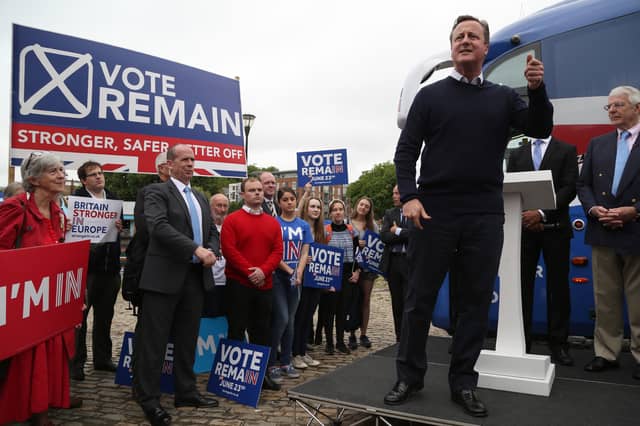
Staying in Europe was official Conservative and Labour policy. Prime Minister David Cameron was asleep at the wheel and his Labour opposite number, Jeremy Corbyn, did the minimum required to promote a Remain vote. EU supporters in the south felt leaderless and abandoned.
In Scotland, by way of contrast, all the main party leaders, including the Conservatives, then led by Ruth Davidson, left voters in no doubt that they not only advised a Remain vote but were also enthusiastic about being in the EU. The Remain machine in Scotland had a clear sense of direction, clear messaging and the benefit of mainstream political unity.
If Labour can maintain stability in the UK’s economy and society, and find sustainable growth, no matter how modest, it could secure enough voter support on Europe to win a second Burnham term. With a general election mandate secure, he could hold an early referendum on the EU. If there is to be another Europe referendum it must be on the 50 per cent plus one system – the same used in the 2016 vote.
Of course, the Leave side will cry foul, arguing that the democratic vote of 2016 is being disrespected. Their case is easily dismissed. In a democracy, the public must be given regular opportunities to change people and policies.
There is nothing in any legislation or in the UK’s constitutional customs and practices governing the time between referendums. Just as no Westminster parliament can be bound by the actions of previous parliaments, nothing should be done that lessens the options available to the electorate to express its wishes.
Democracy doesn’t stand still. There is nothing sacrosanct about the result of the 2016 referendum. Public opinion in England and Wales is now consistently anti-Brexit. The job of the Europhiles is to convince a healthy majority of voters that rejoining the EU is massively in the UK’s best interests.
No more Perfidious Albion
A big Return majority is needed to secure public legitimacy, underpin national political stability, give the government a strong hand in negotiations with Brussels and provide EU governments with confidence that the UK is entirely serious about being not only a returning nation state but also one committed to being a fully engaged EU member, in its actions, and, critically, in spirit. There can be no more Perfidious Albion.
The Return lobby must also deal with the changed nature of politics in Europe. It is a Europe that can no longer be certain that America will always come to its aid. It is a continent facing growing Russian aggression on its borders and one facing China using state subsidies and currency manipulation to try to drive manufacturers in Europe and worldwide into the ground.
The EU must also contend with the rise of the hard right, street protests in some member states and rising anti-democracy sentiments.
A changed EU
The EU itself is fundamentally changing. It’s moving beyond its horizons of regional, political and economic stability and prosperity to becoming a global political actor, aiming to protect Europe’s best interests in the new world order.
This has profound implications for security and defence policy, industrial policy, capital markets and financial services, and the energy, food and public infrastructure sectors. It is change of big challenges and big opportunities.
The UK (and an independent Scotland if that transpires) can play a central and vital role in keeping Europe united and moderate in its politics. We can only fully deploy such influence and benefit from Europe’s opportunities by being party to EU decision-making. That means not being an outsider.
It is worth remembering that peace has reigned in Western Europe for the past 80 years, the longest continuous period without war in the history of the continent. That’s a prize beyond measure. The closer we bond our economic interests, the less likely we are to fight each other.
Familiarity breeds favourability
The EU is complicated. It is a big idea that delivers benefits on multiple levels. It is not easily packaged. Winning hearts and minds on Europe, and in big numbers, is no easy communications task.
The application of some basic brand discipline would help. The pro-Return lobby needs to agree on its core messaging, a timetable and actions to highlight key issues, and a common campaigning lexicon – as well as simple but enormously important marketing techniques like using the same colour pallet, typeface and logos. In an inelegant but true phrase from the world of advertising, familiarity breeds favourability.
There’s no time to lose. The cross-party, cross-organisation machines that were born out of the necessity to fight the 2016 Brexit referendum need to be revived. We are living through extraordinary times. We must try to shape the world to our advantage. And we must begin now.
Martin Roche is a member of the national executive of the European Movement in Scotland
Comments
Want to join the conversation? Please or to comment on this article.