
Sally Rooney and the hypocrisy of the literary free speech brigade
There’s a world of difference between finding your books banned for their content and/or your unrelated political views, and falling foul of a country’s anti-terror laws
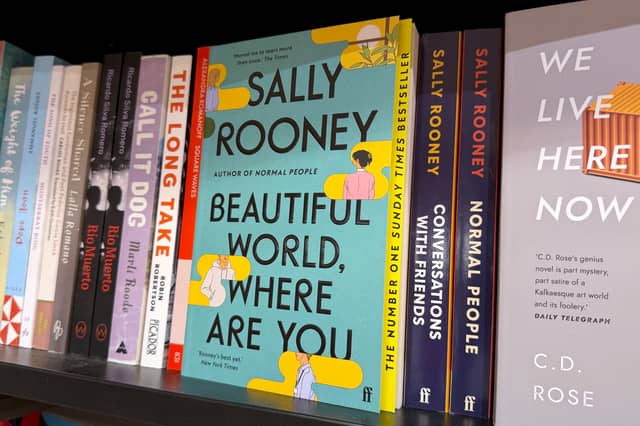


“Sally Rooney is a writer, not a terrorist. Her books must be available to the public.”
So begins the latest example of a burgeoning new artform: the open letter, the literati’s favourite form of “Down With This Sort of Thing” protest. That nobody has actually called Rooney a terrorist is not the most promising start.
But let’s unpack the strange situation that has unfolded this past week. How has a bestselling Irish author found herself unable to sell her wares in UK bookshops? What has led to the need for a robust defence of this supposedly ‘censored’ writer by her fellows? Quite simply: her stated intention to financially support the proscribed terrorist organisation, Palestine Action (PA), via proceeds from her book sales.
Whatever one thinks of PA, the group is so described, therefore supporting them at all, never mind financially, is unlawful. Rooney’s UK publisher, Faber, feel understandably squeamish about passing royalties to its author, given her stated intentions. A mutual agreement to stop selling her books in the UK was thus made.
The signatories to the open letter, published in The New Statesman alongside an opinion piece comparing Rooney to Salman Rushdie, say her books “withdrawal from sale … is an affront to basic principles of free speech and expression”.

But there’s a world of difference between finding your books banned for their content and/or your unrelated political views, and falling foul of a country’s anti-terror laws.
Just ask any ‘gender critical’ poet or author, treated by some of the types of writers who sign open letters as akin to child murderers, despite their views being entirely legal, and perfectly moral.
I didn’t see any of these signatories coming out in defence of poet Rachel Rooney - no relation to Sally - in 2019, for example. After penning a lovely poem for children – My Body Is Me – encouraging kids to be happy with their bodies, she found herself slammed by fellow writers who then successfully hectored her freelance employers to drop her.
One writer called her book ‘terrorist propaganda.’ Why? Well, Rachel Rooney had expressed opposition to gender self-ID. She’d also spoken at one of the first A Woman’s Place UK meetings. That group was treated by trans activists as if it were terroristic despite it being founded by left-wing feminists. For their pains, they were treated to venue harassment, violent threats and abuse, and even a bomb threat.
“Where are all the free speech warriors defending Sally Rooney?” sneer permanently-online grievance-mongers, in an attempt to accuse writers who’ve campaigned against belief-discrimination of hypocrisy, for finding no real commonality between their plight and that of the author.
But, where were any of them – or Ms Rooney herself – at any point this past decade, when women writers were facing egregious censorship and having their books removed from libraries?
It has failed to register with such writers that, should they genuinely be targeted for their political views, or find themselves hounded to within an inch of their sanity as so many of us have been, we’d be right there, defending their right to freedom of speech and expression. That isn’t what is happening here, however.
“We categorically reject censorship – whether direct or indirect – and urge the government to change course, amending the legislation which has led us to this point of repressive absurdity,” the letter concludes.
Let’s be generous and take these two points in turn. To the first: hallelujah. I fully expect every one of those signatories to cease targeting writers such as Polly Clark, JK Rowling, the editors of the Women Who Wouldn’t Wheesht anthology, and Julie Bindel, and to vocally oppose the egregious attacks they’ve all faced.
Censorship can indeed be direct or indirect, and the cultural atmosphere such women have been writing in has been one of fear, discrimination, and demands for their silencing.
To write with a constant background hum of mockery and abuse hasn’t been easy - believe me - no matter the solidarity targeted writers have given each other through their experiences. All any writer wants is to be judged for the words they’ve actually written, rather than their worst bastardisation, after being churned through some gender-identity mangling machine by people intent on turning feminists into folk-demons.
To the second point: here’s the actual crux. Opposition to the proscription of Palestine Action. To many, on the face of it, it is indeed absurd that a popular novelist should find herself facing these consequences for what’s taken to be her generous support of a benign group that simply wants to help the Palestinian cause.
In fact, PA do no work in Gaza. They’ve been deemed a dangerous threat to UK national security. Financing such a group is quite clearly not an issue of ‘free speech’.
However, thousands of people have been arrested simply for saying they support PA. It has been disturbing witnessing this when most stand peacefully holding placards with that message.
That said, there’s been a purposeful conflation of support for PA with support for Palestine itself. I don’t think that at all helpful.
There’s a chance I’m jaded by the incessant ‘culture wars’ of the past decade, but I can’t help but view all of this as a carnival; this open letter, the surrounding stramash.
Sally Rooney is not a martyr, nor some gallant free speech defender. Nor is she comparable to Salman Rushdie, whose lack of signature to the open letter is significant. This is noise, a performance, unserious.
Comments
Want to join the conversation? Please or to comment on this article.