
No Scotland No Party: What fan festivities can tell us about who we are
Following Scotland comes with a strong set of social norms
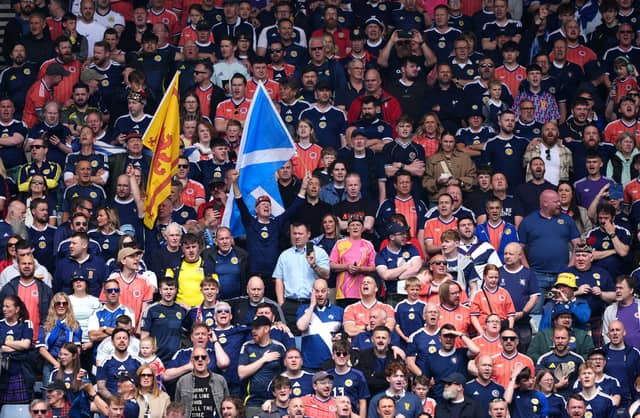

In the wee hours of Sunday morning, the Scotland men’s football team will play their first match at a World Cup in 28 years. I was fourteen during France ‘98, only one year older than my daughter is now.
It’s been a long wait of near – and not so near – misses, and now we’re finally back on football’s biggest stage. Despite our first game against Haiti kicking off at 2am, pubs, clubs and living rooms will be full of bleary-eyed Scots cheering on the team. At a time of social and political division, can a kickabout really bring us together?
Psychologists talk about the importance of shared social identity for connection and coordination. While each of us has a personal identity, who we are is also made up of the groups we belong to. Examples of social identities might include family and friendship groups, nationality, religion or political affiliation. These can be longstanding relationships or they can emerge quickly, such as during emergencies when an otherwise unrelated group of people unite in the face of a shared threat. Each social identity has boundaries which determine who is “ingroup” and who is “outgroup”, in addition to social norms (the ways to think, feel and act as a member of the group). Following Scotland comes with a strong set of social norms about how to act towards other fans (friendly), what to wear (strip and kilt), and what to drink (lots).
Which social identity is relevant to us – and who we share it with - depends on the context. For example, a Dundee fan would be outgroup to me at Tannadice, but ingroup at Hampden. This matters because shared identity with others can lead to trust, solidarity and intimacy. This transformation in social relations is critical during emergency contexts, but it also has consequences for a nation during the World Cup.
Shared identity comes with an expectation of consensus with other group members. This doesn’t mean we can’t still debate formations, lineups and where to hold the victory parade, but it does mean we know that the stranger next to us wearing navy (or possibly coral) will experience the matches in the same way as us. In everyday life, shared identity, shared experience and connection with strangers can be rare. Normally, striking up a conversation with the person crammed next to you during the morning commute is a risk, but not so during the World Cup. The day after Scotland play, you’ll be able to talk about the match safe in the knowledge that others will likely a) know what you’re talking about and b) have shared your experience.
Research has shown that shared experience and norms are key to how people interact in mass events. Often, this sense of oneness can be more memorable and pleasurable than the event itself. Given the current epidemic of loneliness, our fractured politics and recent memories of pandemic isolation, it’s perhaps no wonder that rare opportunities for connection are valued so highly. Indeed, there is lots of evidence to show that feeling part of a social group has positive health consequences. Scientists call this the “social cure”, and it has been demonstrated in contexts as diverse as sport, workplaces and retirement homes.
It will be interesting to see if this phenomenon can overcome a 2am kick-off. Thousands have bought tickets for venues with special late licenses, and many more (including those of us with young kids) will watch at home. The shared experience of exhaustion might even serve as a further point of connection. Suffering together can demonstrate group commitment, and yawning your way through an important meeting the morning after playing Brazil might be excused just this once. While it’s understandable if others choose sleep, the shared experience will extend beyond the matches themselves as the country becomes immersed in the World Cup. Most offices have a World Cup sweepstake, the radio is jammed with rousing anthems from Belle & Sebastian, JJ Bull and Limmy, and John McGinn’s impish grin is in every advert. Beyond the fun, there might also be consequences for our conception of what it means to be Scottish, and who gets to claim that identity.
Nationalism and the meaning of national symbols are constantly reshaped and reproduced. Since the controversial “Operation Raise the Colours” campaign to hang Saltires on lampposts and paint roundabouts, to some the flag has come to represent threat and exclusion. The ubiquitousness of Scottish flags, kits and other symbols during the tournament, and Tartan Army norms of fun, charity and friendliness may play a part in helping reclaim these contested national symbols.
The evidence for whether a Scottish team at the World Cup can impact support for independence is mixed. Scotland will be represented and celebrated as its own nation on the international stage, and the tournament offers a platform for political expression, including for our nationalist elected representatives who have headed for the USA on mass. The relationship between football and independence politics has a long history, such as Barcelona’s Camp Nou as a site of Catalan resistance under Franco. However, evidence from previous tournaments suggest that Scottish national identification predicts sporting pride rather than the other way round, and that citizens’ freedom to celebrate Scottish national identity while remaining constitutionally part of the UK may even count against the independence movement. However, all previous research has been conducted during tournaments we’ve not actually won, so it would be unwise to make too many predictions at this early stage.
Scotland’s participation in a World Cup might not change our politics, but it will create the opportunity for people to share a moment, talk to strangers and think about what it means to be Scottish.
Dr Fergus Neville is a senior lecturer in organisational studies at the University of St Andrews Business School
Comments
Want to join the conversation? Please or to comment on this article.