
I voted Remain, but here's why Starmer is getting too close to the EU
The European Union of today looks very different from the one of 2016

“Just when I thought I was out, they pull me back in,” despairs Al Pacino’s mafia boss Michael Corleone in The Godfather Part 3, as he tries in vain to leave behind his life of organised crime. It’s not an exact analogy, but supporters of the UK’s departure from the European Union may be feeling something similar this week.
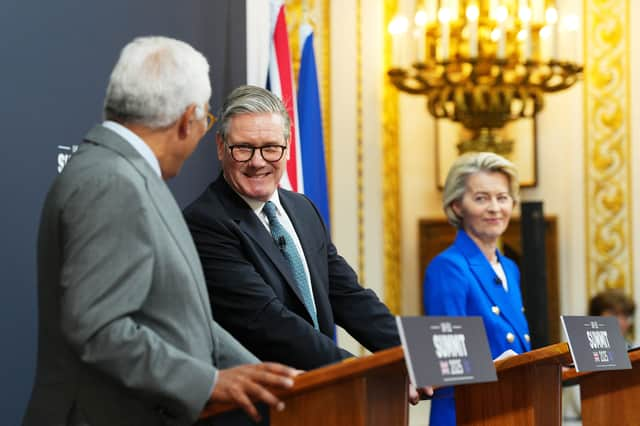
The Brexit wars are back, if they ever went away, thanks to a deal unveiled in London on Monday by Prime Minister Sir Keir Starmer, with Ursula von der Leyen and Antonio Costa, presidents of the European Commission and the European Council.
In a spectrum of favourability towards Brexit, Reform leader Nigel Farage could sit at one end and Starmer at the other. From a crowded field, few politicians did more to try to keep the UK in the EU. Starmer was Shadow Brexit Secretary under the Labour leadership of Jeremy Corbyn and campaigned for a “People’s Vote” – another referendum he hoped would reverse the result of the first.

As Labour leader in opposition, he appeared to make peace with the 2016 result and ruled out a re-run, vowing in July 2022 to “move on from the arguments of the past”.
Three years and a thumping House of Commons majority later, and the old arguments have made a return, which should surprise no one. The Prime Minister is not known for his constancy and his aversion to Brexit clearly runs deep.
For Starmer and those who sit with him at his end of the Brexit-ometer, the EU is a beacon of progressive values, economic strength and political stability.
‘New beginning for old friends’
From this perspective, there are only downsides to Brexit, which can be blamed for much of what’s gone wrong with the UK over the past decade. For the Europeans, it may also have had the unwelcome effect of putting ideas in the heads of other member states.
No wonder Starmer, von der Leyen and Costa looked so delighted as they announced the outcome of their negotiations. They stressed this was not a reversal (perish the thought) but a “reset” of relations - a “new beginning for old friends”, as von der Leyen put it.
But on the other side of the aisle, many of the 17.4 million people who voted for Brexit will, at the very least, have concerns. On fishing, the UK has signed up to allowing EU vessels access to British waters for another 12 years. The free trade agreement rules that were drawn up in 2020 were due to be renegotiated in 2026, and annually from then on. This will now not happen until 2038.
Slippery slope
The “dynamic alignment” agreed in London will see EU rules, overseen by the European Court of Justice, applied in food, farming, energy and climate policy.
Slippery slope theorists suggest that, if EU rules can be applied to British burgers and sausages today, they can be introduced for something else tomorrow. And of course these closer ties, and participation in EU schemes, will come with a hefty price tag from Brussels.
No wonder Farage, many Tories and the fishing industry have been crying “surrender”, “sell-out” and “betrayal”.
But Starmer and his supporters see the EU “reset” as a diplomatic triumph – the third of three trade deals in quick succession, after the US and India. Chancellor Rachel Reeves now has her sights set on the Gulf states of Saudi Arabia, the UAE and Qatar. The “hat-trick of deals” shows the UK is “back on the world stage”, Starmer told MPs on Tuesday.
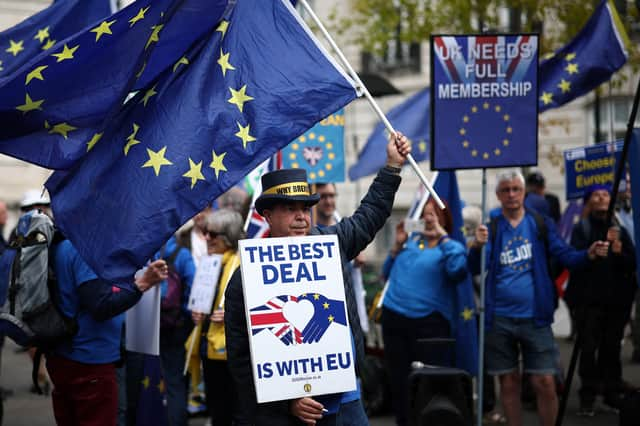
‘Get Brexit Undone’
Emboldened by his success, he may well continue to chip away at the barriers between the UK and the EU. “Get Brexit Undone” could be his rallying call, after Boris Johnson’s 2019 election slogan “Get Brexit Done”. Obviously this would be wildly popular at the Starmer end of the spectrum and wildly unpopular at the Farage end.
Most people are somewhere in the middle. Starmer needs to be alive to the fact that for many Remain voters, like me, today’s EU looks like a very different proposition from the EU of 2016.
This week, the europhile French newspaper Le Figaro published an op-ed entitled “The EU is a hostage to its bureaucracy”. The bloc’s refusal to innovate and “relaunch European capitalism” meant it had “ruined its agriculture and industry”, rendering it incapable of competing with the US and China, it said.
It cited how car manufacturing and steel and chemical production have plummeted in recent years, with European industry shrinking on the world market from 22.5 per cent to 14 per cent since 2000, and how three million farms have disappeared since 2015.
Last October, French president Emmanuel Macron, a passionate proponent of the EU, said: “Our former model is over – we are over-regulating and under-investing. In the two to three years to come, if we follow our classical agenda, we will be out of the market, I have no doubt.”
‘We must genuinely fear for our self-preservation’
Macron’s warning followed a grim assessment the previous month from former Italian prime minister Mario Draghi. In a 400-page report, Draghi, who was president of the European Central Bank from 2011 to 2019, said Europe was stagnating and that, without more investment and less bureaucracy, “we will have to scale back some, if not all, of our ambitions”.
“For the first time since the Cold War, we must genuinely fear for our self-preservation,” he wrote.
These comments, from europhile quarters, paint a picture of a crumbling empire, and in countries across Europe voters are turning en masse to insurgent eurosceptic parties. There is no shortage of reasons why UK support for reintegration with the EU may be less solid than Starmer would like to believe.
But love is blind. The danger for a Prime Minister smitten with an old flame is that he just doesn’t see it.
Comments
Want to join the conversation? Please or to comment on this article.