
How the poll tax left a lasting legacy that blights Scotland to this day – Brian Wilson
Politicians are afraid of touching the thorny issue of local taxation reform so the council tax continues despite its obvious flaws
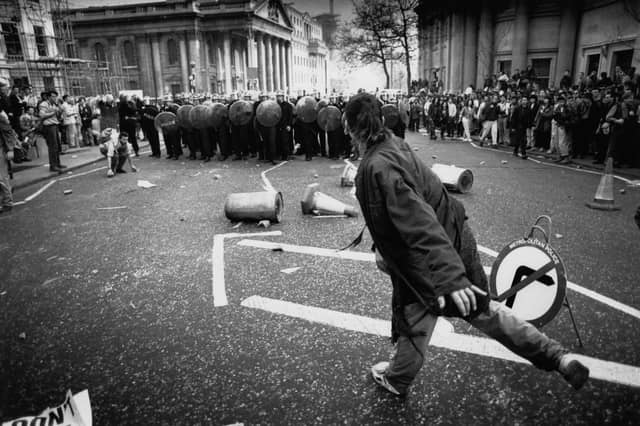


How time flies. It is 40 years this month since the decision to replace domestic rates in Scotland with a “community charge” was set in stone, with implications that extend down to the present day.
Mythology has it that Scotland was chosen for a fiendish Tory experiment whereas, in reality, the motivator was panic rather than premeditation. Great consequences flowed from the anomaly that Scotland, unlike England, had a statutory obligation to hold a rates revaluation every five years.
The Scottish Tory heartlands were up in arms since the revaluation would have resulted in the better-off paying more; sometimes a lot more. And up with that, they would not put.
Scottish Tory wipeout and Thatcher’s downfall
When the normally rational Scottish Secretary, Malcolm Rifkind, was accused of ignoring alarm around the impending poll tax, his response was that the hostility “pales into insignificance beside the groundswell we felt last year” over the threatened revaluation.
Finding themselves between a rock and a hard place, the Scottish Tories made the wrong choice which did not prevent a wipeout at the following year’s general election, from which they never recovered. By 1991, the even crazier decision to extend the poll tax into England had disposed of Mrs Thatcher.
Less fortuitously, the long-term consequence has been to create a fear of anything remotely radical in terms of local taxation. The poll tax legacy was to embed a reverse-Rifkind mindset – ie, that however much the current system is disliked, the political price of changing it might be even greater. So leave ill alone.
In time for the 1992 general election, the Tories cobbled together the Council Tax which was regressive but not nearly so regressive as the poll tax. The issue went off the boil and ever since, give or take some minor fiddling with bands, the Council Tax has remained the answer.
Councils depend on SNP’s grace and favour
Of all the failures to use powers at Holyrood’s disposal, while moaning about not having enough, the refusal to make any significant changes to funding local government is maybe the most remarkable. Here, surely, was the opportunity to do something different, radical, exciting… To which the consistent answer has been “thanks, but no thanks”.
The biggest loser has been local government which must subsist on a narrow base of taxation, topped up by the grace and favour of whatever Edinburgh allows. As well as block grant – two-thirds for ringfenced purposes – business rates are set centrally. Of the £27 billion spent by Scottish councils in 2024-25, only £3bn came from council tax.
Yet it’s that small slice of the cake which is fought over in full public gaze. A few percentage-point increases in council tax attracts opprobrium while raising relatively little money. Councils are blamed for “cuts” while the latitude to forestall them is severely limited by the narrow funding base over which they have any control.
Forty years after that poll tax commitment, 35 years since its replacement by the council tax and more than a quarter-century after the advent of devolution, there has surely been enough time to think about a radical, fairer alternative which could liberate local government from its fiscal straitjacket and also – let’s be really ambitious – serve other political objectives.
A new land tax
The most attractive option, particularly in Scotland, is a form of taxation which reflects the value of land as well as property. This would also embrace the potential role of taxation as an instrument in encouraging land reform which has ground to a virtual halt – not least because the price of land continues to soar, incentivised by public subsidies.
We currently accept the paradox of a free market in land which encourages speculation and drives up prices without any commensurate contribution to the public good. Remarkably, land ownership in Scotland is becoming even more, rather than less, concentrated and vast swathes go virtually untaxed. Surely a linkage between these two issues makes sense?
There is nothing revolutionary about pointing this out. Indeed, the Scottish government’s own quango, the Scottish Land Commission, reported in 2024: “There is a strong case to reform annual land and property tax and change existing taxes to better tax land value.” The caveat followed: “Making reforms to better tax land value requires groundwork… A phased programme to bring all land onto the valuation roll would open up future options for government to reform and improve taxation of land and property.”
A previous report by the same quango in 2017 said much the same thing, but absolutely nothing happened. So when does the groundwork begin? What can be so unattractive, other than hard work and the certainty of offending vested interests, about reforms which would strengthen local government, facilitate land reform, punish rural neglect and urban dereliction, and so on.
Time for leadership
If ministers never embark on that course, the certainty is that they will never reach the destination. But who will take the lead? The SNP manifesto coyly stated that “the future of local tax reform is one that requires consensus, and we will set a high priority for the next parliament of seeking early cross-party agreement on reform”.
But what “reform” worthy of the name would attract consensus? The other manifestos were equally vapid. Labour offered “a new formula for funding local government”. OK, but how? The ever-virtuous LibDems wanted to “guarantee fair funding for local authorities”.
The Greens, to be fair, were more specific though it’s a pity they got rid of Andy Wightman, the only MSP who really understood the power of a read-across between taxation and land reform.
Far from needing “consensus” on such fundamental issues, Holyrood would be better served by leadership and a conflict of ideas that might cause political sparks to fly. Otherwise, what really is the point of it?
Comments
Want to join the conversation? Please or to comment on this article.