
How Sandie Peggie-NHS Fife case is writing the obituary of gender identity politics in Scotland
With less than a year to the Scottish Parliament elections, politicians are starting to realise that most people do not believe that a man who says he is a woman has changed his sex
Are we witnessing the slow death of the absurd ideology that has dominated our public discourse for the last decade, helping to bring down two First Ministers and which saw a male rapist briefly housed in a women’s prison? Frankly, I believe we are.
Earlier this week, an NHS equality and human rights officer, a woman with a degree in immunology, claimed under oath that she did not know her own sex. As the words stumbled from Isla Bumba’s mouth, you could almost hear the country respond: “Don’t be daft, your chromosomes are XX which makes you a woman. What did they teach you at that university?”
Bumba, who also has a postgraduate degree in public health, became the object of ridicule while giving evidence at nurse Sandie Peggie’s employment tribunal earlier this week. Her role, as set out in the 2022 job advert, was to give NHS Fife advice on the interpretation of and compliance with the Equality Act 2010.


Believing in fairy tales
Unfortunately for Peggie, who was suspended last year for daring to object to a male-born doctor using female changing rooms, Bumba based her guidance, not on the law of the land, as clarified by the Supreme Court earlier this year, but on the theory of gender identity. This proposition, which claims that humans can change their sex at will and that we all have an inner ‘gender identity’, has infected Scotland’s public realm for a decade or more.
When transgender campaigners – paid for by the public purse – came up with their cunning plan in 2014 to persuade the Scottish Prison Service to include trans-identified male offenders in the women’s estate, Bumba was only 18. During her early adult years, gender identity was embedded in public services, as well as in universities, charities, the arts and culture.
Little wonder then that she grew up believing in fairy tales. Her understanding of human physiology is based, not on her science degree, but on the same misinformation that led my ten-year-old granddaughter to assert “men can have babies too granny, if they are trans”.
READ MORE: Scottish gender critical academic trained in security 'duck and cover' manoeuvres at universities
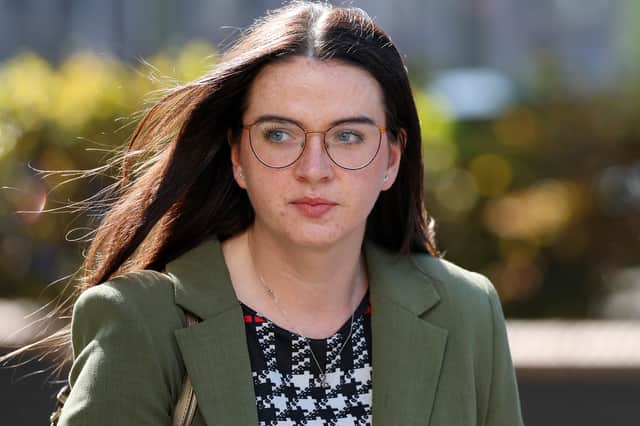
Sturgeon’s zeal for gender identity
The poster girl for the cult – because that is what it became – was Nicola Sturgeon. The politician who in 2000 had dragged her feet over the repeal of Section 2A, the law that banned the promotion of homosexuality in schools, emerged diva-like after the independence referendum as the champion of all things queer. “Trans women are women,” she insisted, even as Adam Graham (aka Isla Bryson), a man in a cheap blonde wig, was found guilty of rape.
Sturgeon was not alone in her zeal for gender identity. Whether because of internal party pressure, a desire to maintain their status within Scotland’s narrow but powerful civic elite, or sheer stupidity, we will never know, the majority of Scotland’s political class went along with the charade – with the notable exception of the Scottish Conservatives and a few determined women like Alba MSP Ash Regan, Labour’s Claire Baker and Carol Mochan, and SNP MSP Michelle Thompson.
READ MORE: Scottish Trans warns 'urgent' UK gender law change needed if single-sex guidance not revised
Regan became one of the leading figures of a grassroots movement that grew up in support of women’s rights, along with her erstwhile SNP colleagues Joanna Cherry and Joan McAlpine and Labour’s Johann Lamont. The movement now encompasses one of the most famous women in the world, author and philanthropist JK Rowling, as well as an army of anonymous women sewing banners, writing emails and mastering equality law at their kitchen table.
Sturgeon did her best to undermine them, sneering that their views were “not valid”, but reality has a way of asserting itself, even in in the face of petty authoritarianism. Slowly but surely, the empress’s new clothes were stripped away and then she was gone.
The penny drops
That landmark Supreme Court judgment, which ruled that For Women Scotland was right to argue that the legal definition of “woman” in the Equality Act 2010 is based on biological sex, was the single most important moment in the campaign to re-assert women’s rights. It will force the Scottish Government, and bodies such as NHS Scotland and the Scottish Prison Service, to unpick the tapestry of transgender guidance and diktats that have been firmly sewn into the fabric of our public life.
The surreal utterings of NHS Fife’s equality and human rights officer are another milestone in the myth’s destruction. Bumba’s public assertion that she could only hazard a guess that she is female and “no one knows” their chromosomes unless they had undergone tests must surely be the moment when the penny dropped for everyone – including, I imagine, John Swinney and Labour leader Anas Sarwar.
The First Minister may well insist that NHS Fife has his full backing, but I will be shocked if the SNP’s 2026 manifesto contains a promise to amend gender laws, as the last one did. With less than a year to the Holyrood elections, Swinney will calculate that public opinion is now firmly on the side of biology, and while the majority are content to live and let live, most people do not believe that a man who says he is a woman has changed his sex.
Nor will Sarwar sacrifice his slim electoral chances on the altar of gender ideology. I hazard a guess that he has always known exactly what his chromosomes are, and that he now realises the electorate know theirs too.
Sturgeon had a ball for a few years, revelling in the adulation of the LGBTQI+ community. But while she and her allies boasted of their progressiveness, children were being harmed, families broken, women hounded.
Bumba’s child-like protestation that she doesn’t know if she is male or female exposed the whole sorry episode as nothing but political slapstick. At next year’s election, Swinney will want to play the role of Prince Charming rather than the pantomime dame.
Comments
Want to join the conversation? Please or to comment on this article.