
How Nigel Farage's claims about election 'cheating' echo Donald Trump's attacks on democracy
Amid low election turnouts, the importation from America of right-wing voter suppression tactics poses a serious threat

The foundations of our politics – democracy, elections and voting – are under threat as Trump-style populism and ideas about ‘voter suppression’ are imported from the US. In the future, ‘one person, one vote’ may only apply to certain people, as if they can’t win your vote, they’ll take it.
The Trump administration has been seeking to protect his power by making voting difficult for ethnic minorities, young people, the poorly educated, the disabled and those in poverty. This is America’s shame and it could soon be Britain’s if the smokescreen created by entirely bogus claims of widespread voter fraud is used to prevent many people from voting.
Boris Johnson has already given credence to this idea by introducing the requirement for photographic ID at polling stations despite figures showing tiny levels of voter ‘personation’. Such attempts at voter suppression pose a real threat to universal suffrage, so central to democracy.
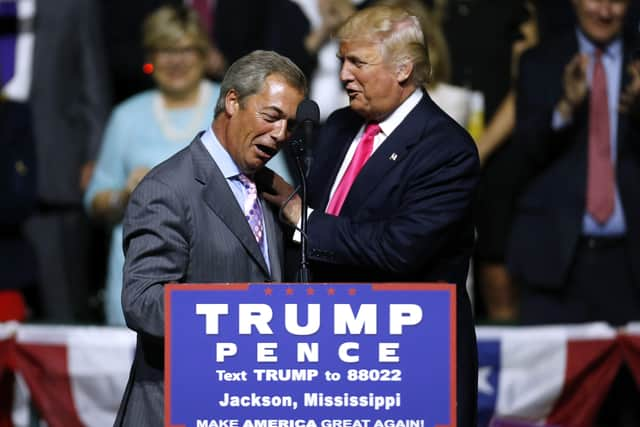

Reform’s Trumpian rhetoric about elections
Reform UK leader Nigel Farage is ready to go even further, with plans to limit postal voting and ban Commonwealth citizens with residency rights from voting.
Writing in magazine Newsweek in August 2020 about that year’s US presidential election, he said: “I have witnessed first-hand the wholesale abuse of the postal voting system in the United Kingdom, and the overwhelming advantage it has given to the British Labour party. Trump is right to sound the alarm...”
After the recent byelection in Gorton and Denton, Farage made similar comments, saying the result was “a victory for sectarian voting and cheating”, while his party’s defeated candidate Matt Goodwin claimed: “We are losing our country. A dangerous Muslim sectarianism has emerged.”
It is Farage’s comments that are dangerous. As an increasingly hate-filled Britain moves to the right, Reform is treating foreign-born residents as aliens in this country, indulging in identity and exclusion politics, and trying to exploit race as an issue.
The Dark Enlightenment looms
However, there is an even bigger problem casting a shadow over our democracy: the lack of interest in voting. Recent turnouts suggest our electoral system could be vulnerable to the deep-seated and enduring interests of powerful and wealthy people who view ‘democracy’ as inefficient, wasteful and in need of what they regard as ‘reform’: less universal suffrage, more divine rights of autocrats.
The extreme ‘Dark Enlightenment’ movement in America advocates establishing a new divine right of kings or an ‘executive officer’ monarchy in which those in power can rule without the constraints of democracy. This sounds far-fetched but there are those in our society who are no fans of democracy or fair and free elections.
Achieving universal suffrage involved sacrifice and struggle over many centuries and was met by fierce resistance from the ruling classes. There was no easy relinquishing of power or privilege to the common man and woman. It required a long, brutal and unrelenting struggle over centuries to move from monarchy to parliamentary government, with significant progress only made after the Great Reform Act of 1832.
Remarkably, it took until 1969, under Harold Wilson’s government, to achieve modern universal suffrage in Britain, in which all men and women over the age of 18 were able to vote. That’s just 57 years ago.
Too many people don’t vote
Our apparent lack of interest in voting is alarming, especially for a country that regularly brandishes its democratic credentials. Voter turnout is a major indicator of the health of a democracy, so what is happening in Britain?
The highest election turnout of 83.9 per cent was recorded in 1951. Despite a fall in voting across Europe after the Second World War, Britain stands out as amongst the worst.
The 59.7 per cent turnout in the 2024 general election was the second lowest since 1918, with 57 per cent the lowest ever recorded in 2001. Amidst the aftermath of the Gorton and Denton byelection, few mentioned the paltry turnout of 47 per cent.
Over half the electors didn’t bother to vote, but there was no call for a public inquiry, just business as usual. We are fast becoming a part-time democracy where the lack of interest in voting seems to be of little consequence and is rarely discussed by politicians or the media. Why is this?
Threats to democracy are enhanced if its enemies can argue that the declining number of people taking the trouble to vote is a sign of a failed system. Our complacency is doing their work for them.
‘We shouldn’t even have an election’
Facing defeat in the November midterm elections, Trump is considering further voter suppression and even claimed that because the Republicans had been so successful “when you think of it, we shouldn’t even have an election”, which was later said to have been a ‘joke’. He is also trying to push the ‘Save America Act’, a restrictive voting bill, through Congress.
With signs Reform is ready to embrace similar voter suppression tactics and declining election turnouts, the danger to British democracy is growing.
On a recent visit to the House of Commons, one of the parliamentary officers provided me with a unique opportunity to experience at first hand a remarkable piece of election history: a broom cupboard of the Chapel of St Mary Undercroft.
In about 1991, Tony Benn installed a plaque which reads: “In this broom cupboard, Emily Wilding Davison hid herself, illegally, during the night of the 1911 census. She was a brave suffragette campaigning for votes for women at a time when parliament denied them that right. In this way, she was able to record her address on the night of that census as being in ‘the House of Commons’, thus making her claim for the same political rights as men.”
The remarkable struggle and sacrifice needed to win the universal franchise must never be forgotten – and Reform cannot be trusted with this precious legacy.
Henry McLeish is a former First Minister of Scotland
Comments
Want to join the conversation? Please or to comment on this article.