
How Germany has gone from hated world war foe to indispensable ally
Europe once feared a strong Germany, now it needs the continent’s biggest economy to rise to its defence
When the guns in Europe finally fell silent in May 1945, Germany and the United Kingdom, for the second time in 30 years, stood on opposite sides of a devastating war that had plunged Europe – and the world – into ruin. Germany was decisively defeated, soon divided, and few in Britain or elsewhere wished to see it rearmed or emerge as a power on the continent again.
Eighty years on, the picture could not be more different. Former enemies have become close allies, and Germany, alongside France and the UK, is one of Europe’s key powers. The most striking shift, however, lies in how neighbours view Germany’s role.
As Polish foreign minister Radosław Sikorski said during the euro crisis in 2011: “I fear German power less than I am beginning to fear German inactivity. You have become Europe’s indispensable nation. You may not fail to lead – not dominate, but to lead in reform.”
More recently, European leaders echoed this sentiment when congratulating newly elected Chancellor Friedrich Merz. Finnish Prime Minister Petteri Orpo stressed that “Germany’s role and leadership is decisive in safeguarding Europe’s security”, while Latvian Prime Minister Evika Siliņa emphasised Germany’s “significant role in the security and prosperity of the Baltic Sea region”.

Churchill on ‘a spiritually great Germany’
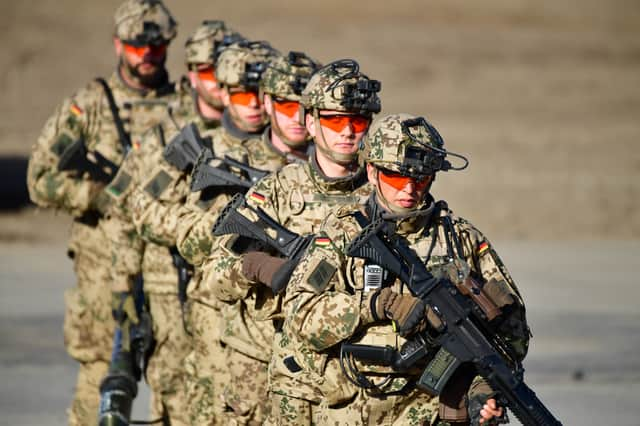
Europe now wants Germany to rearm and help lead its defence against Putin’s Russia. Eighty years ago, Europeans feared a strong Germany. Today, many, including in Britain, worry about a weak one.
In 1945, such a shift would have seemed unthinkable. Yet even then, some leaders, including Winston Churchill, refused to see Germany as an eternal enemy.
In his famous Zurich speech of 1946, Churchill stated: “Germany must be deprived of the power to rearm and make another aggressive war.” But he also insisted that “there can be no revival of Europe without a spiritually great France and a spiritually great Germany”.
Franco-German reconciliation became central to West German foreign policy and the wider project of European integration. Close ties with Britain were also important, especially after the UK joined the European Community in 1973, offering Bonn an ally and a counterweight to French ambitions that often went too far for German policymakers.
When German reunification became a real prospect 35 years ago, Prime Minister Margaret Thatcher – like many in Europe – feared a resurgent Germany might once again upset the balance of power. But over the decades since, such fears have not materialised.
Reluctant to lead
On the contrary, many now see Germany as too hesitant to lead. With its economic strength, central location, and fiscal capacity, Germany has long appeared a natural leader, especially during the eurozone crisis, after Russia’s annexation of Crimea in 2014, during Donald Trump’s first term, and throughout the Covid pandemic. But, as Chancellor, Angela Merkel often held back.
Then, after Russia’s full-scale invasion of Ukraine in 2022, Chancellor Olaf Scholz appeared ready to break with that caution. He announced a Zeitenwende – a turning point in foreign and defence policy – and pledged to rearm the Bundeswehr and boost military spending.
For a brief moment, it seemed Germany might finally assume the leadership role Europe urgently needed. It did not.
Although Germany became one of Ukraine’s strongest supporters, Scholz did not lead efforts to reshape Europe’s broader defence strategy. Nor did Germany step up when the new Trump administration returned to office and adopted a more confrontational stance towards Europe.
Mired in domestic politics, Berlin failed to coordinate a unified European response or push for a rethink of transatlantic relations and continental security. Others – France’s Emmanuel Macron, European Commission president Ursula von der Leyen, and to some extent Keir Starmer – tried to fill the vacuum. But without Germany – Europe’s largest country, a key military actor, and its foremost economy – no decisive action was possible. Europe had to wait.
‘A very European Chancellor’
There is hope the wait is over. With the election of a new CDU-SPD coalition under Merz, the government has pledged to defend Europe in partnership with France, Poland, and the UK. Upon his election, Merz travelled to Paris and Warsaw to reaffirm his commitment to European cooperation, particularly in defence and armament.
Speaking alongside Macron, Merz promised to be a “very European Chancellor”. His tone marks a welcome contrast to Scholz’s constant hesitation. Paradoxically, his failure to secure election in the first vote may even help him – it was a reminder that leadership requires not just blunt pushing ahead but coordination and consultation. If he takes that lesson to heart, both at home and in Europe, his government could provide the leadership Germany and the continent need.
What role, then, for Britain? The CDU-SPD coalition agreement highlights the UK as one of Germany’s closest partners. Despite Brexit, the UK remains a major European military power – not least due to its nuclear deterrent – and a crucial partner in European security. Expect deeper Anglo-German cooperation.
Threats from east, west and within
Moreover, amid the rise of the far-right in Germany, the UK, and across Europe, centrists like Merz and Starmer could help stabilise the political middle. Both currently lead relatively stable governments and have time in office to enact meaningful change.
But for now, populists are gaining ground. Reversing that trend will require smart policies and cooperation – not imitation of populist eye-washing and nationalism. Germany and Britain can lead here too. Together, they can help defend the continent from threats from the east and west – and from within.
Eighty years ago, Britain and Germany were bitter enemies, and Europe lay in ruins. The Europe that has emerged since then is one of peace, prosperity, and friendship. It is a remarkable achievement forged from the wreckage of war – and it is worth defending. The long wait for Germany to do so must now be over.
Eighty years ago, Europe feared a strong Germany. Today, it can ill afford a weak one.
Dr Bernhard Blumenau is a senior lecturer in international history and politics at the University of St Andrews
Comments
Want to join the conversation? Please or to comment on this article.