
How climate change put Greenland in Donald Trump's sights
Global warming is transforming Greenland at an astonishing pace, revealing valuable mineral deposits and opening up new trade routes in the seas around it
Greenland is a surprisingly dynamic corner of the world, and climate change is reshaping it in ways that go far beyond the long-term environmental impacts of warming temperatures and melting ice.
When most people think of climate change, they picture rising air and sea temperatures, more frequent extreme weather events, or shrinking ice sheets. These are all very real environmental impacts, but they don’t begin to touch on the political, social, and economic effects that are already shaping our daily lives.
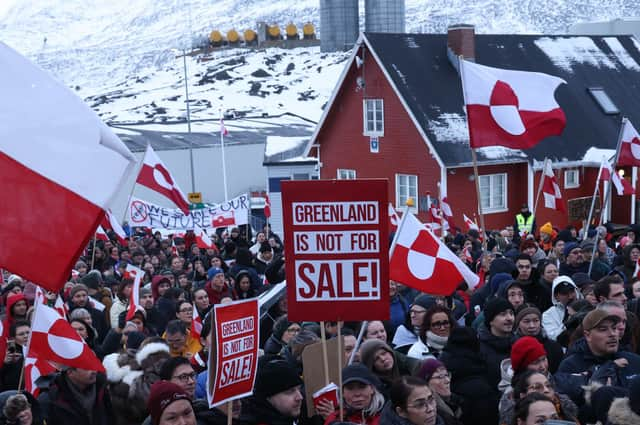
With its vast ice cap and world-class ore deposits, Greenland is an excellent example of how these changes ripple outward – or more recently rumble like a tsunami – producing not just meltwater but new rhetoric from political figures vying for influence in the Arctic. And these factors will continue to ripple through our daily lives as they affect sea routes, minerals, and geopolitics.

Millions at risk from Greenland’s melting ice
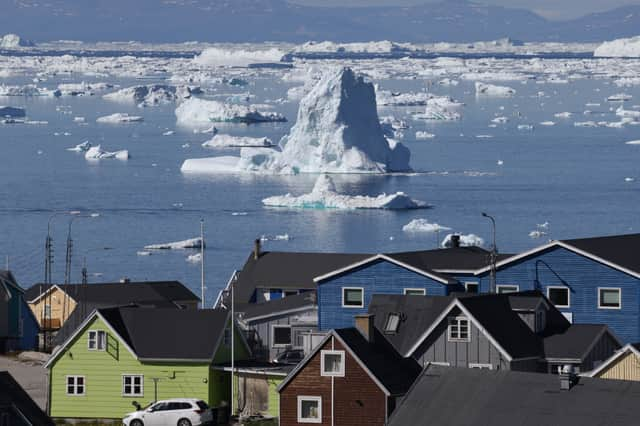
Climate change is transforming Greenland at an astonishing pace. Its vast ice sheet is melting so quickly that it currently adds about a millimetre to global sea level every year. That may not sound like much, until you remember it’s happening year after year, across the globe. It adds up fast: every 10 millimetres of sea-level rise exposes around six million more people to coastal flooding.
To give a sense of scale, Greenland alone holds enough ice to raise global sea levels by roughly seven metres if it all melted, a scenario highly unlikely in our lifetimes. Even so, these figures highlight just how much frozen water is stored in the polar ice sheets, and why even small losses of ice can have worldwide consequences.
As the ice retreats, Greenland is also literally getting greener, with plants and shrubs spreading into areas that were frozen until recently. Meltwater acts like a lubricant beneath the ice, helping glaciers slide faster into the ocean.
And what happens in Greenland doesn’t stay in Greenland; all that freshwater can influence major ocean currents that help regulate weather across Europe and North America.
Economic opportunities
Several opportunities arise alongside the negative impacts of climate change, shaping not only Greenland’s geomorphology but also its role in the global political and economic stage.
As Arctic ice retreats, trans-Arctic sea routes remain open for longer each year, and new routes are emerging that more efficiently connect the North Pacific and the North Atlantic. In today’s geopolitical climate, this is particularly interesting because the main players along these routes are Russia, Canada, and Greenland, with the notable absence of the United States.
The Northwest Passage, for example, runs between western Greenland and northeast Canada, while the Northern Sea Route tracks along Russia’s coast, with Greenland and Canada on the opposite side, giving these countries the most direct access to these increasingly important shipping channels.
Finding Greenland’s hidden wealth
The race for critical metals intersects closely with climate change and geopolitics on the Greenlandic stage. To fight climate change, we need green and efficient energy technologies, which rely heavily on access to critical metals.
However, approximately 10 per cent of global carbon dioxide emissions arise from the extraction, crushing, and processing of rock. So it’s more efficient – and more profitable – if we can find and extract metals from near the Earth’s surface.
The Ilímaussaq intrusive complex in southern Greenland is a near-surface, world-class rare-earth element deposit, containing materials vital for clean energy technologies. Recent research by St Andrews University researchers from the M³Ore Group shows how processes like crystal settling and migration of volatile-rich fluids help concentrate these valuable minerals. Understanding these structural controls is key to finding similar high-grade rare-earth deposits around the world to support the battle against climate change.
Over the past two decades, mining companies have poured huge investment into finding new metal deposits, yet discoveries have actually declined, with copper a good example. That’s because most of the ‘easy’ deposits near the Earth’s surface have already been found or are nearing exhaustion. Today’s exploration increasingly targets deeper, harder-to-find deposits buried hundreds or even thousands of metres underground.
This is where Greenland comes in. It has vast mineral potential, particularly in rare earth elements used in batteries, renewable energy, and computing technologies. Like elsewhere in the world, many near-surface deposits in Greenland are already documented, but unlike almost anywhere else, around 80 per cent of Greenland is still covered by ice. As that ice melts, new bedrock is exposed, opening opportunities to discover surface-level mineral deposits that are comparatively easy and cheap to access.
People of Narsaq must be heard
All of this helps explain