
Here's why SNP legislation always seems to go wrong

After the collapse of the National Care Service plan, Brian Wilson identifies patterns in the SNP’s track record of failed legislation
The collapse of the SNP’s National Care Bill has been a slow motion process but its significance should not be blown away while ministers breeze on, as if it was just another mishap. There are real victims – the people who desperately need tangible reforms.
While the £30 million which has gone down the copious Holyrood drain was dismissed by the care minister, Maree Todd, as “0.2 per cent of the annual budget” – so who, by implication, cares? – the greater scandal lies in the fact that, while ministers fiddled with a doomed Bill, the challenges of social care continued to intensify.
There is more bed-blocking, more financial waste for the NHS as a result, more dysfunctionality in the system, more pressure on too few care workers – and incidentally, Ms Todd, that derisory “0.2 per cent of the annual budget” would have been enough to employ another 1,500 of them.
This was not just another piece of ill-conceived legislation which petered out in the Holyrood dust. It was their flagship commitment, proclaimed in 2021 with all the portentous hyperbole one has come to expect.
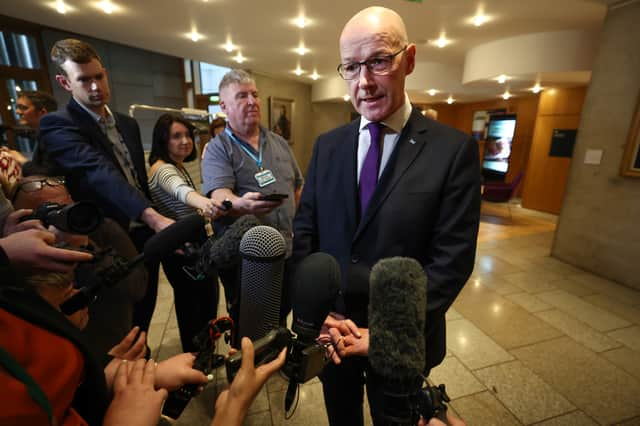

Swinney the clapping seal
It was to be the “most ambitious reform since devolution”, according to Nicola Sturgeon. The other lost leader, Humza Yousaf, who could always find a top to go over, compared it to “the creation of the NHS in 1948” while the omnipresent John Swinney clapped like a seal.
In contrast, Thursday’s announcement did not merit a statement from our First Minister or even the Cabinet Secretary, Neil Gray. It was left to his junior minister to intimate that “we must deliver our Scottish national care service without legislating for structural reform”. So much for the spirit of 1948!
As with everything they touch, the modus operandi was to start with a headline and work backwards. It is an exceptionally bad way to legislate and explains why so much comes to grief. Can anyone name a landmark Bill which has emerged from Holyrood in the last decade that makes a positive difference to people’s lives?
Any bureaucracy in Edinburgh could spend £64 billion a year without anything very much changing while public services deteriorate. That has been pretty much Scotland’s reality of recent years. It is through legislation that real change can be driven but it requires vision and clear intent, capable of winning popular support.
Fanfares of trumpets
Holyrood reverses the process. There is no vision, just what sounds like a vaguely good idea – for example, a National Care Service. So announce it with fanfares of trumpets, then tell the civil servants to work out how it is to be delivered. At that point, the whole thing starts to fall apart.
Ms Todd may have drawn the short straw but you have to go back to the announcement in 2021 to ask why the groundwork had not been done, crucially by involving local authorities and recognising the critical role they and their employees play in the delivery of these services.
It really was some achievement on the part of successive ministers and First Ministers to turn Cosla into arch-opponents of the Bill because of the disrespect it showed for councils’ role in social care – and not just adult social care. Regardless of political complexion, they saw yet another dilution of their role, to make way for a massively expensive centralised structure.
Welcoming Thursday’s statement, Cosla said: “Social care plays a pivotal role in the lives of Scotland’s people, but unfortunately our system faces serious challenges related to investment, access, sustainability, workforce capacity and recognition.” Everyone could have signed up to legislation based on these priorities.
More quangos!
One thing it did not need was another set of quangos – or “care boards overseen by Scottish ministers”. From the outset, Cosla also warned that the Bill “threatens the sustainability of councils, with the potential loss of a critical mass having a significant effect on the ability to maintain other core statutory local authority functions”.
Why has it taken four wasted years – and £30m – for such valid concerns to be recognised when serious, respectful discussions before a Bill was published could have revealed them? Instead, the SNP’s achievement has been to unite councils, trade unions and opposition parties in forcing a return to the drawing-board – with exactly the same challenges remaining, except worse, four years on.
The repeated failure of Holyrood legislation fits the same template. A vague Bill is published with detail to follow later. The Bill is then passed to a committee which hears from a procession of witnesses that it is either inadequate or fundamentally ill-conceived.
Since there is no real vision in the first place, the civil servants are left to accommodate the various objections and some insipid compromise might emerge in the form of legislation. Alternatively, as in the cases of National Care Service, deposit return recycling scheme, gender recognition etc, etc, the whole thing disappears.
Tick-box exercise
I am currently watching this process with two other pieces of legislation which could make a difference on subjects in which I have a longstanding interest – Crofting Reform and Land Reform. Both have started as minimalist exercises which go out of their way to avoid the big questions which urgently demand “reform”.
There is no minister with any vision or commitment behind them. If they pass into law in their current forms, boxes will have been ticked for another decade, crofting tenure will continue to disintegrate and Scottish land ownership will remain as the world-leader in inequality. That really sums up how Scotland is run with Holyrood as a rubber-stamp for mediocrity.
There are necessary lessons for all parties which aspire to run Scotland better. The Holyrood status quo cannot simply be inherited or they will end up in the same dead ends. There should be clear routes to delivery of reforming legislation which, in turn, needs political vision – not idle boasts – to drive it.
Comments
Want to join the conversation? Please or to comment on this article.