
Euan McColm: Nicola Sturgeon's memoir can't gloss over her divisive legacy
More coy than frank, the former First Minister’s ‘tell-all’ book does no such thing
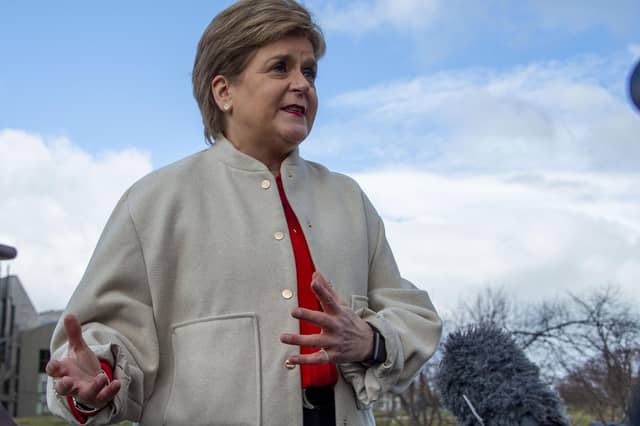

It arrives with a whimper rather than a bang. After months of speculation about its contents, extracts from Nicola Sturgeon’s autobiography have appeared in the press and, after reading, I wish her publishers good luck in earning back the £300,000 advance they paid the former First Minister.
Sturgeon’s memoir, Frankly, will be in shops on Thursday, but we already know the headlines.
Unsurprisingly, she describes the day she was arrested by police investigating the SNP’s finances as the worst of her life.
There are affecting passages about a miscarriage, 15 years ago, and righteous anger about rumours of a lesbian relationship with a French diplomat.
And there’s the revelation that, despite that there being no affair with Catherine Colonna – who would go on to become French Foreign Minister – Sturgeon does not consider her sexuality to be “binary”.
Long-term relationships with men, writes the former FM, have accounted for more than 30 years of her life but she has never considered sexuality – her own included – to be binary.
One can imagine the disappointment of Sturgeon’s publishers when, rather than exploring that aspect of her life, she goes on to write that “sexual relationships should be private matters”.
I completely agree with that position but, then, I haven’t just shelled out 300 grand for a tell-all memoir that appears to do no such thing. Frankly? Try coyly.
Of course, it would have been foolish to expect Sturgeon to tackle the failings of her time in power in Frankly. The ex-leader of the SNP does not do humility or self-reflection terribly well, having a tendency to lash out at critics rather than engage.
We can, I suppose, try to join the dots in some of what Sturgeon writes in an attempt to get to the truth.
Does, for example, that “non-binary” revelation explain why the former First Minister was – and remains – fully committed to the demands of gender ideologues? Was the personal driving the political when she rejected concerns that allowing anyone to self-identify into the legally-recognised sex of their choosing
In an interview to promote her book, last week, Sturgeon said she hoped, next, to turn her hand to the art of fiction. A novel, dear God, is to be attempted.
While the MSP – who will step down from Holyrood next year – may consider the publication of Frankly the beginning of a bright new chapter, the sense lingers that the book marks an end.
Politics is a brutal old game and, little more than two years after stepping down from office, Nicola Sturgeon is no longer the much-adored heroine of the independence movement. Rather, she divides nationalists, with some former allies now hopeful that she will fade into obscurity.
Sturgeon may have succeeded Alex Salmond as leader of the SNP at a time – post independence referendum – when membership was soaring. And she may have led her party to a number of thwocking great victories in elections to both Holyrood and Westminster. But her legacy is a split independence movement and a legal mess around gender self-ID which continues to bog down public bodies and to erode the rights of women.
We can, I think, expect things to get rather more fraught in the SNP in the months to come.
The announcement, last week, by deputy First Minister Kate Forbes that she will not stand for re-election at next year’s Holyrood election, sent a tremor through Scottish politics.
Forbes is among the more talented and capable members of the SNP group in the Scottish Parliament and the expectation was that she would stand to succeed John Swinney as leader at some point after next May’s election which, despite scandal and plummeting membership, the SNP is expected to win.
Making public her plans, Forbes said she had decided to put motherhood before politics.
In making that decision, the MSP for Skye, Lochaber, and Badenoch opened up the prospect of exciting new splits in her party.
Within hours of Forbes’ announcement, the SNP’s former leader at Westminster, Ian Blackford, let it be known that he was considering taking a tilt at the seat next May.
Whether this happens or not remains to be seen. For one thing, the SNP would have to change its rules for candidates to allow Blackford to stand at this late stage in the selection process. For another, we must always make room for the suspicion that Blackford – in common with other politicians – simply enjoys being talked about.
While Blackford mulls a run for Holyrood, the man who ousted him as the SNP’s Westminster leader, Stephen Flynn, has his own ambition to enter Scottish Parliament.
Flynn, one of nine SNP MPs to keep his seat in last year’s General Election, will contest the Aberdeen South and North Kincardine seat next May and – should he win – he will be considered among the front-runners to succeed John Swinney as First Minister.
“Do you know what we really don’t need, right now?” one SNP MSP asked me last week. “We don’t need the Blackford-Flynn f****** psychodrama imported into the Scottish Parliament.”
Heavy briefing against Flynn – he’s too laddish, say some and too abrasive, say others – marks him out as a serious contender for the top job. If he there was no danger of him taking it, there would be no need for some to try to stop him.
There is drama to come.
When the former FM succeeded Alex Salmond in 2014, she inherited an SNP in 2014 that had learned from the infighting of the past and become a united and tightly-focused election-winning machine.
As she prepares to make the rounds of book festivals, Nicola Sturgeon cannot escape the truth that, for all the gloss covering the pages of Frankly, her leadership left her party – and her country – more divided than ever.
Comments
Want to join the conversation? Please or to comment on this article.