
Don’t be fooled by Keir Starmer’s 'imaginary hobgoblins'. He's the real problem
The UK is governed by a political elite who put our security, liberties and future prosperity at risk

It is standard practice in public relations that any campaign for action requires a problem to be solved if it is to meet with general acceptance and eventual approval. Simply offering a solution to a non-existent problem is rarely attractive, especially if it comes with risks and obvious costs.
In politics, if you want to raise taxes you need to explain how the government is skint and has no other resort than ask for “a little bit more” from obliging taxpayers. Variations on this theme include there’s a pandemic coming so “we must save the NHS by building ten emergency hospitals to expand capacity” or “we have a problem policing our borders so everybody already here must have digital identity cards”.
Last week we witnessed two more of these type of false flag operations that are intended, as HL Mencken famously said, "to keep the populace alarmed (and hence clamorous to be led to safety) by menacing it with an endless series of hobgoblins, all of them imaginary".
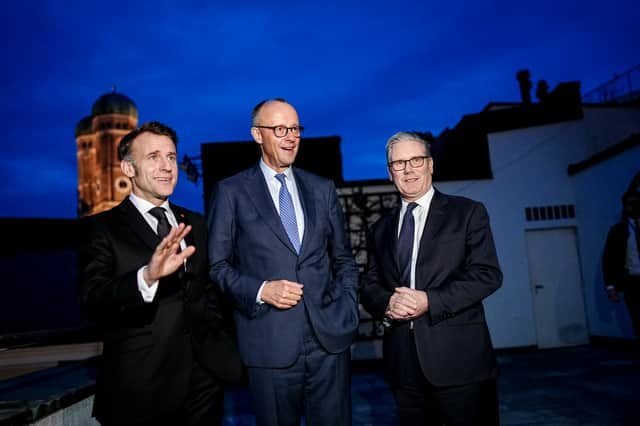

Both hobgoblins involved Keir Starmer’s approach to the European Union; that our economy has been damaged beyond repair by Brexit, and growing United States isolationism threatens Britain’s security. The solution, as ever from our political elite, is “more Europe”.
Let’s look at the issue of Britain’s economy. I write regularly that Scotland and the UK are both living beyond their means, the public finances are shot, taxes are too high, the burden of regulation is too onerous, net zero is loading huge costs on our energy supplies and the consequential de-industrialisation is the political equivalent of Stalin’s scorched earth policy.
All of these ingredients towards what makes Scotland and Britain broken are domestic political choices. The state is trying to do too much and is doing it badly. Although Starmer and leaders of other so-called progressive parties like to blame Brexit, it is the failure of our own politicians to do their jobs honestly that means the public sector and all it touches is at best in a state of disrepair but more often simply not fit for purpose.
Their answer is we must move closer to the EU; meaning we must align ourselves with their regulations (25,000 more since 2016) be it through joining a Customs Union (costing our country £40 billion, borne by us) or subjecting all our businesses, from hairdressers to steel mills, to the single market (ensuring we accept laws irrelevant to our own particular needs).
Scared of actually risking another referendum, because there’s always a chance he might lose it, Starmer intends to bind Britain to the EU through micro-progressions of accepting red tape here and petit agreements there. A mandate is not required because, for the EU, democracy is only ever an after-the-fact rubber stamp.
Yet last week, ten years after our famous UK vote, the largest in our history, and five years after we actually left the EU, the latest official trade figures came out and showed Brexit has not been the hobgoblin our political class seek to scare us with.
The Office for Budget Responsibility forecast Brexit would reduce UK trade by 15 per cent and hence productivity by 4 per cent. Yet apart from the pandemic year, UK trade in real terms has consistently increased. Whatever the starting point, exports, imports and total trade have not only grown, but have risen faster than GDP.
Sure, goods exports to EU have dropped but this has been more than compensated by increased service exports to both EU and non-EU countries – and much of the drop in UK goods exports is due to de-industrialisation thanks to self-inflicted high energy prices.
The suggestion Brexit is the cause for all our economic woes is belied by the similarly appalling state of other economies in the EU, such as Germany, and the reason (again) is the adoption of policies such as net zero. Inexplicably, Starmer wants to move us closer to the EU’s net-zero restrictions, causing greater unemployment and increasing poverty among families and children. By the time we notice, Starmer will be drawing his ample pensions and writing his memoirs.
Also at Munich we had more from Starmer about throwing our lot in with other European armies, justified by Foreign Secretary Evette Cooper because of growing American isolationism. It’s another imaginary hobgoblin. These are the same European nations that are repeatedly obstructing Britain from helping Ukraine by supplying weapons to defend itself.
Behind all the rudeness and belligerent bombast of President Trump, the reality, as his Secretary of State Marco Rubio explained in Munich more diplomatically, is the US remains committed to European alliance but expects us to take our own responsibilities seriously.
In an insightful analysis, Italian foreign-policy scholar Bepi Pezzulli observed how Rubio reflected the mood of the American electorate, saying “voters did not repudiate alliances; they repudiated arrangements that seemed to benefit everyone except them.” Rubio’s subtext was unmistakable: “If Europe wishes to be treated as a strategic equal, it must behave like one.”
That means abandoning the virtuous lectures and pleading poverty and meeting the real cost of expanding our own capacity to defend ourselves both in manpower and technology.
The warnings about Brexit were inflated estimates built on false assumptions; now we have the data and the outcome has shown our political class is the problem. Let’s not fall for the same misjudgment in blaming US foreign policy for our own shortcomings in defence.
We are not governed by serious politicians but by a political elite who put our security, liberties and future prosperity at risk.
We should always consider what hobgoblins we are presented with before accepting a politician’s prescription.
Brian Monteith is a former member of the Scottish and European parliaments and editor of ThinkScotland.org
Comments
Want to join the conversation? Please or to comment on this article.