
Why Russia's new military training for schoolchildren 'sounds like our CCF'

There is one key difference between the children joining the UK’s Combined Cadet Force and those joining Russia’s newly created, compulsory equivalent – the very real risk of being sent off to war after school ends
As Russian school children returned for the start of the academic year this week, many of them found a new subject had been added to their timetable. All pupils aged 15 to 18 now have to study a new, mandatory military training module covering a range of topics including combined arms combat and small arms familiarisation.
Part of a programme grandly called “Foundations of Security and Defence of the Motherland”, it aims at preparing young people for conscription – and ultimately for combat. In the words of the Kremlin, “to protect the State”. Indeed, if the war in Ukraine continues, it will not be long before many of these youngsters will be swapping their pencils and calculators for assault rifles and body armour.
On a post published to X as part of its daily updates on the invasion of Ukraine, the UK Ministry of Defence explained the Kremlin's new tactic. “The programme seeks to create and will likely result in a more militarised and security-focused society,” it said. “The new youth strategy which was approved by the government in August 2024 aims at raising the prestige of military service, instilling patriotism, and civic duty responsibility, but primarily prepare pre-conscription age teenagers mentally and physically for military service.”
12-year-olds in army camouflage
“Sounds like our CCF,” piped up one X/Twitter user, writing underneath the MoD’s post, which, I had already noticed, was quite carefully non-judgmental about Russia’s new youth strategy. People in glass houses and all that.
Because the X user is not wrong. When, aged 16, I first became aware of the existence of the Combined Cadet Force (CCF), I was horrified. As a former state school pupil completing my education at a local private school, I watched aghast, as baby soldiers as young as 12 marched around the playground dressed in full camouflage gear – sent off to learn how to fire a gun when they should have been playing rounders and tig.
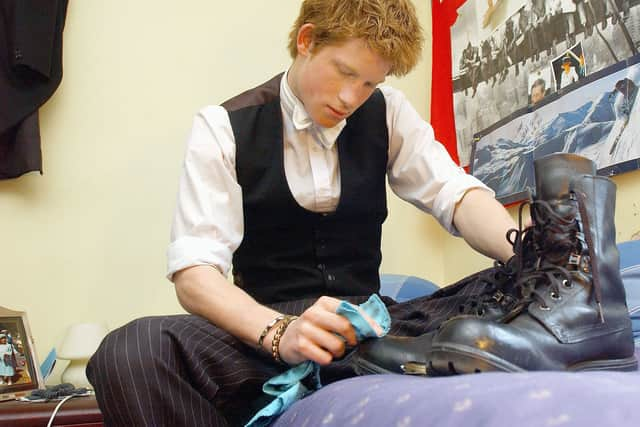
Needless to say, I did not join, although many – I would almost argue, most – of my classmates did. There is no doubt that the CCF is as deeply embedded in Britain’s private school system as spotted dick and custard. Prince Harry was a cadet when he was at Eton.

Created in 1859, the idea of cadet units in schools was developed by the Secretary of State for War, Jonathan Peel, who wrote to public schools and universities, inviting them to form units of the Volunteer Corps. The CCF was born. These early units were focused on Army activities and were usually associated with Rifle Volunteer Battalions for Home Defence, with cadets wearing the uniforms of their parent volunteer battalions.
A bit like the Scouts?
It later evolved into an officer training corps, and during the First and Second World Wars many of the young men who served in the units went on to serve their country in the Armed Forces. So far, so similar to Russia. Now, however, it is pitched as more akin to the Scouts – itself with loose military links through the veteran status of its founder, Lord Robert Baden Powell and the design of its uniforms. The difference comes in the continued Ministry of Defence sponsorship of the CCF.
After the Second World War, the focus of the group moved away from being a recruitment pathway into the Armed Forces and in many schools, it is now offered as an alternative to the Duke of Edinburgh Award Scheme, although that can be completed within the CCF.
“Want to fly a plane, climb mountains, learn to sail and make an incredible group of friends? The CCF offers life-changing experiences that no other extra-curricular activity can match,” the organisation’s website proclaims. In a reassuring line aimed at modern parents, it adds: “There is no commitment or expectation on cadets to join the regular Armed Forces when they have completed their schooling.”
State school CCF expansion
In recent times, the CCF has evolved from being dominated by private schools to being overtaken by the state sector across the UK, following a major drive by the Conservative government. Under the leadership of David Cameron, a cadet-expansion programme was launched in June 2012 which aimed to create 100 new cadet units in English state-funded schools by 2015, a target which it smashed six months ahead of schedule.
Now, a previous figure of around 200 CCF units in UK private schools and 60 in state schools has increased to around 500 predominantly state school units, with a total of 51,360 children enrolled.
In Scotland, however, things are different. The CCF structure is unique to the private school system with the exception of a small number of “linked detachment” partnerships between Scottish state schools and their local army cadet forces. As a result, the school-based cadet system remains limited, unlike in Russia, where military training is mandatory across all schools.
Chilling reminder of Soviet days
New recruits are still required to sign up to one of four service sections: the Royal Navy, Royal Marines, Army or the Royal Air Force. They get a uniform and they take part in “adventurous, military-themed activities”.
For many, Vladimir Putin’s latest move is a chilling reminder of Soviet times, when military training was last a compulsory part of the school curriculum in the country. It is easy to be critical of the Kremlin, yet, taking measures to ensure a ready supply of well-trained soldiers is something that any country at war would undoubtedly consider, as the origins of the CCF prove only too well.
What is most tragic is that Russia has the power to protect its young people from going to war – it is just choosing not to.
Comments
Want to join the conversation? Please or to comment on this article.