
As Rachel Reeves' cruel Spring Statement continues Tory austerity, Scotland deserves better
Instead of lifting the Conservatives’ miasma of despair, Labour have chosen to turbocharge it
I hope readers will indulge me as I begin with a short tribute to the indomitable Christina McKelvie, who sadly passed away this week after a long illness that she fought with her characteristic dignity and customary good humour.
Christina, who served as an MSP from 2007 and a Scottish Government minister from 2018, had that thing that is all too rare in politics today: warmth and an unashamedly human touch.
Her politics were rooted in helping those at the margins of society, and she believed with all her heart that Scotland’s people would be best served with independence. Even those who would passionately disagreed with her found her impossible to dislike, because she could always see past the politics and understand the person.
My party, Christina’s constituents and, most of all, her loved ones, have lost a fine woman and champion, and she will be greatly missed by the many people whose lives she touched.

Indeed, helping those at the margins of society is why all politicians go into public service. Far from the lazy stereotype, I genuinely believe all my parliamentary colleagues enter Holyrood and the Commons with a desire to do good.
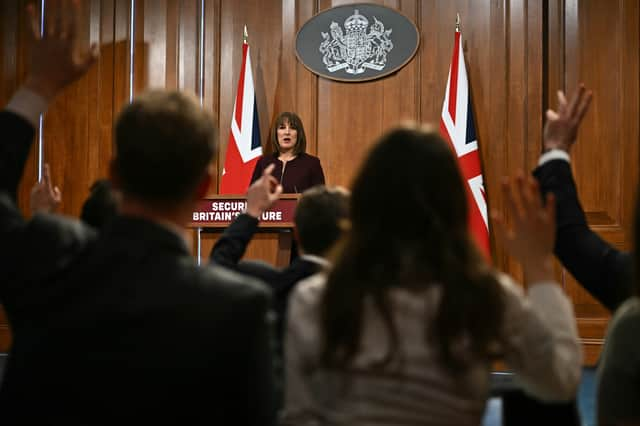
This was the hope that voters pinned on Labour at last year’s election: a break from austerity and a focus on fairness and public investment. After this week’s Spring Statement by Chancellor Reeves, those voters will feel badly let down.
The Chancellor’s announcement that she intends to press ahead with further cuts to public spending – putting the heaviest burden on the disabled and the poor – is a continuation of the Tory orthodoxy that has delivered anaemic growth, stunted wages, and some of the lowest living standards in modern times, making the UK an outlier in Europe.
There was nothing inevitable about this doomsday direction of travel: it’s a political choice – and one that threatens to entrench inequality as a feature of modern Britain.
The Chancellor has sought to position herself as a fiscally responsible tenant at No 11 Downing Street, but responsibility must never be reduced to balance sheets at the expense of good policy outcomes: productivity, public wellbeing, and the life chances of future generations all matter.
Yet, at the Despatch Box on Wednesday, Reeves issued the wrong prescription on all fronts: economically, politically and morally. This was evidenced on the faces of the Labour MPs sitting behind her. Having already lost much of the country, the Chancellor has lost the Labour dressing room.
Having spent 15 years in a self-imposed cycle of underinvestment by successive Conservative-led governments, Labour’s cuts will deliver more of the same.
Indeed, the problem was displayed in a single chart by the Office for Nation Statistics, who mapped the decades of decline Britain has endured since the 1970s. Back then, GDP growth per head was 2.5 per cent. In the 2020s, it stands at 0.3 per cent.
The public’s mood on the country’s economic outlook looks dire. Research by the think-tank More in Common ahead of Reeves’ statement found that people have a gloomy outlook. Over half of British citizens believe we are returning to austerity or have never left it.
When Labour swept to office in July, 54 per cent of voters believed the new government would improve their lives against 46 per cent who thought they would not. Today only 29 per cent believe they will, against 71 per cent who don’t. It’s a brave Labour politician who tells the public they’re wrong.
So bad is the public outlook for Labour, that nearly six-in-ten voters say they would trust the former Conservative Chancellor, Jeremy Hunt, to handle the economy compared to the four in ten who back Reeves. Given the government will live or die on its economic success, this is catastrophic for Labour politically.
The attacks on the poorest and disabled stand out as a particularly immoral pursuit by the Chancellor. Having hoped that the 14 years of despair that hung over them when Conservatives were in government might finally be lifted or eased, Labour have instead chosen to turbocharge that miasma of despair with a particularly cruel focus on those who need help the most.
Is it any wonder that 44 per cent of voters believe the government is being too harsh with its welfare reforms, compared with only 28 per cent who think they’ve got it right.
Labour’s posture of cuts, low growth, declining living standards and targeting the vulnerable raises fundamental questions about the UK’s capacity for democratic renewal. The burden of evolving our institutions for modern problems and opportunities falls to each new generation, but if, after being out of office for 14 years, Labour is still wedded to an orthodoxy that’s 15 years out of date, then it’s no wonder that people are losing faith in democratic institutions.
For many in Scotland, this will reinforce an already growing sense that the choices our country needs to make, and the priorities we wish to pursue, will always run into a dead end whilst tied to Westminster.
The debate about independence is, at its heart, a question of where power lies and how it’s used. A government in London, of either stripe, that rejects investment in creaking infrastructure, attacks the poor and is content with scandalously low living standards only adds to the case for independence in Europe.
Scotland can have a future of investment in our people, public realm, national infrastructure, wellbeing and prosperity by rejecting the false dichotomy between fiscal discipline and social progress. One that returns us to the European mainstream. There was a time when Labour social democrats understood this, no more apparently.
Britain today is a country of managed decline, but Scotland deserves ambition and a politics that embraces the challenges of the 21st century with clarity and confidence. That’s what Christina McKelvie believed in and a future the Scottish Government wants to deliver.
Stephen Gethins is MP for Arbroath and Broughty Ferry
Comments
Want to join the conversation? Please or to comment on this article.