
As COP climate summit dithers, massive 'Doomsday Glacier' sounds a terrifying warning – Ian Johnston
New research suggests the melting of the vast Thwaites Glacier in Antarctica has reached a point of no return
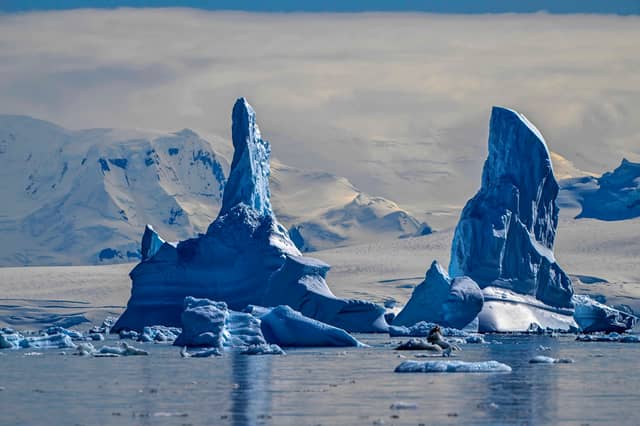


With the international COP climate summit underway in Antalya, Turkey, the big story seems to be the palpable lack of interest. This is understandable.
After a grand total of 30 other COPs, global carbon emissions have continued to grow, with the problem getting worse, not better. There are only so many of these annual jamborees that you can put your faith in before coming to the disappointing conclusion that they are ‘not much cop’ – and all-too worthy of bad puns.
It’s far removed from the optimism around the supposedly landmark Paris Agreement in 2015, when 195 countries pledged to pursue “efforts to limit the temperature increase to 1.5C... recognising that this would significantly reduce the risks and impacts of climate change”.
Previously 2C had been regarded as the target to avoid ‘dangerous’ climate change and the move to 1.5C seemingly underlined the seriousness with which the problem was being taken. One reason for the change was scientists’ concerns about the risk of locking in long-term sea level rise from melting ice caps and glaciers.
Great Britain-sized glacier now doomed
Unfortunately, according to a new study by the British Antarctic Survey, even though the world hasn’t quite reached 1.5C of warming, the massive Thwaites Glacier in West Antarctica is now set to continue to losing ice for the next 150 years. Essentially, the glacier appears to have reached a tipping point from which there is little to no chance of a return.
Using computer models, the researchers looked at what would happen to the Thwaites Glacier and the Pine Island Glacier, the two largest sources of ice loss in this part of the Antarctic, if the melting effect of warming seawater was switched off.
As expected, the Pine Island Glacier got thicker and began returning to the size it was in the first half of the 20th century. Thwaites, however, continued to lose ice.
Dr Rosie Williams, a glaciologist at the British Antarctic Survey, and the lead author of a scientific paper about the study said: “These results show that past changes in ocean-driven melting have now committed us to unavoidable future ice loss from Thwaites Glacier. This ice loss cannot be undone or prevented by simply cooling the ocean.”
Thwaites is roughly the same size as Great Britain and its ice is about a kilometre thick. If it collapsed completely – a process that would take several centuries – it would add an estimated 65cm (just over 2ft) to global sea levels. As a general rule of thumb, every centimetre rise in global sea level means another six million people are exposed to coastal flooding.
That would be bad enough. However, it gets worse. Thwaites is known as the ‘Doomsday Glacier’ largely because it acts like a cork, holding back the West Antarctic ice sheet, which is about the size of India and contains enough ice to raise sea levels by 3.3 metres, which would render many major coastal cities uninhabitable and swallow huge tracts of land.
READ MORE: ‘Net stupid zero’ vs economic madness: How the climate change debate is losing touch with reality
Runaway global warming
Clearly, a computer model is a best estimate based on current knowledge. Perhaps our descendants will get lucky and some unconsidered factor means the Doomsday Glacier is not doomed. But they will probably curse us if we rely on unsubstantiated optimism.
Serious questions remain. Are other major glaciers like Thwaites or Pine Island? How close are they to their own points of no return? And how close are we to triggering the myriad of other climate tipping points, which could ultimately lead to ‘runaway’ global warming? These are the sort of concerns that keep leading climate scientists awake at night.
Back in Antalya, the talk is of this being the ‘overshoot COP’. With the 1.5C target set to be missed, the idea is to limit the increase by as much as possible and then bring global temperatures back down.
A report published last month by the United Nations Environment Programme, called Limiting Overshoot, was the first from the UN to explicitly state that global warming would go above 1.5C, saying this was “likely within the next few years”. “There are no good outcomes in remaining above 1.5C. Risks and impacts above 1.5C intensify with every fraction of a degree,” it warned.
One of the world’s leading climate scientists, Professor Johan Rockström, director of the Potsdam Institute for Climate Impact Research in Germany, told the journal Nature: “We need to first recognise that global policy has failed. This is a moment of self-critique.”
Environmentalists need to get real
But if world leaders need to finally get real about climate change, the same can be said of environmentalists who oppose carbon capture technology – as being developed at the Acorn Project in Aberdeenshire – which they complain has been used as a smokescreen by the oil and gas industry (as in, ‘don’t worry about our emissions, a fix is on the way’).
However, if the global temperature ‘overshoot’ is to be brought back down, this will require the removal of carbon dioxide from the atmosphere. As Nature reported, some environmental campaign groups, such as the US-based Natural Resources Defence Council, have now changed their position to back CO2 removal technologies. Attitudes towards low-carbon nuclear energy have also been shifting but some, like the SNP government (no surprise), continue to dig their heels in.
The biggest change environmentalists needs to make is in their opposition to fossil fuel production. Self-evidently, it is the demand for it that must first be reduced, not the supply. Agriculture is a major source of emissions, but ‘Just Stop Food’ would be only slightly more daft that ‘Just Stop Oil’.
Perhaps environmentalists, the oil industry and COP31’s legions of delegates will surprise me, but I doubt it. This is what failure looks like.
Comments
Want to join the conversation? Please or to comment on this article.