
Ann Widdecombe's murder puts threats to Nigel Farage in a new context – Brian Monteith
I have heard Nigel Farage challenge bigoted language, while Ann Widdecombe stood by former MP Harvey Proctor after he was falsely accused of paedophilia, writes Brian Monteith


The media agenda for the run-up to the summer recess appeared to be set. Sir Keir Starmer seemed to be departing Downing Street not so much with a fanfare as a whimper.
But I was wrong, for last Tuesday the news focus moved away from Labour’s leadership switch. Nigel Farage made an unscheduled statement in response to continued coverage of his receipt of £5 million as a personal gift from billionaire Christopher Harborne in 2024 – before he became an MP.
Farage typically came out fighting. Previously he’d settled for letting a complaint to the Parliamentary Standards Commissioner take its own meandering course because he is actually limited to what he can say about it in public – while his political opponents can make all sorts of unsubstantiated insinuations, speculations and accusations. Instead he announced he would resign as the MP for Clacton, forcing a by-election that he would then contest, to seek a fresh endorsement from the electorate.
It would not halt the Standards Commissioner’s inquiry, which would resume if he wins, but it would allow the public to have its say. That would provide a new context for those hoping he is found guilty of not declaring a donation (because he had treated it as a gift) so they might force a petition for a recall by-election (if he is suspended from the Commons for ten or more days).
‘Uni-parties’ conspiring against Farage
Farage’s aim is to convince the electorate that his opponents are using the standards system in an unfair way so that the loaded process is the punishment, irrespective of its outcome. Two events brought this to a head; a Telegraph article saying the Standards Commissioner would not report for another two months, and a media approach by Sky TV at his daughter’s house.
For Farage it looked like a long, drawn-out silly season with continued speculation and mud-slinging that he could not respond to. While he is used to verbal attacks (and much more), the doorstepping of his family (with other examples revealed) told him he had to reframe the narrative as him versus the establishment ‘uni-parties’ conspiring against him.
It was not an attempt to avoid scrutiny, but to give context to why he and his family need protection, probably for the rest of his life, and that the £5m he was gifted would provide that.
By the evening, events took a surprising turn when the parties, dismissing his need for security (Kemi Badenoch accused him of throwing a hissy fit), were declining to take him on. By Wednesday morning, only Count Binface and Laurence Fox seemed willing to give Farage a contest.
Shock, sorrow – and derision
Farage’s political gamble and the unwillingness of the anti-Farage parties to put their faith in the public square were now dominating the media. Then on Friday morning, the sad news of the death of Ann Widdecombe was announced. Those who knew or had worked with her began to express their shock and sorrow – while some who accepted a false caricature thought it smart to demean her for her views, her looks or supposed prejudices.
The news agenda then took a new and more tragic turn when, by Friday evening, a 26-year-old “white British national” was in police custody under suspicion of murder, following the revelation Widdecombe’s body had actually been found in a pool of blood.
Those who had been dancing on her grave now looked especially cruel and heartless; those who knew her were even more distressed that she had not merely had a bad fall and suffered a fatal concussion.
But by Saturday morning the first suspect was released and no longer a person of interest to the police; then, later that evening, the police arrested a 28-year-old in Rotherham, some 275 miles away from Widdecombe’s Dartmoor home. Since then, despite the police repeatedly stating that – as yet – there was no reason to believe her death was politically motivated, counter-terrorism police have taken over the investigation.
Public portrayals far from reality
The nature of her shocking loss gives some harrowing context to what Farage was saying earlier in the week about the threat to politicians and their families. Standing joke candidates in by-elections doesn’t look quite so comical anymore.
As a former MEP who worked with both Farage and Widdecombe in Brussels, I know the portrayals of their personalities have often been very far from reality.
Widdecombe said what she believed in with reasoned argument, put frankly and vigorously, but took care to listen to what her opponents and critics said so she might consider their points. She defended their right to be heard and would go out of her way to help people irrespective of their personal views. Her help and support for former MP Harvey Proctor, who was falsely accused of paedophilia for no other reason than being homosexual, was typical of her belief in standing by people.
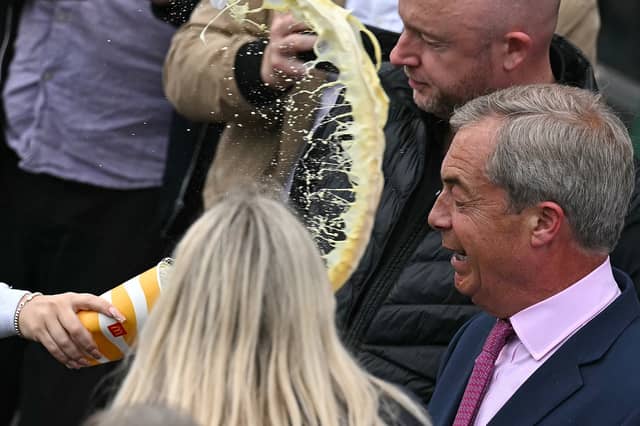
My wife and I were immediately behind Farage in Newcastle when he was drenched by a milkshake. I have never heard Farage ever make a racialist or bigoted accusation; indeed I’ve known him to challenge such language. He is right to be concerned about threats to public figures.
Our politicians are as entitled to be innocent until proven guilty as every other citizen and their private space should be as sacrosanct as anyone’s. The process of justice should not be a punishment but a fair hearing, and seeking personal safety cannot be so cheaply dismissed as a hissy fit.
Brian Monteith is a former member of the Scottish and European parliaments and editor of ThinkScotland.org