
Alex Salmond and Nicola Sturgeon's No refusal has left Scotland a poorer place
Yes campaign leader’s rapid abandonment of ‘One Scotland’ was followed by his successor as first minister’s cult-like insistence on promising her followers what she could not deliver
Alex Salmond had prepared for victory. Hours before voting stopped in the 2014 independence referendum, polling experts hired by the then First Minister told him he was a winner. Salmond rehearsed a statesman-like speech in which he would offer the hand of friendship to defeated No voters and declare the nation “One Scotland”.
But Canadian company First Contact had got it hopelessly wrong. On the evening of September 18, 2014, they told Salmond he’d achieved his dream of breaking-up the UK, with Yes Scotland on course to win by 54-46 per cent.
A few hours later, Salmond was in a thunderous mood. The Better Together campaign, led by the late Alistair Darling had achieved a significant victory, winning by 55-45 per cent.
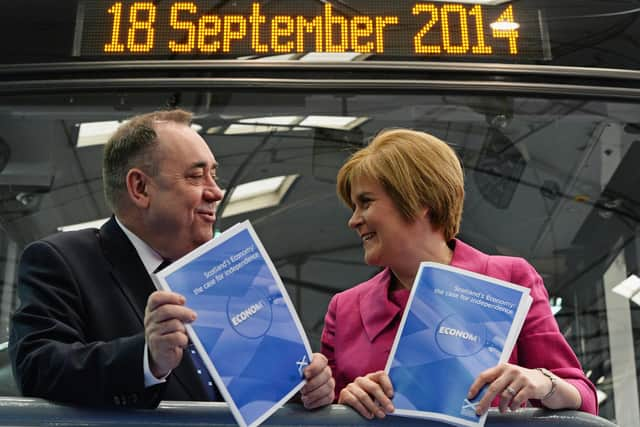

Salmond called a press conference at his official residence Bute House on the day after the referendum, and resigned.
Anyone labouring under the misapprehension that Salmond might respect the result of what he had described as a “once in a generation” referendum would be disappointed. All notions of “One Scotland” banished, Salmond was clear that the SNP’s campaign to achieve independence was ongoing.
“The position is this,” he said, “We lost the referendum vote but can still carry the political initiative.”
Salmond was never the statesman he performed in public. Short-tempered and thin-skinned, he was livid on that Friday. Some of those who’d worked closely with him for years recall deep disappointment with the result, of course, but also relief that their boss would be moving on.
After a brief return to the House of Commons and a stint as a presenter for the Russian state broadcaster RT, Salmond now exists as a caricature of his former political self. His Alba Party attracts the fundamentalists he – the former champion of Scottish nationalist gradualism – once defeated in internal SNP power struggles, and his grand proclamations are of the Braveheart variety he spent years rejecting. He is, by some nationalists, still adored. And that matters to a man like Salmond.
We all have to do something to fill the days so why shouldn’t Alex Salmond see out life in public as an Alex Salmond tribute act?
Those who had voted No were, I think it fair to say, generally relieved when Nicola Sturgeon confirmed she’d stand to replace Salmond. Compared with her friend and mentor, Sturgeon seemed a model of reason.
Oh boy, did they get that one wrong.
A decade on from Scotland’s “historic”, “once in a generation” referendum, the country remains, often bitterly, divided on the constitution and the government at Holyrood is exhausted and out of ideas.
There was something deeply unhealthy about Sturgeon’s decision, at the start of her leadership of the SNP, to tour Scotland like a rock star, appearing in arenas in front of tens of thousands of unquestioned and adoring disciples. The Cult of Nicola was born.
Today, both the SNP and Scotland continue to pay the price for that.
Armed with the overall majority at Holyrood achieved under Salmond’s leadership, Sturgeon revealed an arrogance greater than her predecessor’s.
Convinced that her destiny was to lead Scotland to freedom (yes, even “civic nationalists” think like that), Sturgeon continued – throughout more than eight years as FM – to call for a second referendum.
She ignored the wishes of the majority of voters who – as polls made clear, time and again – wanted her government to focus on the NHS and a mounting cost-of-living-crisis.
Sturgeon rejected the advice of even the most senior SNP figures – many of whom saw the damage her obsession with a second referendum was causing to their party’s reputation – and continued to promise plebiscites she had no way of delivering. And, while Sturgeon maintained the constitutional divide in Scotland, she opened up a new split in her party.
The former First Minister bought in to dangerously incoherent gender theory and aligned herself with radical trans rights activists who seek to remove the sex-based rights of women.
The Sturgeonian piety was never more evident than when she branded as bigots feminist critics of her unworkable plan to reform the Gender Recognition Act to allow anyone to self-identify into the legally-recognised “sex” of their choosing.
That piece of legislation was passed by MSPs more concerned with “being on the right side of history” than with the fears of women who didn’t, for perfectly obvious reasons, want males to enter female-only safe spaces.
When then Conservative Secretary of State for Scotland Alister Jack struck down the legislation on the grounds that it was incompatible with the existing UK-wide Equality Act, there was no public outcry. The shine had left the Sturgeon crown and, humiliated over her idiotic attempt to undermine women’s rights and out of road on her race to hold a second referendum, her resignation in 2023 seemed best all round. Her successor Humza Yousaf’s 13-month tenure as First Minister was fraught.
Yousaf only narrowly defeated the socially conservative Kate Forbes in the contest, exposing divisions in the SNP on issues as varied as gender ideology and fiscal priorities.
After breaking the power-sharing deal with the Greens at Holyrood, Yousaf found himself facing a confidence vote that he could not win and quit. The consensus was that he was simply inept. Perhaps, but his decision to remove ministerial power from clueless Green ministers was a wise one.
Now John Swinney, the man whose failure as SNP leader 20 years ago prompted Alex Salmond to return from the wilderness, leads a party broken and weary, over which hangs an ongoing police investigation into allegations surrounding the use of party funds.
And he leads a country whose public services have been woefully neglected and, when the publicly-funded Edinburgh Rape Crisis Centre is damned in a shocking new report for “damaging” victims while under the leadership of a trans woman, no major party, except the Conservatives, issues any kind of statement in response.
Is Scotland a better county than it was a decade ago?
I’m damned sure what I think.
Comments
Want to join the conversation? Please or to comment on this article.