
'One of the boys' - how Robert Duvall made cult Scottish football film
Late Hollywood legend was driving force behind David versus Goliath sporting tale featuring a host of Scottish football talent

When Douglas Dalgleish answered his telephone in the offices of Dumbarton FC in the late 1990s, he would have been forgiven for presuming he was on the wrong end of a wind up. The transatlantic caller was from a little known company called Butcher Run Films, and was enquiring about shooting a movie in Boghead Park, the dilapidated stadium of a team languishing in the old third division.
Across Scotland, other parties received similar enquiries. Calls were fielded at Palmerston Park in Dumfries, Finlaystone country park in Langbank, and to businesses in Crail in the East Neuk. When the blazers at the Scottish Football Association were asked about the availability of Hampden, it became hard to dispel the notion that a large-scale prank was afoot.
Yet the firm in question was entirely sincere in its intentions. Named after the sprawling estate he owned in Virginia, Butcher Run was a production firm set up by Robert Duvall, the Oscar winning actor and producer who died earlier this week at age of 95. Best known for his roles in Apocalypse Now and The Godfather, his interest in football stretched back to the 1970 World Cup in Mexico.
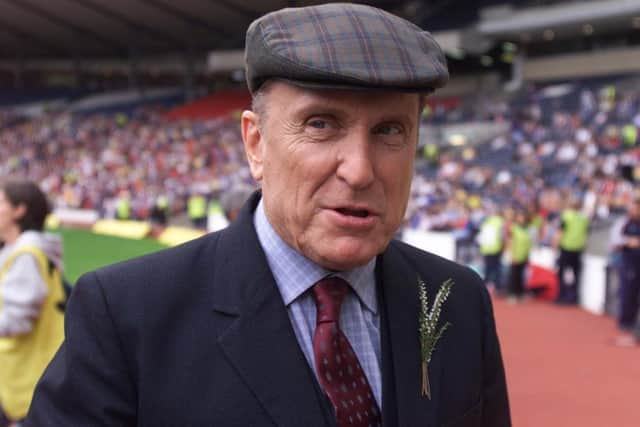

That curiosity lay dormant for decades, but when Duvall and his team began exploring the possibility of creating a film in honour of the game he loved, he hit upon Scotland. After teaming up with screenwriter Denis O’Neill, they struck upon a plot following the exploits of Kilnockie FC, a fictional small town outfit who overcome the odds to reach the Scottish Cup Final.
As part of pre-production, Duvall attended various matches and rubbed shoulders with various figures in the game, much to the bemusement of fans. The Raith Rovers manager, John McVeigh, made a big impression, allowing Duvall to sit in on his half-time team talks, and he was entranced by the anecdotes of Celtic great, Jimmy Johnstone, going so far as to name one his dogs, Jinky, in tribute.
With Michael Corrente aboard as director, Duvall and his fellow producers began casting. Duvall himself starred as Kilnockie’s bunnet-sporting manager, Gordon McLeod, drawing heavily on McVeigh’s demeanour, and other well-established stars were recruited, including Michael Keaton, who played the gum-chewing US owner with the inexplicable idea of relocating the team to Dublin.

Yet the unlikely stars were the Scottish footballers called on to provide a bit of grit and authenticity to proceedings. The original choice for the lead role of Jackie McQuillan, a former star striker for Celtic and Arsenal now put out to pasture at Kilnockie, was Russell Crowe, whose career was about to go stratospheric with Gladiator. But Crowe knocked back the part, forcing Duvall to have a rethink.
The key qualities for the role was someone with natural ability on the pitch, and charisma off it. Enter the ever-personable Ally McCoist, then winding down his playing career with Kilmarnock, and engaging in weekly banter as a captain on the BBC show, A Question of Sport. After meeting the legendary Rangers star at Glasgow’s Hilton Hotel, Duvall was won over. “This guy is 80 times better for this part than Russell Crowe, and more charismatic,” he would later remark. Many critics agreed.
But for Scottish audiences, the prospect of seeing McCoist in a feature film was not the only draw. The supporting cast featured a long list of the good, the bad, and ugly from 1990s Scottish football, including well-kent faces such as Ian McCall, John Martin, Owen Coyle, Peter Hetherston, Andy Smith and Mike McCurry.

Such a roll call has ensured the film retains cult status nearly a quarter of a century after its 2002 release, but perhaps more importantly, it ensured the on-field action appeared relatively realistic, at least compared to some football films.
Those qualities were acknowledged by reviewers at the time. The Scotsman awarded the film a respectable three stars out of five, noting that for all its sporting cliches, it succeeded where many other movies had failed by depicting an accurate version of the beautiful game, and showcased the little known acting chops of McCoist. “He has more than his fair share of soulful moments in scenes which he often has to carry, and carries well,” noted the reviewer, John Marriott.
Across the pond, the Austin Chronicle was the most effusive in its praise, garlanding it with four stars out of five, and praising “some of the best action scenes you’ll ever see on film.” Well, as far as football is concerned, that is. Elsewhere, however, the film received a middling to lukewarm response. Variety dismissed it as a “mediocre, dramatically flat pic” and a “manufactured slice of twaddle.” Others were less than charitable about Duvall’s Scottish accent.

The end result was a meagre global box office taking of around £100,000 - a dreadful return, even accounting for the firm’s modest £6.5 million budget. Its release in the US was so minimal as to be practically invisible, while its foray in UK cinemas was restricted to those north of the Border.
Despite such a lukewarm commercial reception, Duvall spoke fondly in his later years about the experience of making A Shot at Glory. “We had a great time on that movie and I reckon it is about the most fun I had making a movie in my career - and I've certainly made a few,” he explained. “Ally McCoist was another big character and he could have gone on to do more movies. He was a natural in front of the camera.”
And for his part, McCoist also looks back fondly on the experience. In the wake of Duvall’s death, he reflected on the “fun” experience of filming all over Scotland, and described the Hollywood star as someone who “just became one of the boys.”
“Whenever there was a break, he’d set up a heady tennis court and he’d just pull up a chair and he’d watch the boys playing heady tennis,” he said. “He’d love the craic, he’d love all the patter. He used to take all the boys to dinner.”
Comments
Want to join the conversation? Please or to comment on this article.