
On the Norwegian sardine trail in Bergen


Fish, art, history - and goats- are highlights of a trip to the Scandinavian city.
The goats are imperious as they balance on the thin wall. There is no recognition of the steep drop beyond, let alone the tourists busy with camera phones. They allow onlookers a stroke, but no food, thank you, as they dine off the mountain top, helping keep the vegetation under control. Apparently they are a famous attraction, but I hadn’t anticipated the goats on Mount Fløyen, one of the seven hills surrounding the Norwegian city of Bergen.

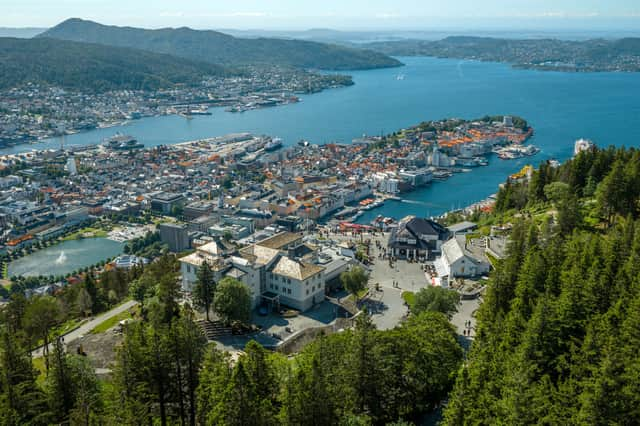
A curtain of rain and cloud parts as I step out onto the platform, having been delivered to 1,300ft by the Fløibanen Funicular. The view is breathtakingly spectacular – I can see the streets I’ve walked, ships on the fjord and houses on the shore.
The funicular is a century-old feat of engineering, especially its vertiginous final ascent, and it transports up to 120 passengers skywards in under ten minutes. The final station is one of Bergen’s top tourist destinations and rightly so because alongside panoramic views, there are shops, a cafe, restaurant, play park, troll trails and the goats.
As fascinating as the goats are, they are a distraction from my pursuit of something much more fishy. I’m on the sardine trail.
A country with 62,700 miles of coastline – if you include islands – has a right to be ripe with references to one of its best-known catches.
The sardine – a small, nutritious, silvery fish caught world wide – was first preserved in oil in tins in 1830s France. In 1873 the Stavanger Preserving Company was founded and Norway exported its first canned sardines in 1880. Today Norway’s distinctive “Brisling sardines” – warm-smoked locally-caught Clupea Sprattus covered with olive oil or tomato sauce – are still exported across the globe.

I started my fishy adventure with an overnight stay in a former factory on a small island that was once a centre of fish processing. My B&B, Fab 8, was a sardine factory on Fedje on the west coast, about two hours’ journey from Bergen. Today the island is home to Feddie Ocean, a distillery building with an impressive reputation.
In Bergen, it is art that is the modern day occupant of what was once Norway’s largest cannery. United Sardine Factory (USF) Verftet is a major arts venue with performance space, cinema, gallery and studios and the home of the Bergen International Film Festival and Nattjazz.
In Kafé Kippers, I meet restaurateur Fredrik Saroea, well known as the singer and guitarist of cult Norwegian electronic rock band Datarock. He is proud of the cafe’s links to sardines and stocks a special vintage-style edition of Norway’s best know brand, King Oscar.

To celebrate my sardine journey Fredrik has paired white wines with three types of King Oscar sardines and bread. As he tells me about the history of King Oscar and USF, we decide our initial guess – that the Burgundy aligouté would work better with the fish – was wrong and are won over by the Riesling.
I also decide the sardines with dill sauce and sherry are my favourite, but the star of the trio is the exclusive King Oscar tin with its extra plump fish. After 1983, when the fish packers left, the huge site was colonised by artists and there are now more than 250 working here in studios.
USF is slightly off the beaten track but has one of the city’s best sea-level views. Ferries, cruise liners and cargo ships pass right by Kafé Kipper’s huge terrace. Easy as it would have been to stay and chat, I head off admiring how the walls of the site have been decorated. Street art is a feature of Bergen and I spot it in unexpected corners as I head to my next port of call.

I want to dip into the city’s seafaring history and among several options pick Bergen Maritime Museum. From USF my route takes me past the utilitarian docks and along streets of pretty wooden houses, ultimately climbing to the university area and the museum.
It houses a mix of exhibits and plenty about fishing but I am sidetracked by the passenger liners, Viking boats and things related to the North Sea oil industry. Then, totally off the sardine trail by now, I’m absorbed by the exhibit about the Second World War and the importance of the Norway’s merchant fleet and its contribution to the allied war effort. What I’m particular interested in is the material about the Shetland Bus.
I’ve long known about the heroic exploits of the Norwegian resistance and its lifeline to Scalloway in Shetland, so I am intrigued to hear it from a Norwegian perspective. I’ve already seen the memorial at the head of the Vågen bay to “Shetlands Larsen”, Leif Andreas Larsen, the Bergen-born sailor who was a key figure in the secret network that smuggled agents, weapons and refugees across the North Sea. Here I learn about the wider part played by the Norwegian merchant fleet and the high price it paid.

Sobered by the wartime tales, I return to the inspiration of the USF artists and go in search of more art. Another of Bergen’s treasures is Edvard Munch and Kode, the city’s collection of art design and music museums, and home to the world’s third largest collection of his work. In an elegant building beside a formal lake, I first discover the art that preceded him through the eyes of Rasmus Meyer, a Bergen industrialist who amassed works by leading Norwegian artists.

There are influences from across Europe but it is interesting to see the how artists, including the father of Norwegian painting, Johan Christian Dahl, interpreted their own landscape and it gives context for what is to come.
Meyer was an early admirer of Munch and able to purchase works that reflected his development. After Meyer’s death in 1916, his family donated his large collection to the city and the public museum was built for it.
Although there is no “Scream”, the pictures show Munch’s journey from Oslo art student to creator of some of world’s most instantly recognisable paintings.
Factfile
Tourist information www.visitbergen.com; Bergen Card offers free or discounted rates for a range of museums, tours and restaurants; free travel on buses, light rail and boats in the Bergen region, en.visitbergen.com/bergen-card; Logan Air operates direct flights from Edinburgh to Bergen. www.loganair.co.uk; Mount Fløyen and Fløibanen Funicular, https://www.floyen.no/en/about-us; Kafé Kippers, www.kafekippers.no; Bergen Maritime Museum, https://sjofartsmuseum.museumvest.no/en; Kode, www.kodebergen.no
Comments
Want to join the conversation? Please or to comment on this article.