
Notre Dame was rebuilt with traditional skills under threat in Scotland


In the aftermath of the fire at Notre Dame Cathedral in 2019, the efforts to rebuild it called for people with traditional skills in stone masonry and carpentry. As the Paris landmark prepares to reopen, there are fears there aren’t the skills in Scotland if something similar happened here, writes Cat Thomson.
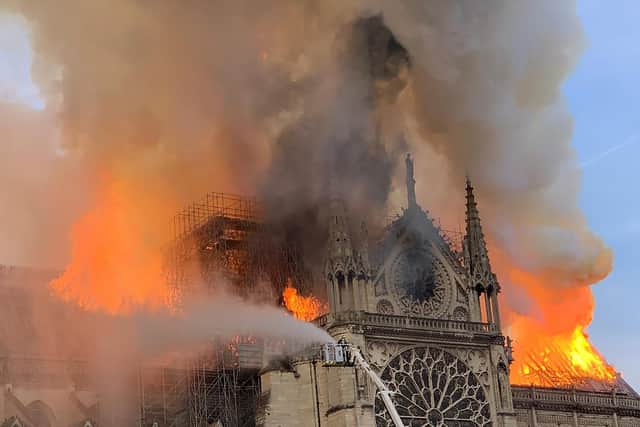
On the evening of 15 April 2019, disaster struck in Paris, when a fire started in the eaves of Notre Dame Cathedral. The world looked on in horror as the inferno raged through the historic spire, and the roof collapsed into the transept. For 850 years Notre Dame Cathedral had stood out on the Paris skyline, a symbol of a nation’s pride.
But out of this tragedy has come a unique opportunity to restore the cathedral using 13th-century carpentry skills, perfected by a new-build castle near Saint-Sauveur-en-Puisaye, in Bourgogne, just a few hours’ drive from Paris.
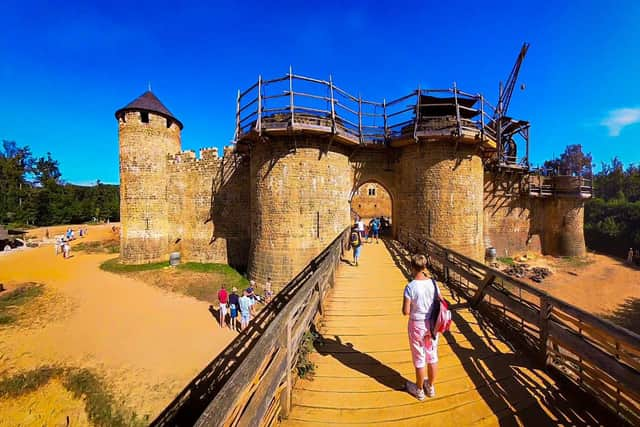
When you enter the grounds of Guédelon Castle, you feel you have stepped back in time. The castle's gatehouse and medieval scaffolding looms large, while a Percheron horse crosses the drawbridge with a wooden cart filled with stones, for the masons to build another layer of the castle wall. The air is filled with the sounds of masons chiselling stone in their workshop, and the aroma of wood smoke from the blacksmith's forge and baker’s oven. Nearby you will find the carpenters’ workshop and hear the haunting echoes of the axe hitting the tree shaping it into an oak beam.
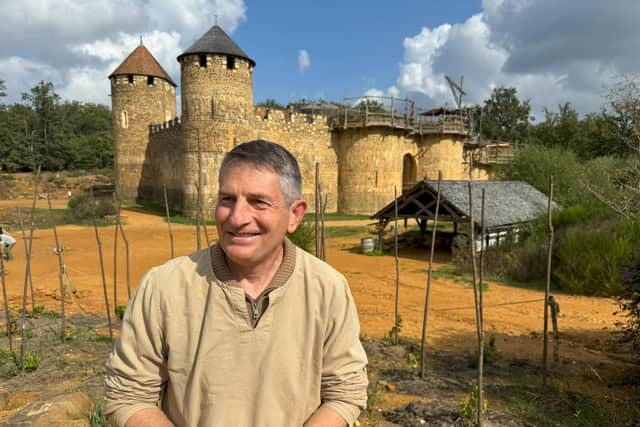
The idea of building an entirely new castle using authentic historic methods was a direct result of an architectural study of Saint-Fargeau Castle. Experts discovered the remains of walls from an earlier 13th-century castle hidden within the structure of the 17th-century pink-brick exterior. The chateaux owner, Michel Guyot who had over 20 years of experience in saving historic buildings, was inspired by their report which mooted the idea that ‘‘Reconstructing Saint-Fargeau castle would be an amazing project.’’ Guyot gathered a team to build a castle from scratch nearby, using only the resources and the ancient construction methods available in the 12th and 13th centuries.
The first stone was laid in June 1997 and the castle should be finished in another 12 years. Over this time, the artisans have refined their techniques using both practical experience and archaeological evidence. The castle building project was influenced by the nearby castles, Ratilly and Druyes-les-Belles-Fontaines which were built in the same period.
Florian Renucci, the Master Stone Mason, has worked at Guédelon since 1998. When he first heard about the fire at Notre Dame he says, “I was very ashamed that it had happened. But it isn't the first cathedral in French history to burn. In 1917 the Germans bombed Reims Cathedral, and when it was rebuilt in the 1920s, it was remade with concrete, not wood. Back in the 19th century, they didn't have the knowledge of old methods, so they chose to rebuild using the materials of the industrial way.”
“But today when you have a UNESCO-protected monument, you must rebuild it with three criteria; respect the form, the materials, and the substance or the sense of the space. That means ensuring it’s made using the same methods that the wood or the stone was produced in the past.”
At Guédelon, “We proved that we still had the knowledge. When you cut wood by hand with each stroke there are a lot of marks in the wood - it is not straight. The substance of hand-hewn wood is quite different from mechanically sawn wood.”
While Guédelon is not a UNESCO site Renucci says, “If we can work here exactly as people of the 13th century were working, then we stand as the example of the best way to rebuild Notre Dame.”
Initially, the project managers at Notre Dame did not know how long it would take to remake the wooden roof structure using old techniques. However, Renucci adds, “Five former Guédelon-trained carpenters, recruited as part of the Cathedral reconstruction team, knew it was possible because they had experience working here.”
The blacksmith at Guédelon hand-forged the shaping axes needed for reconstructing Notre Dame timber roof beams.
Renucci is pleased that the Cathedral has been rebuilt authentically using timber sourced from France. He says, “If they used iron or plastic or concrete, it would not be French – the iron would come from India.” Although it is expensive, he says, “It's less damaging to rebuild using wood cut by hand and it is a modern approach which is better for the environment, uses less energy and is less expensive to transport. Perhaps it will provoke the same kind of restoration in all the cathedrals and other monuments elsewhere.”
In France, there is a widespread appreciation of traditional building skills. The organisation, Compagnons du Devoir et du Tour de France, traines apprentices in a range of disciplines. Renucci explains, “It’s a school and a way of life for people. They keep the tradition of making with an excellence of savoir-faire.”
In Scotland, Colin Tennant, the Head of Technical Conservation for Historic Environment Scotland, feels that traditional building skills are at a crisis point. He says, “If we had a fire like Notre Dame, we would probably struggle to find structural carpenters that could reconstruct places like the Great Hall at Stirling or Edinburgh Castle.“
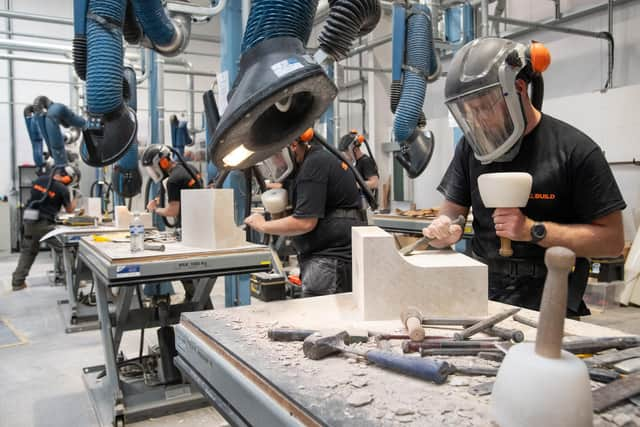
Historic Environment Scotland delivers an SQA-approved skills training programme which provides opportunities for pre-apprenticeships, apprenticeships, trainees and craft fellows. They are the largest provider of traditional skills training, but they are one of only two providers in Scotland (along with City of Glasgow College) who deliver the four-year modern apprenticeship in stonemasonry.
Although there is demand for stonemasonry training, which saw the largest intake of 21 students this year, Tennant says, “Things are bleak, with huge parts of the country, where there is no formal stonemason training available, so stone buildings are being maintained, converted, and prepared by people who have no formal training in it.
“To me, it's all about funding and about recognising the value of something. Nobody questions how many hairdressers are trained in Scotland in a year but trying to point out to people that training stonemasons is fundamental to keeping our existing building stock safe – stopping it falling on people's heads – just seems to go by the by.”
Lesley Cadger, the Head of Technical Education and Training at Historic Environment Scotland feels, “It’s a misconception that these skills just help us to keep the past, they are vital for us to meet Net Zero targets and to move into the future. These skills have been learned and passed down generations, we can’t be the generation that stops them from being passed on.”
Although there are issues with traditional building training, Scottish apprentices are amongst the best in the UK and will represent Scotland at the SkillBuild National Final 2024, in Milton Keynes in November.
Many believed rebuilding of Notre Dame Cathedral, as it was, would be impossible but after just five years France has proved them wrong, and it reopens on the 8th of December.
The final word comes from Yassim Hajji from Toulouse, a carpenter at Guédelon who swapped from a career in electrical engineering to carpentry two years ago.
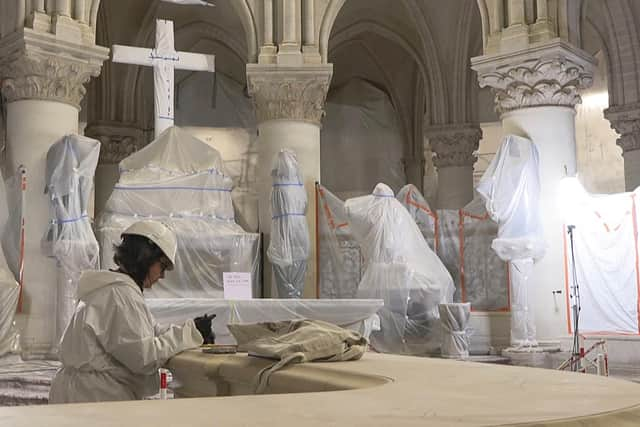
He says, “The rebuilding of Notre Dame has put a spotlight on these traditional techniques and it shines a light on these skills. It has allowed people to discover those skills and maybe it will enthuse a new generation.”
Let’s hope this also happens here in Scotland.
Cat Thomson stayed in www.le-vieux-saule.com, Saints-en-Puisaye, rooms cost from €95 as a guest of www.puisaye-tourisme.fr and www.france.fr
Visit the websites to discover more about traditional heritage skills in France and the castles of Guédelon,Saint-Fargeau, Ratilly and Druyes-les-Belles-Fontaines, and Notre Dame Cathedral.