
Maureen Beattie on playing Lear in gender-swap Pitlochry production
Watching Maureen Beattie perform at his school was a life-changing moment for Alan Cumming and now he's cast her as the lead in a bold new inclusive play


Traditionally men get all the best parts in Shakespeare but things have changed and it’s time for a female Lear, with Scottish acting legend Maureen Beattie taking on the role of a monarch whose pride and foolishness see her give everything away in a bold new Pitlochry Festival Theatre Production.
Taking time out from learning her lines and rehearsing, Beattie strides around the womb-like auditorium, all red walls and seats, then leads us up the stairs, through the airy, open foyer with its glass walls and out into the summer sunshine, quoting Shakespeare and recounting anecdotes as she goes. Ever the professional, in her element, she never misses a beat, coming to a pause by the trees in front of the building, her ridiculously blue eyes a match for the sky overhead as the sun blazes down on Pitlochry.
It’s a far cry from the storms that will rage in Lear, the reimagined version of Shakespeare’s tragedy King Lear by director Finn Den Hertog (The Fifth Step), designed by Emma Bailey (Six The Musical; Sunset Song), which opens next month as the theatre celebrates its 75th anniversary. Exploring family, succession, trust and power in a bold, gender swap version which is one of the highlights of Alan Cumming’s first season as artistic director at the theatre, the production also stars Cumming’s former comedy double act counterpart (The High Life and Victor & Barry) Forbes Masson and a cast of Scottish talent revealing what happens when lies trump loyalty and a monarchy descends into crisis.
“It's about family, the importance of love and what's really going on under the surface. It's about the person called Lear, learning massive lessons about where the truth lies,” says Beattie, back in the auditorium.
“It’s about how if you're poor and you’re accused you have no carapace to protect yourself against the law but if you are rich and have cloths of gold and furs and riches, the law glances off like a straw. It's about ego and getting rid of ego.”
We are being given a bold new interpretation with a Scottish female Lear, but Beattie has reassurance for Shakespeare traditionalists too.

“We're not swearing and using different words. There are no mobile phones or laptops. Finn has very much stuck with the text but he's cut some and moved some stuff around, and I think it works really brilliantly.”
Playing Lear is a full circle moment for Beattie as she performed in the play when she joined the RSC in 1988, playing the king’s youngest daughter Cordelia. Growing up in Glasgow around theatre with showbusiness parents, the actor and comedian Johnny Beattie and model Kitty Lamont, she had trained at the now Royal Conservatoire of Scotland.
Now 71 she has amassed vast experience on stage in various roles with the RSC, National Theatre of Scotland, National Theatre and Royal Exchange in productions including Shakespeare, Chekhov and Ibsen plays, made headlines with Lorca’s Yerma, with Billie Piper in 2024 and most recently appeared in Zinnie Harris’s The Scent of Roses. Familiar TV roles include Casualty, Outlander, Deadwater Fell, Bramwell, The Bill, Ruffian Hearts, The Long Roads, Wing and a Prayer and All Night Long.
“Playing Cordelia back then was one of the greatest experiences of my career and life,” she says. “At nearly five foot eight with a lower voice, I’m not what people tend to think of for her,” she says, but suggests that this deeper vocal register makes her a natural choice for gender swapping parts.
“I've become quite a go-to person for parts traditionally played by men. Maybe it's the age, height and lower voice. I’ve played Jaques in As You Like It, and it works brilliantly as a woman. Jaques is a kind of eco warrior person and you could imagine she's a vegetarian and likes a bit of the ganga.
‘Bringing feminine intuition to these roles can be very interesting,” she says.

Delighted to be cast as Lear, Beattie recounts how it came about.
“I’ve known Alan Cumming since he was at drama school and he is astonishing so when he was announced as artistic director here, I sent him a message saying ‘I am so thrilled, this is great news for Scotland and Pitlochry, congratulations,’ and he got back and said ‘what are you going to come and do for me?’ I said, ‘oh, well, since you ask, I'm increasingly interested in the male roles, Lear, and The Scottish play’ and he got back and went, ‘hmm, Lear’. Then he was coming to London to MC the BAFTAS, as you do, and said let's meet for lunch and talk about it, which I'm sure was partly to do with, at my age, him checking I can walk and talk at the same time. It was four or five years since I'd seen him and it takes a hell of a lot of energy to sustain that part twice a day. So about 10 minutes in he said, ‘Do you want to do Lear?’ We shook hands and that was it.’
Cumming credits Beattie with changing his life when her traveling theatre visited his school. As he watched in the playground as they packed their costumes and sets into a van, he decided performance was the life for him.
“I cannot tell you how much that's done for my street cred,” says Beattie laughing. “People are literally, ‘Oh my God, you're the woman that made Alan Cumming want to be an actor. He’s just genius and a delight. Such exciting things are going on here, building on a tradition of attracting younger audiences because they are the future of theatre.”
For Beattie the way to attract a new, wider audience is inclusivity.
“Switching the roles is the way,” she says. “Shakespeare wrote what Shakespeare wrote and we can either say we've got to stick with what he said to the letter and have exactly those gender roles or we can do what we like, because there's no question Shakespeare was adaptable. He had the clowns come up to him and go, ‘I do that great routine with a dog, could you put that in?’ And somebody playing Hamlet going, ‘maybe that speech you cut from Richard II, could that go in?’ We know there are about five different versions of Hamlet. Thank God the one that lasts five hours is not done very often. So the ability to play around with The Bard is important. This is the way forward, to switch the roles, switch the genders and have people of colour playing parts.”
As a former president of the actors’ union Equity, a position to which she was first elected in 2018, and committed to promoting and representing workers’ rights - as was her father who began his working life in Glasgow’s shipyards - Beattie feels very strongly about the issue.
“It doesn't matter what race you are. It doesn't matter what colour your skin is, just come in and do it.”
“It runs alongside disabled people being in shows, the minorities that maybe don't get a chance. It’s maybe still the case that if you're trans, chances are you'll be cast as a trans person, but why don't you just get cast as whatever? Those parameters are being pushed all the time and I think women playing men's parts is very much part of that bigger story that we're telling.”

Billed as a bold reimagining, what's new in this version and what remains of the original?
“Having a female as Lear is pretty bold,“ says Beattie. “And although 99.999% of the original is in there it is trimmed, which is a good thing. And it's contemporary. It’s about making it accessible, making people feel they recognise these characters. It's not at a distance, it's in the room with you.”
Alan Cumming has said that our accents and passion in Scotland bring The Bard to life in ways other countries can't. What does Beattie think?
“I think we bring a particularly connected and organic visceral-ness to what we do. And also our sentimentality and our kind of, ‘I love you, I'm f***ing pissed off with you, I love you, I hate you.’ I think there is a quality to it. It's not quite as well washed, deodorised, it's got a very real scratch ‘n’ sniff quality.”
King Lear is regarded as one of Shakespeare’s greatest plays, so how does Beattie account for its longevity?
“I think people want to be guided on how to deal with how they feel. And I think they want to see good prevail, to watch people who make terrible mistakes and are unpleasant and horrible come through a redemption process.”
To illustrate her point she goes back to the day of the 9/11 attacks in 2001, when she was performing in Liz Lochhead’s version of the Greek tragedy Medea.
“We were all sitting at home watching those planes going into those buildings again and again and everybody was devastated. We thought nobody's gonna come to see this show tonight, but it’s our job so we went to the theatre and got into our makeup and costumes, and everybody came. It was sold out. The atmosphere in the auditorium that night was astonishing because the air was crackling with this battened down tension of what had just happened.
“The show is cataclysmic of course: you watch a woman murder a young woman and then go ‘I'm gonna kill the kids as well’. And the applause afterwards, the audience wouldn't let us go. Three days later I got a letter from Corin Redgrave, who'd come to the show, and he said it did what theatre does like no other art form. He said we had no idea what to do with how we were feeling and you gave us the release we needed. Theatre gave us release, through watching this terrible thing.
“I think there's something of that in Lear as well, because although it's domestic - and Finn is very keen to make a play about a family - it is also epic. Shakespeare does this all the time. Epic and also small and intimate. And hopefully we'll get that duality going.”

Lear is also relatable to a population with rising numbers of people with dementia as it centres on Lear's insanity. Flagged from the start, through losing his mind, he loses his sense, his children’s love and his kingdom.
“Lear goes mad without question,” says Beattie. “I played a very interesting role at the turn of the year,” she says, referring to her starring role in This Thing of Darkness, the acclaimed BBC Radio 4 drama series created by Frances Poet and Eileen Horne, “about a woman who suffered from frontotemporal dementia which can make you unable to connect on an emotional level with people and say horrible things.
“The brain is still such uncharted territory and when madness comes along, where does it take you? It’s believable, something people recognise. So many of us have a parent, an aunt or uncle with dementia. So that's all in it.”
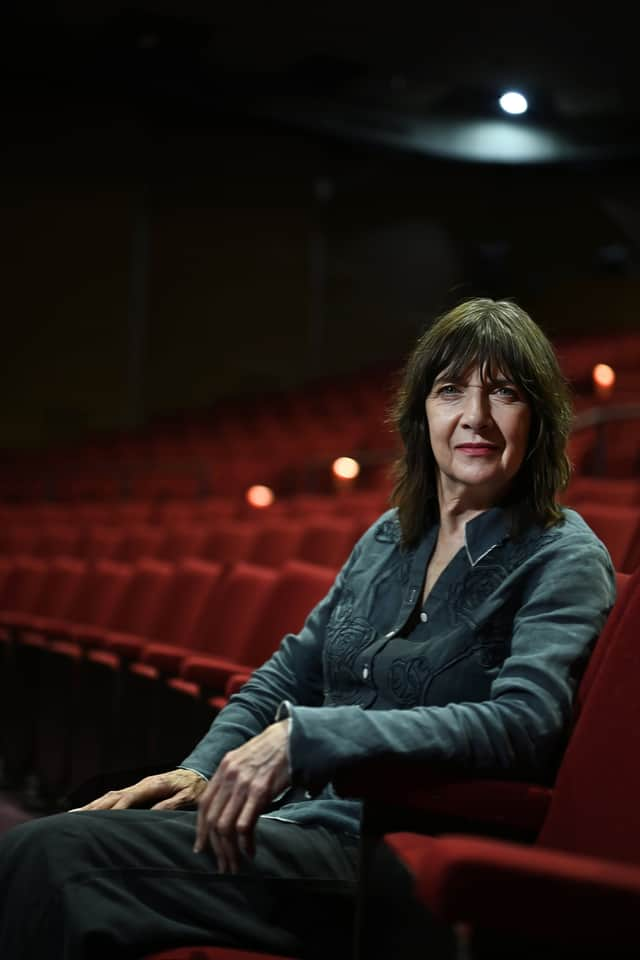
Beattie has the air of a woman who has achieved what she set out to do and continues to enjoy doing it, when she’s not working dividing her time between her flats in London and on the Isle Bute where she is involved in rejuvenating the Winter Gardens. She decided early while at primary school that she wanted to be a performer.
“First I wanted to be a ballet dancer and I want to be a nun. It was all about the costumes. And I was very conflicted about which to choose then I saw Debbie Reynolds in The Singing Nun and I thought, well, she can sing and be a nun, I could be a ballet dancer being a nun. My mum said ‘no darling, you have to dedicate your entire life to one or the other’ so I chose ballet, because of the better costumes. Then I wanted to be a vet until I discovered you needed 112 A levels, then about the age of 10 I went, ‘oh, maybe I'll just be an actor, or a performer. I wanted to be a chorus girl because they were so glamorous and had blue eyeshadow all the way up to their eyebrows, so I did dancing and singing.
“Then at school when I was about 12 we did Twelfth Night, which is a fabulous play, but not at that age and unfortunately we had a teacher who taught it by reading the play out very badly. Thank God they don't do that anymore. It was like she was punishing us. But something about the language made me go home and learn my first ever Shakespeare speech, for the sheer joy of it, ‘if music be the food of love, play on’, and my friends were all like ‘Sorry? You did what?’ Anyway, that was it.”
Looking ahead, Beattie is excited about the roles ahead, hoping to follow in the footsteps of a father who was still working at 89 - in BBC Scotland’s River City.
“If they'll still have me and I can learn the lines and face in the right direction, why would you not want to go on being creative your whole life?”
“Everyone has a creative imagination and people should have opportunities. It's why the lack of funding in the arts and education is so appalling. It does more for children's well being than anything else you can imagine. And all these CEOs running big companies say I wouldn't be in this position if it hadn’t been for my drama teacher, because I was scared and now I get up and make long speeches. Also just socialising and finding your metier, you don't have to become an actor, you can become a photographer, lighting designer, do costumes.
“The people who are most down on the working classes having wonderful teachers in the arts all go to schools where if you look at their website, it leads with, ‘come to Eton, we have two auditoria, fully equipped with a staff of six and an artistic director. They know how important it is and want to keep it for themselves.
“That's what this theatre is trying to do, be a theatre for all and part of the community, accessible for all and anybody can come in.
“Look at it, it’s glass!” she says, throwing her arms wide. The new Citz in Glasgow have done it as well - glass! It says welcome. Come in! You don't need to get dressed up. Just come and enjoy it. And that's hopefully what our production of Lear will do.”
Lear, Pitlochry Festival Theatre, 4 July - 1 August. Audio Described 23 July 7.30pm, 30 July 2pm, BSL Interpreted 24 July 7.30pm, Captioned 30 July 7.30pm, Relaxed and Dementia Friendly 26 July 2pm, Ticket Info or call box office 01796 484626, www.pitlochryfestivaltheatre.com/whats-on/lear/
Comments
Want to join the conversation? Please or to comment on this article.