
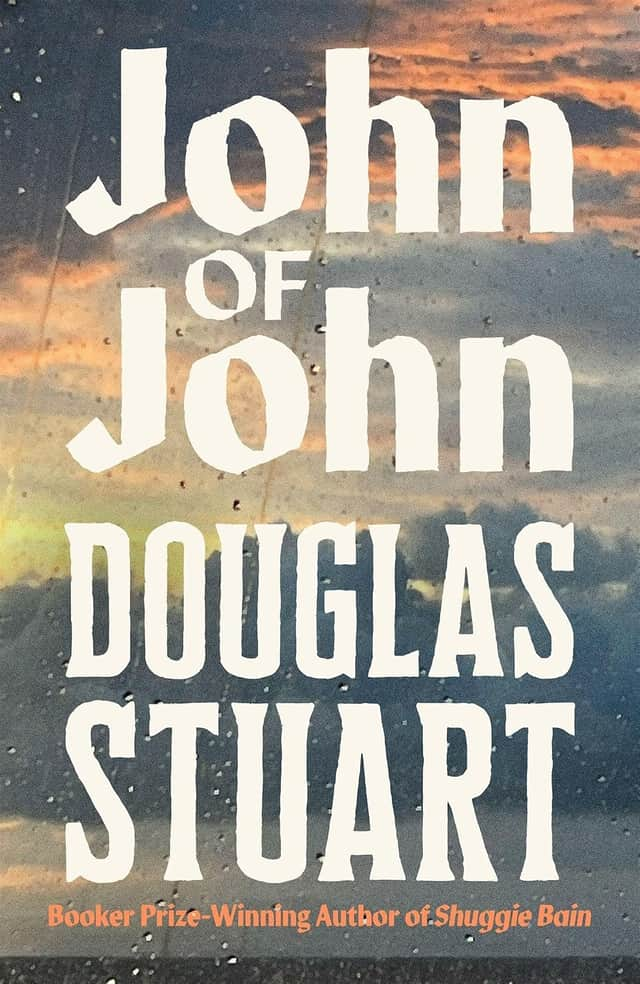
'I've been writing this book since I was 18' Shuggie Bain author Douglas Stuart on John of John
Ahead of his Edinburgh International Book Festival appearances the Scottish writer looks back at a Hebridean journey of discovery that sparked his latest work.
Booker-Prize winning author Douglas Stuart is sweltering in a Manhattan heatwave yet the rocks and rain-soaked peat of a Hebridean island three thousand miles away fill his thoughts as he prepares for his Edinburgh International Book Festival appearances next month.
Harris was the inspiration and setting for his latest book John of John, which Douglas will discuss with former Makar Jackie Kay, along with an event with Michael Pedersen & Friends and a panel discussing his favourite Scottish author Agnes Owens’ work. And it was hours of conversation with islanders and time spent there during visits in 2019, back before Shuggie Bain was published and Stuart became the internationally acclaimed, full-time author he is today, that formed the book.
“There's always a long window between a book being accepted and publishing and the best thing to manage your anxiety and expectations is to get right back to work,” he says, recalling how he set off for the islands.
“I went with the hope that a novel would come out of it, but I really went first and foremost because I had to see the Outer Hebrides for myself. If a story didn't emerge, at least I would understand my own country a little bit better,” he says, the child of a single parent who had neither the time or money to show her children her own country.
“It was before Shuggie published so I was just a guy that showed up and would say, ‘I'm thinking about writing a book’ and everyone was just so generous, saying ‘come on away in’. It was that time I spent on the islands that form the book. I discovered a real love of place and of the islands that I didn't know was buried inside me. It’s a place that when it gets its hooks in you, it won't let go.”
“I sat at kitchen tables, in cafes, pubs, and we would chat, and I had to learn everything about island life, from the rhythm of the islands, how crofting really works, religion, sheep rearing, community, people, what life was like.”
What Stuart already knew about was weaving, having studied textiles at the Scottish College of Textiles in Galashiels and London's Royal College of Art after a childhood in the Glasgow southside housing scheme of Pollok that inspired his first book Shuggie Bain, written while he worked in fashion design after moving to New York at 24.
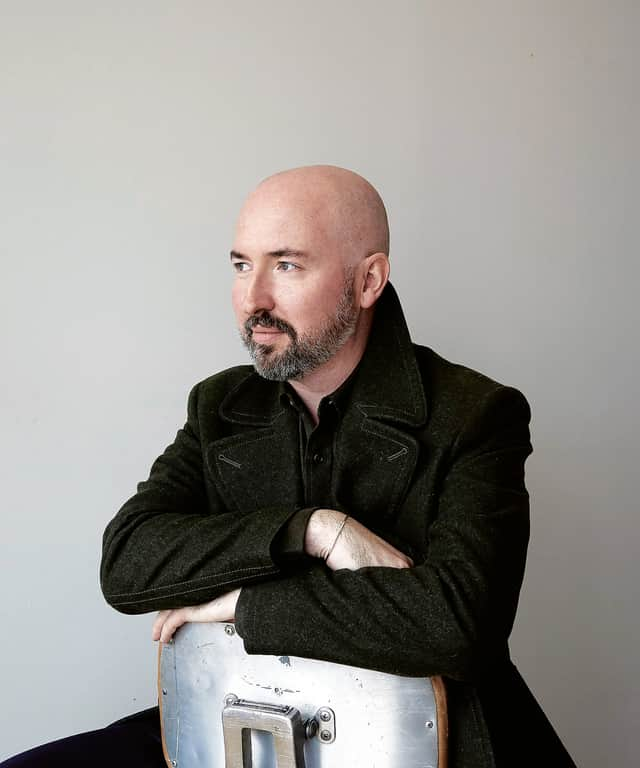

Travelling up the Hebridean archipelago, experiencing the islands’ variations in culture, history and outlook was where he found his book.
“I got to Harris and met that lunar landscape on the rocky east coast where everything's denuded and the sky is so big, and realised this is where the fascinating things I was interested in converged.
“There was my Tweed weaving, the Gaelic language, the crofting way of life that was changing and the Free Presbyterian Church, and through those warp threads I realised the story was coming together, that this was the place, the setting.”
“Seeing the home weavers, suddenly I saw my textiles and my writing come together and I felt like I was at home,” was what he told me while writing John of John when I interviewed him on the eve of his Booker win in 2020.
Harris Tweed is woven all the way through John of John, as it follows Cal, a young queer man reluctantly returning home from college on the Scottish mainland in 1996/7 to his family croft to care for his grandmother.
“It was the most spiritual time of my recent life. Firstly with the weaving, I thought ‘I can't believe I'm writing about weaving, what a delight’, but when I stand back now I think that was inevitable. I've been writing this book since I was 18, maybe even earlier, because of how I was raised in textiles, and what I was waiting for was the alignment of the time to be able to go to the islands and to sit in it and absorb as much as I could.
“The other thing was, writing about the working class in Scotland and the queer working class, I realised every time we talk about class or work we let the Central Belt take all the conversation, and don't think about the changes that happened in the Highlands and the islands. We exclude them from Scottish history in a way. You can think of the islands as romantic, a beautiful idyll, but I learned instantly it’s a very practical place. People are trying to make a living and raise their families. And I realised there's a whole different working life there, a whole different conversation that's happening about class.”
He reaches back for the yarn that forms the warp of a book that took him six years to write as Shuggie Bain (2020) and Young Mungo (2022) took off and won him acclaim, and continues:
“When I connected with the weaving I realised it was so lovely to talk about working men and women who are making something of beauty. After writing about coal miners and ship builders and steel workers in my first novels it was beautiful to write about men who make cloth and are fascinated by colour and pattern, who have beautiful singing voices, who have a book club in a time when men aren’t necessarily reading as much as they could, to turn that cliche or expectation on its head that somehow rural men are not really interested in culture. I thought there's a real attunement to beauty in all of its forms on the islands, whether that is the textiles or psalm singing or curiosity for the written word, which obviously stems first from close attention to the Bible, and I thought this is a new way to look at the working class. So it was spiritual getting there and feeling like I'd finally arrived in the place I was supposed to be at that time. I’d been waiting a long time to get there, but also it was a real education.
“It was one of the most influential periods of my life because it let me look at my own country from a different point of view and look at masculinity and at queerness, and I thought I'd understood it, but the islands made me reconsider all of that anew.”
And did he speak to men on the islands who, like his characters, had hidden their sexuality?
“Yeah, I did. I spoke to many queer men, now of a certain age because the book was set in the 90s, the last minute before the internet comes and transforms loneliness and who can work and live on the islands, a time when settlements would just be islanders for generations. “And I also spoke to a lot of men in the Free Presbyterian Church. I spoke to ministers to make sure I understood the theology and outlook, and asked, as a gay man, would I be allowed to be in the church, and they said, you would, but you would have to be celibate, because any sex outside of one man and his wife is a sin.
“That was a very honest answer, but it's also still quite a harmful answer because it makes a second-class citizen out of any gay person, and says not only are we not allowed to live a full life, but can't have companionship and love because God sees that as a sin. So I spoke to many queer people who'd grown up then, and then since publishing the novel I've had so many letters from queer men and women who grew up there who said you've expressed something quite perfectly.
“The thing that I discovered is there wasn't any homophobia in the way that is expressed in my earlier novels. There wasn't any violence because if you live in a rural place where you've lived for generations, whatever you do, you're going to have to live with those consequences for decades and so people are very measured. But instead, what there was for a lot of young queer people was a complete erasure. People could maybe see it and understand it, but they'd never acknowledged it. It just didn't exist.”
Does Stuart set himself a challenge when writing, and if so, what was it with John of John?
“There were three challenges,” he says. “The first was to understand this side of Scotland, the way of life and what it meant to be a working class queer man in a rural place.
“The second was could I write something that was gentler on the world after my two big urban novels, Shuggie and Mungo? In hindsight part of the reason I was drawn there is after the inner city sectarian violence of Mungo and that male on male violence, I wanted to write a book that was quieter and gentler and more mature. I think as a writer I wanted to mellow a little bit.
“And the third was how do you write a novel about a family who are so closely bound that it's almost claustrophobic? Three generations of a family in this house and work, worship, eat, spend every moment together. There are no secrets between them and yet they're all carrying their own secrets. How do you write the silence of men while also underscoring that with the deep knowing of women?
“Because men can be emotionally avoidant and at the same time I'd always known a world where women knew everything that was happening and had to hold that and manage the emotional complexity of it while not disrupting the comfort of the men, and that's what the book was about for me. It's not just a novel about the silence of men, it's also about everything women hold and manage without letting the world know.”
Raised by women, surrounded by women as one of very few men on his textiles college course, Stuart knows about women and while his books discuss masculinity, his female characters and their dramas are writ large.
Equally vibrant, as you might expect from a former fashion designer, is the kaleidoscope of colour with which Stuart imbues his novel. It’s everywhere in John of John, from the landscape which produces the raw materials and inspires the hues of the yarn mixed in the Tweed, from drizzle over the sea to the ochre of lichen or a single strand of bright red that signifies the day someone had a nosebleed to a mill where ‘multicolored snowflakes’ of wool dance in the air.
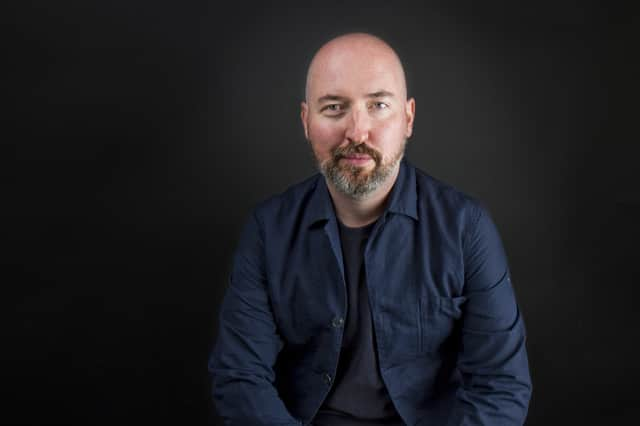
“Colour serves as an emotional language for the men, the only time they’re ever direct. It's why the first line in the book sets everything in motion.
“Her feet were as purple as calf liver” - a description of Cal’s grandmother’s state of health - because Cal understands the one place his father always tells the truth and is always supremely accurate is when he talks about colour. He thinks ‘that's a really bad colour, I must come home’ then we discover Ella's perfectly fine and something else is afoot, no pun intended,” he smiles.
Similarly, a moment of tenderness between a father and son is channelled through a need to care for each other’s work raddled hands.
“Yeah, you're mending a useful tool,” says Stuart. “But also that came from a mussel farmer I met who'd spent years setting up beds and harvesting them every day to make his living. I said, ‘Oh, how lucky you are to be out on the water’ and he didn't think much of that because it's freezing and dark and wet, so I said, ‘Well, at least you've got all the delicious mussels you can eat. And he turned and said: ‘I don't like mussels.’
“Your job and your passion and wellbeing might not align, but you've got to make a living. That mussel farmer changed everything for me, because I thought, ‘you've given your life to farm these when you don't even like to eat them. That's astonishing.’”
Stuart is thankful that for him passion and work align, the success of Shuggy Bain and winning the Booker allowing him to transition from writing on his commute to becoming a novelist full time.
“My life has changed entirely. Leaving fashion and textiles behind and joining a whole new world. Yeah, I feel very lucky to be able to follow my dreams and to be able to write,” he says.
And what of living on a Hebridean island like Harris, is it something he could see himself doing? It’s a long way from Manhattan, where the Scottish/US lives with his husband, art curator Michael Cary.
“Yes, I could. But I think I've been living on various versions of islands my whole life. A housing scheme in Glasgow can feel like an island because they're designed to be self-contained and keep people on them and also socioeconomically it's hard to get off. Also ideologically, when you grow up in a very sectarian part of the city that's also an island. And queerness felt like an island. I certainly felt very alone with no way to cross over and meet other people.
“But Harris, I could live there. I would absolutely love it.”
In the book the main character Cal is asked who he belongs to and replies ‘John of John of Iain of Iain the breabadair (weaver)’. Who does Stuart belong to?
“I think that’s why I wrote the novel. I’m not sure. That’s been a central question of my life. Now I’ve reached 50 and grew up without parents and chose not to have children, I’ve been contemplating that. Am I just this lonely satellite in space or who do I belong to?
“I joke that I define the eras of my life by what my straight friends have gone through so I lived through my engagement party era, then weddings, then kids coming, then kids going to high school, then divorces, I’ve just lived through my perimenopause and now I’m entering into my care giving era, where my friends are 50 and turning their attention to caring for elderly parents. And I don’t have that. I guess I was freed from that at 16, but it doesn’t mean it doesn’t hold a real fascination for me and it’s part of why I wrote Ella and Cal, because I was thinking can I create a love that is strong enough that would cause a grandson to give up his own future to come home and care for his granny.
“So who do I belong to? I belong to my husband and I belong to myself. And that belonging to self is part of the thing that makes me question what caring is. Because all my novels are about caring for somebody else and I think that’s central in my life. I think caring for someone is the purest form of love, especially when that person is in deep need or not behaving in a way you like. In the case of Agnes Bain, her children still care for her. I think that’s such a huge declaration of love and that’s what I’m fascinated by.”
Looking ahead to the Edinburgh International Book Festival, Stuart emphasises his desire that a home audience enjoy it as much as visitors from further afield. What would he say to encourage people to come to the book festival, or pick up a book?

“The best thing that ever happens to me with readers is when they come to events and say I never read a book or I gave up on reading until I read Shuggie Bain, or Shuggie Bain is the first book I’ve read in my adult life. I get more out of that than you could possibly imagine because my own journey to reading has been circuitous and meandering.
“Growing up in Glasgow I would have thought maybe the doors at the Edinburgh Book Festival wouldn’t have been open to people like me and that’s not true. I find it to be such an inclusive environment and such a brilliant day out, no matter what you see, just to be in the city and the world of books. So I encourage everybody to come and support it and meet it on their own terms. It’s for everybody. We often think of it as a very international thing, for people visiting the city, but it is first and foremost for Scottish people, so I hope they continue to support it.”
“So I’m doing three events at the festival which is dead exciting: John of John with Jackie Kay and Agnes Owens as part of a panel and then I’m having a wee ceilidh evening with Michael Pedersen and other guests.”
“But what I mostly do when I’m back is spend time with my family in Glasgow. It’s just nice to be at home at the kitchen table with my sister and my sister’s kids. That’s where I feel most at home, just talking about nonsense, in Pollok, on the south side of Glasgow, just being with my family.”
Also on his to-do list, because he still loves textiles and fashion, is ordering some yarn so he can get knitting on the machine he has at home and colour is a must. Today’s white T-shirt is only because New York is ‘absolutely roasting’ at 35C.
“I’m about to order a bunch of yarns from Todd & Duncan in Kinross, because I want to get my knitting together for when the weather turns,” he says.
“One of the things that really helps me with my writing whenever I’m stuck is to start to make something. I knit scarves or jumpers or presents for people and find the repetitive action of textile making allows my mind to rest and my subconscious to figure out the problems in my writing. I would advise every writer to have some sort of handicraft or project of making. It’s good to use all of your mind. It’s so much better than scrolling the internet because the other thing you can do with your hands is look at your phone too much and what you’re actually craving is something to do. So I want a blush pink, a very royal navy and a sort of alabaster-y stone. I already know the sort of fair isle-y pattern thing I want to make.”
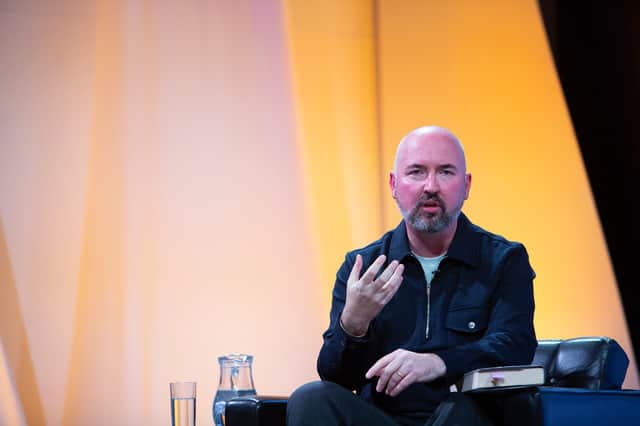
Now that John of John is out there, is he working on a new book?
“I'm thinking of it, but haven't started yet. John of John finishes a very loose triptych. I wanted to look at Scottish working class queerness at the end of the 20th century and feel from the first word of Shuggie to the last word of John, 18 years of work is closing, my time with Scotland is coming to an end. I'm not quite sure what I'm going to write next and that's going to take a minute to figure out.”
An exciting place to be.
“I hope so. Maybe I'll not write anything. Maybe this is my retirement announcement,” he laughs.
He’s joking, but the boy from Pollok doesn’t have anything to prove.
“I think I've had a North Star for the past 20 years, where I knew what I wanted to write, what I was trying to excavate, the pain I was trying to put on the page, about how I felt very affected by themes and factors in the nation that raised me, whether that was poverty, deindustrialisation, addiction, male identity or gang violence. And this last one is about isolation, faith and how faith affects a queer life and I think I was wanting to dig into that and look at it almost as a tapestry, and I've completed that tapestry for now. So what next? I'm gonna figure it out.”
Just as Stuart didn’t have John of John until he arrived in Harris, his next book will emerge from living a life.
“I think so. I think the book's already inside me. I'm not a writer that searches for an idea. Even with the Harris Tweed book, all that pain and loneliness and the weaving was already inside me, I just had to find its place.”
Maybe he’s going to write more of an American novel now he’s 50, a successful writer, married and living in New York…
“Yeah… and I'm happy. Can you write a novel about happiness?”
John of John by Douglas Stuart is published by Picador. Douglas Stuart will appear at the Edinburgh International Book Festival on Sunday 30 August 2026, 1-2pm, at The McEwan Hall. He also appears at For the Love of Agnes: A Celebration of Agnes Owens, with Jenni Fagan and William Letford, chaired by Chitra Ramaswamy on Sunday 30 August, 7-8pm at the Courtyard Theatre and at Michael Pedersen and Friends, on Saturday 29 August 8.30-10pm at the Spiegeltent. See www.edbookfest.co.uk
Comments
Want to join the conversation? Please or to comment on this article.