
I take the world’s shortest flight to an ancient world: Exploring Orkney’s Holm of Papay


Take a two-minute hop across the sea to a tiny, uninhabited Orkney isle where 5,000 years of history await.
We sit nervously, packed two abreast in the eight-seater Islander, as our pilot Colin, gives the briefest of safety briefings: “Seatbelts on? Pull on this red handle and the window will pop out." As we taxi onto the tiny gravel runway, he turns and asks “Do you want the short way or the long way?" Without waiting for an answer, the throttle opens, the engines scream and we surge forward. As the ground falls away, we skim the glassy grey sea and reach the rich green of Papa Westray around 30 seconds later. We bank sharply, the runway appearing before us, and set down firmly, coming to an abrupt stop.
Turns out we went the short way, taking off and landing in less than two minutes, completing the world’s shortest scheduled flight across to Papa Westray. We’re on our way to the uninhabited Holm of Papay, the smallest Russian doll of an island off the coast of Papa Westray, itself an island off the coast of Westray - one of the northernmost Orkney isles. The island is flat - thin stripes of black coastal rock and vibrant green grass sandwiched between the grey-blue sea and light grey sky. Flat, except for the grassy mound of one of Orkney’s finest Neolithic tombs rising at its southern end.

We take a small inflatable rib across to the Holm, slapping at speed across the channel, as the outboard motor drones loudly. Arctic terns, white against the clouds, soar and dip, whilst eider ducks flap across the surface. Approaching the beach, Tim, our skipper, cuts the engine. As we drift to a halt in the silence, he points out the half dozen seals who have surfaced, eyeing us with suspicion. “That’s a common seal,” Tim explains, “although grey seals are more common in Orkney. You can tell because common seals have a face more like a cat, but grey seals are more like a dog with a longer snout.” Tim - tall in thick, waist-high insulated waders - has an infectious enthusiasm for this spot, having moved to Papa a few years ago as a bird warden, drawn by his research into arctic terns.

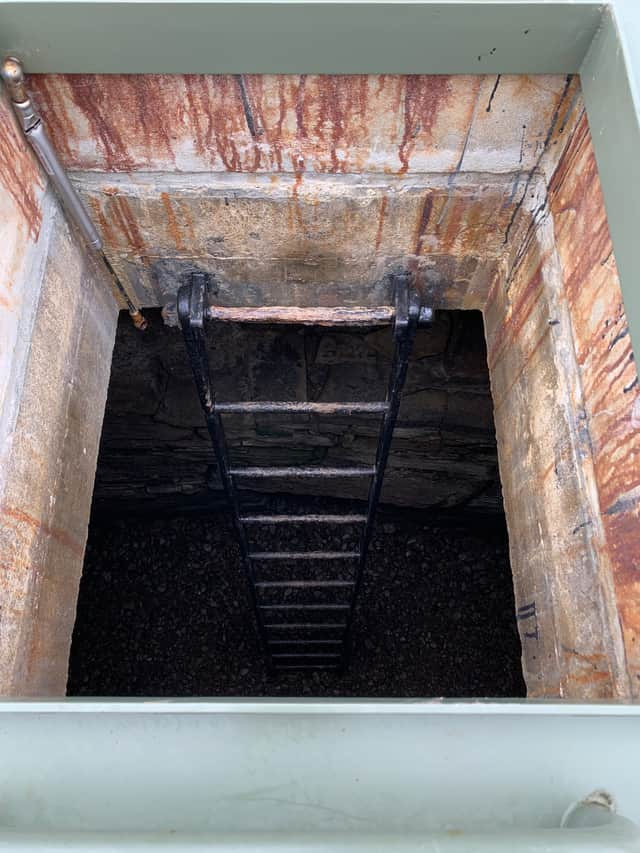
We make our way to the tomb from the beach, stepping across slabs of rock thick with vivid yellow lichen, spotted with bright pink globes of Sea Pink. The original entrance was via a long, very low passage to the east. Today, you enter through a metal trapdoor in the concrete roof (a protective covering added in 1929). After carefully weighing the door open with a rock, you climb down a rusted iron ladder into the darkness.
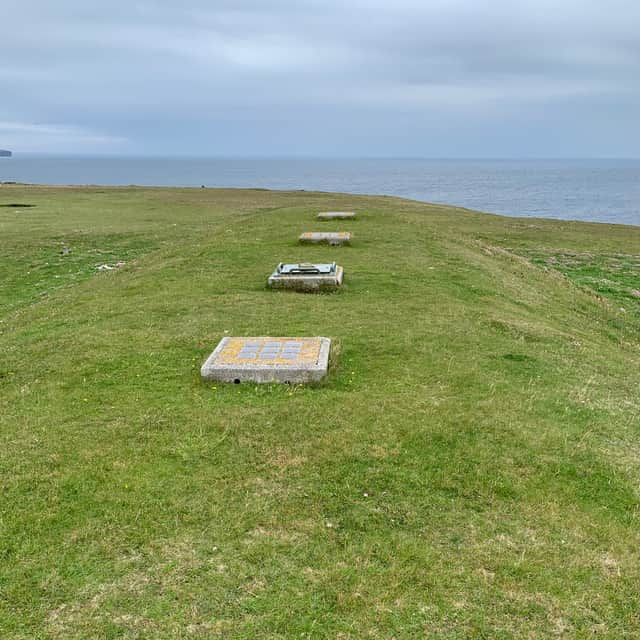
Inside there’s immediate shelter from the wind but also the damp underground cold and an earthy scent. As your eyes adjust, you find yourself in the centre of a long, rectangular chamber with shoulder-high walls of large, rounded sandstone blocks. There are plenty of Neolithic burial cairns in Orkney, but the Holm cairn stands out. Firstly, it's huge - from the outside it’s 38 metres long, nearly 20 metres wide and three metres high - so was intended to be seen from a distance. Its rectangular shape is also unusual as most cairns were circular. Inside are 12 small side chambers (where it is thought human bodies were laid to rest although no remains have ever been found), and the main chamber is divided into three parts by two cross-walls; you crawl through small doorways to breach these. But the most remarkable feature is the stone carvings - over 30, far more than any other cairn. They include circular marks, a zigzag, an inverted V, and fascinatingly, a curved pair of eyebrows above two pecked eyes.
This cairn was extraordinarily ambitious at the time; it had to be given the colossal collective effort, ingenuity and will needed to quarry, transport and precisely fit these massive stones without modern machinery or metal tools. As you crawl to reach the outer chambers, seeing the carvings directly before your eyes, it’s hard not to imagine our predecessors doing the same.
You’ll likely have the tomb to yourself - there are no ticket offices, turnstiles, gift shops or guided tours, and the cairn is open anytime for those who travel this far. It’s tempting to think the chamber always existed in such splendid isolation, but these islands were busy with human activity five thousand years ago. Orkney’s remarkably fertile soils and temperate climate allowed early agriculture to flourish, enabling the transition from the hunter-gatherers of the early Stone Age (Mesolithic) to the farmers of the Neolithic, the new Stone Age.

It’s easy to forget that sailing, making clever use of the strong Orkney tides, was the most effective form of transport at the time. It’s thought trade, both within the Orkney archipelago and with Scandinavia and mainland Scotland, helped produce the wealth and power necessary to build these monuments. Such investments were intended to venerate ancestors but perhaps also as very conspicuous symbols of wealth.
As we wait on the beach for Tim to collect us, what stays with me isn’t the scale of the cairn but something smaller - the eyebrows above two pecked eyes. Someone made that. Someone crouched where I crouched, pressing stone to stone. Those people would have stood on this same beach, under these same broad Orcadian skies, perhaps quietly observed by another bob of curious seals.
PLANNING YOUR TRIP
● Getting to Orkney: Orkney can be reached by air (loganair.co.uk) from across the UK or sea (northlinkferries.co.uk) from Scrabster in the far north of Scotland or from Aberdeen.
● The shortest flight: The two-minute Westray to Papa Westray flight is operated by Loganair (loganair.co.uk) as an onward leg of the Kirkwall-Westray flight. Book ahead as seats are extremely limited.
● Getting to the Holm: Boats to the Holm can be arranged by messaging Tim Dodman on 07493 685428. It’s a short walk from airport to ferry. More information on Papa at papawestray.co.uk.
● Bird-watching: It’s worth spending time on Westray for the dramatic sea cliffs to the north, teeming with birdlife, and the puffins near Castle o'Burrian (late April to mid-August). Take a vehicle ferry (orkneyferries.co.uk) from the Orkney mainland to Westray then either the flight or small passenger ferry to Papa.
Comments
Want to join the conversation? Please or to comment on this article.