
'I felt I needed to do this' - Slow Horses actor Jack Lowden and Michael Pedersen bond over lighthouse tale
This article contains affiliate links. We may earn a small commission on items purchased through this article, but that does not affect our editorial judgement.
Muckle Flugga is the poet’s first foray into fiction and the Scottish actor was his first choice to bring it to life
Poet and author Michael Pedersen is standing on a cliff edge in Shetland gazing at the small rocky island of Muckle Flugga and its lighthouse as his partner and fellow poet Hollie McNish films him. Out of nowhere he’s dive-bombed by a bonxie, a great skua, which misses his head by inches.
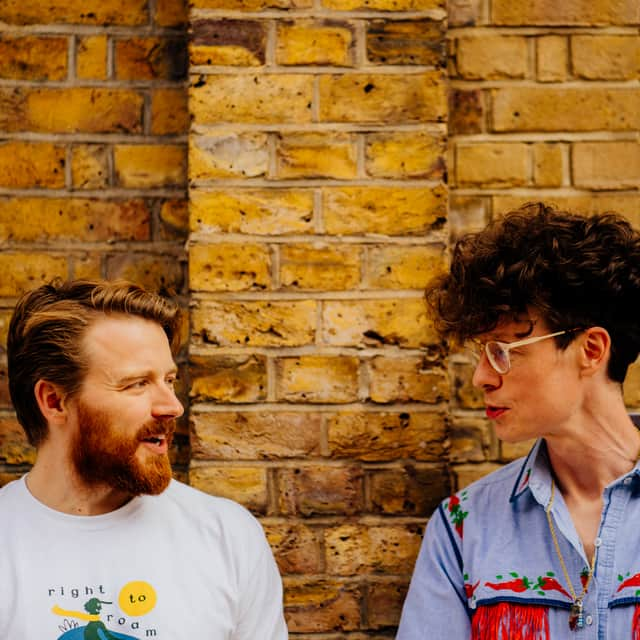

“I'm pantsing around on the cliff edge with my book, doing a bit of posing and Hollie’s taking a little video of me then her face changes to this moment of urgency and a second later I feel this swoosh across the top of my hair and look up and there's this massive bonxie. Huge wings, about three times the size of an Edinburgh seagull and it's dive-bombed me and is swinging back to come a second time so I hit the dirt and it passes over the top of my head. Then I remember from my book you're supposed to carry a stick for when the bonxies come - because my character Firth gets dive-bombed as he doesn't have the acumen or Shetlanding wherewithal.

“So I start swinging my bag around my head because they'll clip the highest surface and really they're giving you warning blows. It's rare they'll viciously go for you.
“It was a self-fulfilling prophecy. The right dandy from Edinburgh ended up getting divebombed in the exact fashion I'd written for my hapless character. So I quite enjoyed that.”
Pedersen wanted a closer look at Muckle Flugga as it’s the setting for his debut novel, named for the island off Unst and Britain’s most northerly lighthouse, out now in audiobook and narrated by BAFTA-winning Slow Horses and The Gold actor Jack Lowden.
This time round it was as near to Muckle Flugga as he would get but while on Shetland, performing poetry and promoting the novel, Pedersen met many Shetlanders who shared his fascination with the lighthouse island and received a warm reception for his story of its fictional inhabitants: the hostile Father and his fey son Ouse, Firth, a visiting fractured writer, the ghost of Robert Louis Stevenson, nurturing Figgie, an absent Mother and a further cast of minor characters. All of these are inhabited by Lowden who “delivers it all with eclat and bravura,” as Pedersen puts it.

Muckle Flugga is a vivid rollercoaster of a book that takes the reader on a wild and wonderful journey as lives are turned upside down by the arrival of a stranger from the city, in what is Pedersen’s first foray into the world of fiction writing. In it the 41-year-old prize-winning poet and current Edinburgh Makar and writer-in-residence at The University of Edinburgh develops some of the themes explored in his poetry books Play with Me, Oyster (with Scott Hutchison), The Cat Prince & Other Poems and autobiographical prose work Boy Friends - friendship, fraternity, love, loss and laughter, grief and joy - and expands into an imaginary world that leaps off the page.
“It's a novel of landscape, lore and lighthouses. It's a love letter to Shetland and nature, but for me at the core it's a character drama between Ouse and The Father and it’s a deep friendship romance. There are old bonds up against new, with Ouse at a juncture where he either follows his creative ambitions or family loyalty. So it's a friendship romance but deeply grounded in place, landscape and lore.”
Lowden, who is currently in rehearsals for Netflix’s Pride and Prejudice, in which he is the first Scot to play Mr Darcy, after the London run of National Theatre of Scotland’s The Fifth Step, joins me along with Pedersen on a Zoom call.
So why did the BAFTA and Olivier Award winner choose Muckle Flugga as his first audio book after being approached by Pedersen’s publisher?
“I felt I needed to do this. I'd read Michael's memoir, Boy Friends and was obsessed with it. I get so excited when there's talent of that level that's homegrown, it's such a buzz, and to be asked to do this made complete sense.“

For Pedersen, Lowden was his first choice as narrator.
“The big movie with him for me, and thinking he could do such a good job was Benediction when he played the poet Siegfried Sassoon. I thought he really shone in that role and knew he had that ear for poetic dialogue and for the poet's heart. Then I saw him in the play, The Fifth Step, and how he carried himself on stage made me realise how good he would be because an audio book is a one-man play in which he has to play every character.”
“I knew he'd be sympathetic to, let's face it, the poetic flamboyance of my storytelling, which is I think my most loved facet of storytelling, but also the most divisive. If you're looking for an iconic, well-expressed every single syllable machismo-based storyteller, that's not what I am.
“And I like the sound of his voice and some of the Scottish vernacular that comes with it, the way words sound coming out of his mouth - he says words like ‘gobshite’ brilliantly. So knowing he could handle the deep poetic sensitivity but could also be super playful with the Scots language vernacular as well and having the awareness that he loves Scotland, its history, nature and storytelling, yet he's ambitious with it. He wants us to be better, like these characters want to be better.”
For 35-year-old Lowden, this was a first too, as he’d never narrated an audio book before.
“It was fascinating. I didn't know how to go about it at first,” he says. “Full disclosure, I chose not to read it beforehand. Because you very rarely as an actor get to perform or read anything cold and experience it as you go along. I jumped on the fire!”
“The characters are all very different and I didn't come in with any preconceptions. My opinion of them changed as the chapters went by. I didn't know what was going to happen next.”
The pairing of Pedersen and Lowden with Muckle Flugga is a meeting of minds, both of them keen to champion the talent and creativity of their native Scotland.
“It's so promising to have people like Michael,” says Lowden. “Artists that are completely singular but so embedded in where he's from, celebrating it. To find a prolific Scottish artist that isn't tartanised in that shortbread tin Walter Scott kind of vein. We have such a rich heritage running alongside that and sometimes pushing past it and overtaking it. He's more John Byrne, Peter Capaldi and that mad sort of outer space artistry that we have in this country.”
For Pedersen, hearing Muckle Flugga read by someone else gave it a fresh perspective.
“It's the biggest opportunity I've ever had to listen to my own work as a reader or spectator. Because everything's been autobiographical and poetry it makes no sense to have anyone else read it but with Muckle Flugga, because of the range of voices, we needed a professional actor.
“There are moments of darkness and despair that Jack could portray and also lilting fun, and some brilliantly Scottish profanities I was excited to hear Jack flying out with. I spat out my soup in a cafe listening at one point.”

Muckle Flugga was inspired when Pedersen visited Shetland with the musician and artist Bill Drummond and Kevin Williamson, Pedersen’s co-founder of Edinburgh-based literary and arts production house Neu! Reekie!, to show Drummond’s film Imagine Waking Up Tomorrow and All Music Has Disappeared. Invited to brunch at the lighthouse keepers’ former shore station, they all go for a walk and Pedersen sees the island for the first time.
“It's over there in the water, standing-emerging like a giant out of the oceanic depth and staring off into the abyss and it stuck with me, the idea of water and how we share the energy and the spirit of us, and the lighthouse continued to present itself as the setting for a book. And in a way, there was a continuation of a lot of themes and threads from Boy Friends, which had been written in the Curfew Tower at Cushendell [Northern Ireland] and I was looking for a sibling edifice, this other guardian of the whale road, this other wish tower to set my first ever fiction novel in. I knew it was going to be in Scotland, I knew it had to be in a lighthouse and I just had to find the right one.”
Muckle Flugga was it.
“The extremity of it being the UK's northernmost lighthouse - if you followed north you would just keep going until you hit the Arctic - and exploding these characters in an intense place, it had to be there.”
“The name as well,” smiles Pedersen. “Muckle Flugga. Everyone thinks I invented it and I tell them straight, I don't think I could have conjured a name that is as fascinating as Muckle Flugga. I have borrowed that and am paying tribute to it, but a lot of people think it's just me trying to say motherf***er in a clever way on the front of a book, which I also like, but it's not the intention and makes me sound edgier than I am.”
With a location secured, the characters became rooted in place.
"I had the characters, but they were so much shaped by the way I explored the place that for me, this was a novel of place. Each of these characters was carrying a deep love or deep conflict about it.
“I probably put a tincture of myself into each one of them alongside a tincture of somebody else I knew, but by the time I learned who they were on Michael Flugga and put them through their paces, they had shed every form of my identity like a snake sheds its skin and all the biases I've given them that belong to myself drifted away and they became their own fully fledged beings.”
It wasn’t long before Pedersen’s long-held desire to write a novel began to become a reality.
“I would have been content writing poems from now until forever but this story took hold of me. I was in a sense flying by the seat of my pants writing my first novel. I’ve always worshiped at the altar of novels. I've read stories and fancied my chancies at writing one for as long as I can remember, probably way before I even conjured the idea of writing a poem. I guess it’s a more natural impulse because we have a more immediate understanding of what stories are. But I didn’t really know how to write it.”
Pedersen solved his quandary by writing a 40-page script synopsis that he worked on with TV director Robert McKillop [Guilt, A Young Doctor's Notebook and Other Stories].
“I held myself back from writing any really juicy dialogue or the more poetic aberrations, which are the things that I have most fun with and come most naturally to me, to give myself the reassurance that this is story first and all of the poeticisms then start to service it rather than take premier place. I would say I wrote a book based on a script synopsis for a script that never got written for a movie that never got made.”
Does he think it ever will?
“I hope so. We're starting to have initial conversations with people about the way this could be adapted.”
Meanwhile, Pedersen is focusing on touring with the book, with Australia and New Zealand on the horizon, while the translations into French, German and Spanish are imminent.

“I want to give this story time to breathe. The paperback comes out next year and it’s being translated. If it travels into an adaptation, I want to be there to service every element of it.”
“My writing is always so stridently Scottish. It’s all I know, it comes out of me fiercest when I try and war against it so the fact there have been international editors resonating with the emotional core of the story and the setting and identity of place has been a rhapsodic experience and lights a little fuse for me.”
“The tour of a book is always the life manifestation and the celebration of it is such an important thing to me. I’ve sat down in conversation with Stephen Fry, Jackie Kay, Nicola Sturgeon, Hollie [McNish], Fern Brady, Val McDermid and Kirsty Wark and all these amazing people who have all given me their insights into the book, and it's amazing how many different biases or characters they focus on.”

Having established such larger than life characters and an imaginary world that leaps off the page, Pedersen is not ready to let them go.
“They're very much still alive in my head, and it was a two book deal with Fabor, so there will be a future for these characters.”
Will the further adventures of the inhabitants of Muckle Flugga shine like a beacon in the distance for readers, as yet the island of Muckle Flugga has remained tantalisingly out of reach for Pedersen.
“I looked into chartering a boat when I was there looking over at it and then the day we could have done that it was engulfed in this thick fog. But I've laid the seeds for setting foot on Muckle Flugga. It's a tricky landing and they don't advise it but it’s not illegal to go.”
How he’ll get there is still in the planning stage.
“Maybe the coastguard or private charter or The Northern Lighthouse Board, who would have the keys to the lighthouse and I could get inside. I’m biding my time.”
“Also there's something beautiful about still having not been on it despite a couple of different attempts now because I like the fact that my Muckle Flugga is fantastical and I've been equally loyal and disloyal to it in as complimentary a sense as is possible. For me, it remains the unattainable island. I've been so close and gazed upon it, but I've yet to set foot on it, and I just have to accept my time will come. It will…”
Muckle Flugga by Michael Pedersen is available to listen to now on Audible. www.audible.co.uk www.audible.co.uk/pd/Muckle-Flugga-Audiobook
Muckle Flugga is published by Faber, hardback, £14.99, www.faber.co.ukBook
Comments
Want to join the conversation? Please or to comment on this article.