
I cycled the ‘longest, loneliest and loveliest glen’ in Scotland.


Jack Thurston shares one of his favourite cycle routes from his new book, Lost Lanes Scotland, a Highland Perthshire journey along quiet lanes and tracks from Killin to Kenmore.
To see a country best, travel its byways. Away from Scotland’s main roads is a network of country lanes and hill tracks that twist and turn through the folds of the landscape. These are roads with stories to tell: ancient routes trodden by pilgrims; thieves’ roads where thousands of black cattle were spirited away; Wade roads built for marching soldiers; coffin roads to distant burial grounds; whisky roads where smugglers hid from the excise man. On a bicycle you notice the clues. The weathered milestone half-hidden in bracken. The drovers’ stance. The bridge that’s just wide enough for a train of packhorses. This is time travel at a human pace.
Scotland’s lost lanes come in a few distinct types and this circuit in Highland Perthshire combines three of them: the glen road, the lochside lane and the pass-stormer. At 57 miles, it is of one of the most spectacular (and challenging) routes in Lost Lanes Scotland, a collection of day rides on quiet roads and gravel trails, ranging from 25 to 75 miles. The routes can be ridden in a single day, or knitted together as part of a longer tour. This route, for example, is paired with one from Pitlochry, making them both accessible by train.

The ride begins in Killin, the village that grew up around the Falls of Dochart, which tumble into the western end of Loch Tay. In 1803 Dorothy Wordsworth passed through on her tour with brother William and Samuel Taylor Coleridge. The scene is little changed from her diary entry: ‘the river took up a roaring voice, beating its way over a rocky descent among large black stones: islands in the middle turning the stream this way and that; the whole course of the river very wide.’ To visit Inchbuie, the wooded island in the stream, and the burial place of Clan McNab, borrow the key from the Breadalbane Folklore Centre in the old watermill beside the falls. From Killin you’ll head up Glen Lochay. Look out for the Moirlanich Longhouse, a rare survivor of a traditional Highland farmstead, its carefully preserved interior offering a glimpse of rural life in another age.

The lane follows the River Lochay upstream through woodlands of gnarled oak carpeted with ferns, mosses and wild flowers. Eventually you’ll turn onto the mountain road originally built for a hydroelectric scheme and now closed to motorists due to its deteriorating surface. For adventurous cyclists it offers a secret route over the top into Glen Lyon.
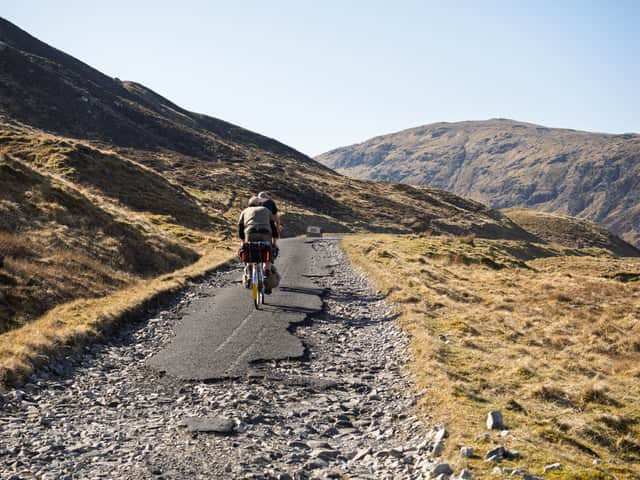
The initial series of hairpins is the roughest and steepest; further up you go, the easier it gets. The first time I crossed the summit pass I met a rider coming the other way. We stopped to greet one another, as wayfarers in remote places always do. He explained he had ridden his bicycle to the foot of nearby Creag Mhòr, a 1,047m high peak in the Ben Lawers range, leaving the machine at the foot of the hill and making the ascent on foot. I made a mental note to add a few Munros to my next Scottish bike tour.
From this high point of the ride, the fast, smooth descent to the dam at the mouth of Loch Lyon is pure adrenaline. And here begins the road along what Walter Scott described as the ‘longest, loneliest and loveliest glen’ in Scotland. He wasn’t wrong. Glen Lyon — An Crom Ghleann, the Bent Glen — is series of scenic revelations, from the upper reaches beneath monumental glacier-smoothed buttresses, through groves of Scots pine to the lush pastures, meadows and woodlands further down.
Take a moment to stop at Bridge of Balgie, a picture-postcard hamlet with a humpbacked bridge and superb post office tea room serving filled rolls, freshly baked scones, coffee and cake.

Towards the far end of the glen is Fortingall, a tiny village of thatched cottages that feels like a slice of rural Devon transported to the Highlands. The village was largely the creation of Sir Donald Currie, founder of the Castle Line of steamers to South Africa, who bought the Glenlyon Estate in 1885 and commissioned the Arts & Crafts architect James MacLaren — a forerunner of Mackintosh — to transform what had been a semi-derelict settlement into a vision of Highland vernacular. Currie is buried in the churchyard, beneath the ancient yew.

After crossing the River Tay you’ll pass Taymouth Castle, a huge neo-Gothic palace completed in 1842 on the site of a Campbell clan stronghold. No expense was spared on the grand exterior nor the lavish interiors which featured ornamental plasterwork, gilded carvings and intricately decorated ceilings, as well as paintings by Rubens, Titian and Van Dyck. When Sir Gavin Campbell inherited the estate in 1871 it comprised nearly half a million acres, from Aberfeldy to Oban. Mounting debts, due, it is said, to Campbell’s extravagance (and a reputed gambling habit), forced the sale of most of the land and eventually the castle itself. Since then, it has been a hotel, a boarding school, a hospital, and even a nuclear bunker, before falling into dereliction and ending up on Scotland’s official register of buildings at risk. Its latest chapter, as the site of a luxury golf resort, has stirred strong local opinion, both for and against.

Kenmore is the estate village of Taymouth, with a church, a village shop and a cluster of black and white cottages set on a headland at the outlet of Loch Tay. The last 14 miles of the ride takes you the full length of Loch Tay back to Killin, following National Cycle Route 7. A little hillier than you might expect of a lochside lane, the reward for the climbs is a succession of grand vistas over the water to Ben Lawers.
At the western end of Loch Tay are a few small beaches where, if the sun’s shining, you might be tempted to go for a reviving end-of-ride plunge. You’ll have earned it.
Cafes, Pubs, Hotels and Bike Shops

Glenlyon Tea Room, Bridge of Balgie, PH15 2PP (01887 866324). Post office, shop and tearoom serving great cakes, scones, pies and pasties.
Fortingall Hotel, Fortingall PH15 2NQ (01887 830367, www.fortingall.com). Rambling Arts & Crafts country house hotel, live music nights in the Ewe Bar. Lunch and dinner served (booking advised).
The Courtyard Brasserie & Bar, Mains of Taymouth, Kenmore PH15 2HN (01887 830226, www.taymouth.co.uk/restaurant). Large eatery on the Mains of Taymouth golf club and country estate. Open all day, plenty of outside tables.
Killin Hotel, Killin, Perthshire, FK21 8TP (01567 820296, killinhotel.com). Good value rooms in this large riverside hotel.
Falls of Dochart Inn & Smokehouse, Gray Street, Killin FK21 8SL (01567 820270, www.fallsofdochart.co.uk). Perfect spot for a post-ride pint and a bite.
Bike Hire & Bike Shop: Killin Outdoor Centre, Dreadnought Place, Main Street, Killin FK21 8UJ (01567 820652, www.killinoutdoor.co.uk). MTBs for hire.
Comments
Want to join the conversation? Please or to comment on this article.