
'I appreciate making things up' - Sally Magnusson's latest novel reveals her love of Orkney and Norse myths
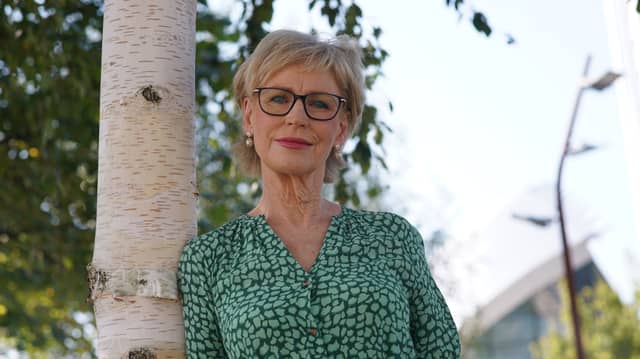

The journalist and broadcaster talks about The Shapeshifter’s Daughter at St Andrew’s Book Festival in London
At her home north of Glasgow, author, broadcaster and journalist Sally Magnusson is worried about the signal as she picks up the phone to chat about her appearance at St Andrew’s Book Festival in London on 28 November where she will discuss her latest novel, The Shapeshifter’s Daughter.
“I'll let you know if the signal fades out. But I’m in a chair, so I should be okay,” she says.
Triggered by the mention of ‘chair’, I can’t help asking if it is her dad, Magnus Magnusson’s Mastermind chair? Is it in her house?
“I'm not in it at the moment,” she says, “but yes, we are custodians of the original Mastermind chair. It wasn't left to me, but in the way things get moved around after people die it ended up in our living room here and it's very much a part of the family furniture, and even made an appearance last year on The Repair Shop, getting spruced up a bit.”
With that settled, we turn to her specialist subject, the Norse myths and sagas which have inspired her latest book, set in contemporary Orkney. Her fourth adult novel, it follows on from The Sealwoman’s Gift (2018), The Ninth Child (2020) and Music in the Dark (2023), as well as her memoir of life with her mother and their experience of dementia, Where Memories Go, and several children’s and non-fiction books.
The daughter of journalist and author Magnus Magnusson and journalist Mamie Baird, after studying at the University of Edinburgh, Magnusson became a journalist, starting at The Scotsman in 1979. She moved into broadcasting with BBC Scotland where she was the face of its flagship news programme Reporting Scotland from 1998 until April this year when she stepped down from it to concentrate on freelance projects.

Along the way she also presented Songs of Praise, anchored current affairs shows and documentaries, won a Scottish Bafta as part of the team covering the Dunblane tragedy, a Royal Television Society award, and presented shows on Radio Scotland and Radio 4, and in 2023 received an MBE for her work with people with dementia and their carers.
It’s my turn to ask the questions ahead of her literary lunch event with journalist and author Hugh Pym where she will discuss folklore, memory and the inspiration behind The Shapeshifter’s Daughter, published this month.
“All of these things are very much part of my writing in general and specifically this book,” she says.
Also appearing at St Andrew’s Book Festival - Interview with Nicola Sturgeon and Val McDermid
So what is it about folklore and myths that fascinates and inspires her?
“Myths speak to the hopes, fears, fallibilities and cruelties of the human condition and human disposition and what they tell us about is ourselves. And although they have been for hundreds of years reinterpreted for different times, what remains at the core is who people are - which never changes - and we can all recognise ourselves in the Norse myths.”
Magnusson grew up with them, her father recounting stories about Odin, Thor, Loki and the goings on in Asgard [the realm of the gods] and he also translated the Icelandic sagas from Old Norse.
“I would hear the click clack of his typewriter and go into his study and he would be surrounded by dictionaries and manuscripts. Also I've been to Iceland a lot and I feel very comfortable and at home among these kinds of stories.
Also appearing at St Andrew’s Book Festival - Interview with Irvine Welsh
“In more recent years, I have enjoyed what writers have been doing with the Greek myths, taking characters and updating them and very often seeing them from a female perspective in cracking good novels. I started to think why has nobody really done this with the Norse myths? Take a female character and embody her and dramatise what's going on in these stories?
“I realised it's probably because there are plenty of alpha males - Thor chucking his hammer around, Loki being a trickster and shapeshifter - but the women are very much in a secondary role. Then reading them again I came across Hel of The Underworld [the god Loki’s daughter] who is an extraordinary figure, described as having a face that was half lustrously beautiful, half like a corpse. She was obviously being used to dramatise the human fear of ageing, possibly female ageing, and the fear and horror of death itself.”
Also appearing at St Andrew’s Book Festival - Interview with The Witches of Scotland
Magnusson explains that Hel was thrown into The Underworld by Odin, leader of the gods, who wanted to neutralise the children of his blood brother Loki because he had seen in a vision they were going to destroy him.

“I thought how interesting would it be if you took Hel's story and saw it from her point of view? Used a novel to dramatise her awakening to who she was meant to be before she got chucked into The Underworld, and examine what her relationship with death might really be.”
If this sounds weighty, it’s not, as Magnusson has a light touch, imbuing darkness with light and myth with mirth, her characters nuanced and contradictory, making them authentically human (even when they’re otherworldly). So The Shapeshifter’s daughter blends modern day Helen Firth, returning to Orkney after 40 years and a terminal diagnosis, and the myth of Hel. This delicate balancing also occurs in The Sealwoman’s Gift - inspired by the real life 17th-century abduction of Icelanders to North Africa by slave traders - and in her memoir of life with her mother Mamie Baird, Where Memories Go, and their experience of dementia. Real life events also make an appearance in Music in the Dark, focusing on the aftermath of a brutal suppression of an uprising by the women of Strathcarron during the Highland Clearances, and in The Ninth Child, where 19th century engineering innovation merges with Trossachs folklore.
Quick to smile, Magnusson points out that Norse myths are very different from the classical Greek ones.
“There's something very kind of rumbunctious about the Norse pantheon. There's a lot of slapstick,” she says.
What she aims to capture is “the richness and fullness of life, which is complex and never simple.”
Also appearing at St Andrew’s Book Festival - Interview with Jenny Colgan
“In plot terms Hel came first, and she is queen of The Underworld so it was going to have to be a book that addressed death. I thought that's an opportunity because as a society we don't really like thinking about it. I felt I had reached a stage in my writing where I could tackle something as important as that and also try to make it not necessarily morbid or dark, and not glib or sentimental.
“I saw how the story of Hel and could be a foil for Helen beginning to understand through her relationship with the male protagonist Thorfinn, that it is never too late to live and laugh and that even in the midst of dying you can have golden times that are in a curious way better and more intense than anything you've ever lived before. It was that side of the experience I wanted to express so people would find themselves nearly laughing and crying at the same time.”
Also appearing at St Andrew’s Book Festival - Interview with Coinneach MacLeod
Already familiar with Orkney, having been there over the years with work, she is fascinated by its neolithic past, and finds its mix of Norse and Scottish heritage always makes her feel at home. In the winter of 2022/23, she took herself off there to research and write.
“I wanted this to be a winter book, focused on the miracle of the winter solstice and Maeshowe, so I went in November and January. I tramped the roads and familiarised myself with the wind and the dark and flavour of Orkney. I was there enough, I hope, to do justice to the islands.”
After a working life of deadlines and live presenting, along with raising five now grown up children with TV director and illustrator husband Norman Stone, it's easy to imagine Magnusson has a steady writing routine built into a daily schedule, but this is not the case.
“No, I've never been able to do that,” she says. ”There's always been a little bit here and a little bit there and then a huge panic as a deadline looms, in which case I often try and go away somewhere for two weeks and put my head down and get myself away from temptations.
“With each book I've always done a bit of writing in situ so I can get the atmosphere because I'm very influenced by place in my novels. The places they are set are almost characters of their own so it's important to be there and try and find words for what I'm feeling when I'm there.”
Also appearing at St Andrew’s Book Festival - Interview with Gordon Buchanan
Have her years as a journalist been helpful to Magnusson or does she get bogged down in research sometimes?
“I think you learn as a journalist what a good story looks like, and a good story in the past is the same as a good story in the present. But I think it is very easy to get bogged down and it was a lesson I had to learn as a novelist that, yes if your genre is historical fiction you have to research and get your story authentic, but there is a point at which you need to stop. And it's usually earlier in the proceedings than you think. I know when I'm prevaricating. With each succeeding novel it's not necessarily that I've done less research, but I've been more discriminating and I've changed the way I approach it. It was important to move from being a journalist to a novelist because they are different crafts.
“With The Shapeshifter's Daughter I started out with reading The Eddas [two 13th-century Icelandic literary works recording Norse mythology], and two or three Victorian books I had seen on my grandfather's shelves, then I put that aside and said, right now, I'm going to go to Orkney and I'm going to write.”
Also appearing at St Andrew’s Book Festival - Interview with Michael Pedersen
What does she most enjoy about writing fiction compared to journalism?
“I think now that I'm more confident doing it, I appreciate making things up. You know, you're trained as a journalist not to make things up. People don't believe this of us but we are!” she laughs. “Whereas there’s a freedom that comes of not thinking ‘well, that didn't happen quite like that so I can't use it’, compared to ‘well, actually, I'll use that and make it work’.”

This was something she learnt writing Music in The Dark, based on the true experiences of her great-grandmother.
“She was evicted in her own Highland clearance from Mull and came down to Rutherglen and moved into a tenement and the whole book took place in the street where she set up home. And this shows how patchy my research had been by this time, because it was only when I got to the end I thought I better check that the street is as I've described it and discovered it hadn't been built at the time my character was there. I had a minute and a half of, ‘oh no, this is the end, this is ruined, what am I going to do?’ then I just thought, ‘I'll call it something else then’. So I made it a fictional street and it was all mended!” She laughs. “Fiction is different and as long as it's authentic where you need it to be authentic…”
Also appearing at St Andrew’s Book Festival - Interview with Denise Mina
Magnusson has always written, but was it a dream that when she had more time she would write novels, and is this what she plans to do from now on?
“I don't know. I've been trying my hand at a screenplay which is a non-fiction story I've been interested in. I've done that for fun and didn't get very far before I was whisked off to do something else. It’s embryonic and I don't even know whether I'll get back to it,” she says.
“In life I just see what comes along and it's sometimes the same with my writing. I always knew I wanted, needed rather than wanted, to write. But I didn't dream of being this or that. It was just, I need to write. And I hope I'll always have the opportunity to do it in some form.”
Also appearing at St Andrew’s Book Festival - Interview with Chris Brookmyre
As well as her writing career, Magnusson works on her charity Playlist for Life (www.playlistforlife.org.uk) which she founded in 2013 after seeing music’s effect on her mother’s dementia. Scottish Charity of the Year in 2024, it aims to encourage access to personally meaningful music for every person with dementia.
“Playlist For Life has been going from strength to strength. I'm still on the board as the president, although I'm no longer chairing it. It's a huge part of my life and there’s always something on the go. It's very important and we have strong aspirations to get the therapeutic intervention that is personal music embedded into dementia care in this country. It’s happening already. We're training care homes, working in hospitals, but the next level is for it to be adopted at government level. It doesn't cost a lot of money. It's not money we're looking for. It's for people to understand that the music that's been part of the soundtrack to your life can keep you connected to yourself as this very vicious brain disease takes hold.”
Her 2024 BBC documentary Sally Magnusson: Alzheimer’s, a Cure and Me (available on BBC iPlayer) investigated developments in the scientific understanding of dementia with the pioneering Scottish Brain Sciences (SBS) and she considered the possibility of testing for early symptoms of Alzheimer's.
“I haven't done it yet,” she says. “I did sign up for it but actually quite a lot happened in my life one way or another, and I haven't had a chance to take it further yet. I'm still involved with Scottish Brain Sciences and with research in Scotland and helping to do what I can to bring the various forms of research together. But personally I haven't gone through the test yet. It’s the way I live my life. I sort of stumble around doing this, that and the next thing, you know. I'll get around to it.”
Also appearing at St Andrew’s Book Festival - Interview with Cressida Cowell
In the meantime, there’s the publicity for The Shapeshifter’s Daughter, which was chosen for the autumn series of the Radio 2 Book Club, with appearances at the St Andrew’s Book Festival and around Scotland in the coming weeks, and another potential novel that may be claiming her attention and imagination, but it’s too soon to say.
And because I started with a silly question (about The Mastermind chair) I’ll finish with one. With her knowledge of the sagas and myths and Icelandic heritage, the links to a land where for centuries people sought an explanation for the erupting mountains and unique landscape in folklore, does she believe in trolls and elves at all, like the one in The Sealwoman’s Gift?
“You asked me why I was interested in folklore and that's why. I mean, it's just in the blood, I think. These amazing, terrible shapes that are embedded in the lava and generations have just grown up believing in that.”
So does she believe in elves and trolls?
“I think I'm happiest giving them life in my fiction.”
Sally Magnusson will be speaking at St Andrew’s Book Festival in London, Friday 28 November 2025 at The Caledonian Club, London SW1X 7DR. St Andrew’s Book Festival in London 27-30 November www.standrewsbookfestival.org
The Shapeshifter’s Daughter is published by John Murray Press, £16.99, hardback.
Comments
Want to join the conversation? Please or to comment on this article.