
First DNA evidence of Black Death in Edinburgh discovered on teeth of excavated teenage skeleton

Experts said the discovery was “ground breaking” with new testing transforming understandings of the city’s medieval populations.
New scientific research analysing ancient DNA has discovered evidence of the Black Death in a 14th-century skeleton of a teenage boy excavated from Edinburgh’s St Giles' Cathedral.
The discovery was made during advanced DNA testing of over a hundred skeletons dug out of the historic site on the Royal Mile almost 45 years ago, and is the first time pathogens of the disease have been recorded from an archaeological excavation in the city.
John Lawson, Edinburgh City Council's curator of archaeology, said the revelation was “really exciting” and an “eye-opener” in terms of what researchers may be able to find out about the lives of medieval populations going forward.
He said the Francis Crick Institute, which has been carrying out the testing, discovered the pathogens in samples taken from the male skeleton’s teeth. His remains are estimated to date back to between 1300 and 1370, the period the city experienced two major plague outbreaks and the church was taken down and rebuilt.


Approximately 115 skeletons dating from around the time the church was built in the 1100s to 1560 were excavated from the grounds of St Giles' in 1981. Mr Lawson said they have since been stored securely in Edinburgh City Council’s archaeological collections.
Almost 45 years later, the bodies are undergoing detailed analysis using new advanced methods like ancient DNA sequencing, isotopic analysis and radiocarbon dating. The research is still ongoing with the full results still to come, but Mr Lawson said the early discovery is extremely positive.
“It’s great to get this early result,” he said. “It’s just really exciting, the fact that science can reveal diseases such as this that you wouldn't normally see from archaeological material looking at bones.
“We would never have known this person had evidence of the plague on him, especially because he was buried in an individual grave rather than the mass graves or plague pits we associate with the plague.”

He said the new science has significant consequences for archaeological study in the future. “It’s an eye-opener in terms of how we're looking at our medieval inhabitants and how people died,” he said.
“The new science that we can now use to examine our forebearers is changing the way we understand medieval populations. And this is just the start.”
The testing coincides with other work being carried out on the St Giles’ excavations bringing some of the earliest remains to life through facial restorations of a number of skeletons.
Among them is a man buried within the grounds of the cathedral in the 12th century and a woman who was one of eight females buried inside the Chapel of Our Lady between the 15th and 16th century. Two 15th-century pilgrims have also been studied.
Dr Maria Maclennan, senior lecturer at the School of Design, Edinburgh College of Art (ECA) at the University of Edinburgh, led the work on facial restorations. The restorations were created through a process called craniofacial approximation, a hybrid science and art practice used to estimate a face from a skull.
Dr Maria Maclennan said: “Each craniofacial approximation involved the marriage of archaeological evidence together with myriad scientific analyses undertaken by the research team, to help inform final facial appearance.”
She added: “It has been an enormous privilege to contribute to such a fascinating and interdisciplinary project, which adopted a truly interdisciplinary approach requiring collaboration on the part of many.”
The work is part of a project called Edinburgh 900, a year-long celebration of events, talks, and tours marking 900 years since the founding of the city in 1124.
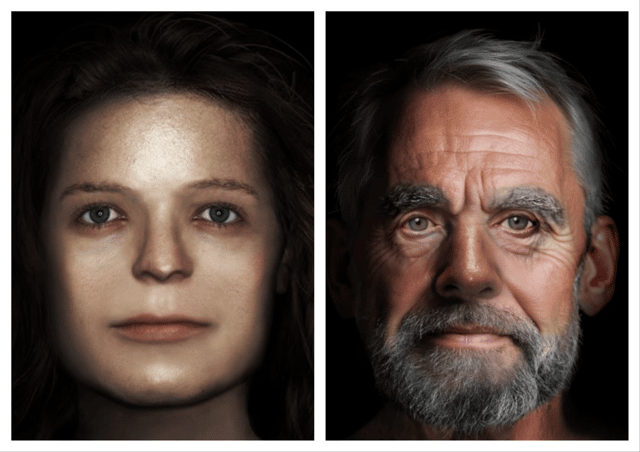
The faces of five of the residents are on show at St Giles’ in the exhibition Edinburgh’s First Burghers: Revealing the Lives and Hidden Faces of Edinburgh’s Medieval Citizens, which runs until November 30.
The Black Death is one of the most serious and deadly pandemics in history. It originated in Asia in 1346 and spread to Europe by fleas on rats living on trade ships.
The Black Death was a bubonic plague spread by rats in homes, villages and towns where hygiene was poor. If a flea that had bitten an infected rat jumped on to a person and bit them, it would transmit bubonic plague.
The most famous symptom of the bubonic plague were swellings under the armpits and on the groin, known as buboes. The plague had a mortality rate of approximately 50 per cent.
According to the National Library of Scotland, the first epidemic-level outbreaks of the plague in Scotland were recorded in 1349 to 1350 and again in 1362.
There are various estimates of how many people died during the Black Death, but a popular estimate is that 25 million people in Europe died during the outbreak.
Margaret Graham, Edinburgh City Council's culture and communities convener, said: "Thanks to this exciting new research, we've been able to get a closer insight into the lives of those who existed through such a notable chapter in our past.
"As an ancient city, we have such a rich history and the discovery of a young male who may have died during the Black Death is a hugely significant find.
"I've no doubt that we have so much left to uncover and our heritage and shared stories will be enhanced over time."
Comments
Want to join the conversation? Please or to comment on this article.