
'Extraordinary' altars from Roman temple in Scotland to go on show for first time

Remarkable find will form part of major new National Museum of Scotland exhibition
They once stood sentinel in one of the Roman Empire’s most northerly outposts, where members of a long-forgotten cult honoured an ancient deity in secretive rituals in an underground temple.
Now, after lying forgotten for nearly two millennia in the soil beneath an East Lothian park, an “extraordinary” archeological discovery which sheds new light on the Roman campaign in Scotland is set to go on display for the first time.
In what has been hailed as one of the finest examples of sculpture from Roman Britain, two altars which formed part of a temple dedicated to the Mithras, a divine guardian of covenants, oaths, truth, and light, have been acquired for the nation and painstakingly conserved by experts at the National Museum of Scotland (NMS).
The intricately crafted stones - the only such examples ever discovered in Scotland, and among the earliest found anywhere in Britain - were uncovered by chance during excavations at a cricket pavilion in Inveresk’s Lewisvale Park nearly 16 years ago.
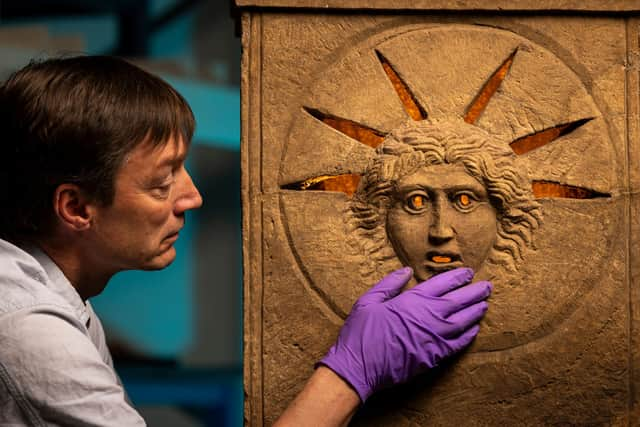

The altars date back to the 140s, a time when southern Scotland was reoccupied under Antoninus Pius, and reveal new details not just about the lives of the Roman soldiers on the frontier, but their belief systems.
Mithraism was a secretive, male-only religion which celebrated the triumph of good over evil and light over darkness. The altars would have been a striking focal point in the underground Mithraeum.
One altar honours Mirthras himself, and is adorned with carvings linked to the god Apollo, another god of light - a griffin, lyre and plectrum - as well as two ravens, which are often seen in Mithraic imagery.
Another found at the Inveresk site, south of Musselburgh, depicts the face of the sun god Sol and would have been illuminated from behind so that in the low light of the temple, worshippers would have seen his eyes, mouth and the rays of his solar crown glowing. It also features carvings of the four seasons - depicted as female deities - conveying the passage of time, another prominent theme within the cult of Mithras.
Dr Fraser Hunter, principal curator of prehistory and Roman archaeology at National Museums Scotland, said the artefacts told a unique story of Mithraism’s Roman adherents in Scotland.
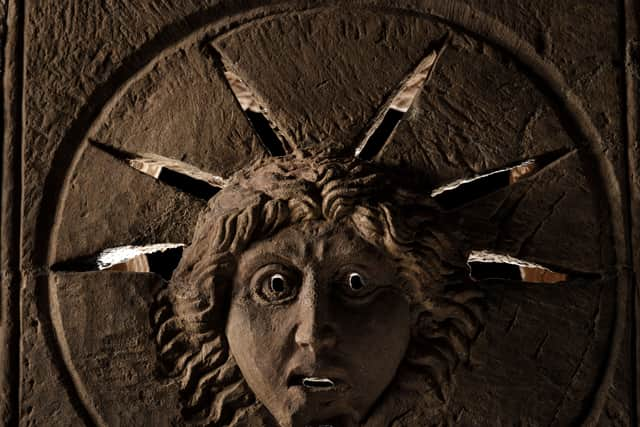
“These stunning altars really bring the beliefs of the Roman frontier to life,” he explained. “The quality of the carving, traces of paint and dramatic lighting effects show they were impressive and expensive monuments.
“The cult of Mithras represented the triumph of good over evil and gave soldiers a sense that there was a purpose to their world and a life after death. I’m sure visitors will be amazed by them when they can see them up close in our new exhibition.”
The altars had broken into fragments during their long burial and have undergone extensive conservation work to reconstruct them and prepare them for display. During the process, conservators identified traces of paint on the carvings, revealing that they would originally have been painted in vibrant colours.
The NMS said that both altars, which it acquired in 2016, were dedicated by a legionary centurion whose name was abbreviated on the altar as G CAS FLA, probably Gaius Cassius Flavianus. He is believed to have been in command of the fort garrison at the time.
While evidence for Mithras in Britannia mostly dates to the third century, the discovery of the earlier altars demonstrate that his cult was flourishing within the army by the middle of the second century, as it was on the continent.

For the first time, the major new exhibition, ‘Roman Scotland: Life on the Edge of Empire’, will explore in detail the attempts by the Romans to conquer Scotland, and address the common misconception that they never ventured beyond Hadrian’s Wall.
The famous landmark is often thought of as the northernmost reach of the Romans in Britain. However, their empire extended its reach much further north, up to Scotland’s central belt and deep into north-east Scotland.
The Antonine Wall was built across the narrowest part of Scotland from Forth to Clyde, with additional forts along the coasts to east and west. Inveresk was one of these, and grew to become a major centre with a substantial population.
A thriving town surrounded the military base at Inveresk. This bustling community, ranging from soldiers and their families to traders, craftworkers and enslaved people, will be brought to life in the exhibition. The NMS said locals in this occupied land had to interact with these invading groups, and the exhibition will paint a vivid picture of their relationships, from “bloodshed to diplomatic deals.”
Other finds from recent excavations have helped transform modern day archaeologists’ understanding of the site’s significance, and some of those artefacts will also be displayed together for the first time. The NMS said it would showcase how the “significant frontier outpost” was supplied from across the Roman Empire, and the impact on what communities across what is modern-day East Lothian.
“This rich exhibition is the first to explore Roman attempts to conquer Scotland in detail, asking why they failed, what effect they had on the locals, and examining the legacy they left behind,” Dr Hunter added. “The extraordinary material found at Inveresk sheds new light on the peak of Roman occupation in Scotland, taking visitors beyond the soldiers and into the lives of a vibrant and diverse frontier community.”
The exhibition, which will also bring together other unseen archaeological discoveries from Scotland, as well as “significant loans” from other European institutions, will run from 14 November through to 28 April next year.
Comments
Want to join the conversation? Please or to comment on this article.