
Restoration project landmark as 60,000 oysters returned to the Firth of Forth


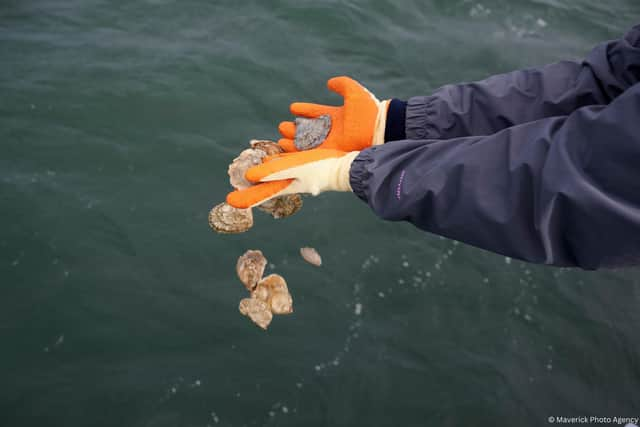
An award-winning project has introduced 60,000 oysters to the Firth of Forth.
It’s another milestone for Restoration Forth in its bid to bring back oyster beds to the waterway. They were once the size of Edinburgh, before being wiped out by over-fishing and pollution.
Teams of volunteers have worked hard over the past four years at locations including Burntisland Sands, Belhaven Bay, and Drum Sands to restore four hectares of seagrass meadows and European flat oyster beds in the Firth of Forth.
The recent addition of 14,080 more European Flat Oysters meant it has now doubled its original target - and monitoring shows they are thriving in their new home. They also play a valuable role by filtering water, storing carbon and providing shelter for countless marine species.
The Forth’s oyster beds were some of the most famous in Scotland over the 17th and 18th centuries. Oysters were significant for the economy and diet in the local Newhaven and Leith areas. The ‘Newhaven Fishwives’ would sell them around Edinburgh and were a prominent part of the community.
Some records show that nearly 30 million oysters were fished from the Firth of Forth annually, over a 10 year period. Unfortunately, overfishing and industrial development led to their local extinction.
Strict bio-security rules mean the new oysters have to be cleaned before moving somewhere new to avoid spreading any disease or introduced species. Near the end of last year monitoring by the Heriot-Watt University scientific dive team, as part of the Restoration Forth project, showed a high average survival rate of around 88% for the oysters deployed from boats.
Dr Naomi Kennon from Heriot Watt University said: “I’m over the moon to have reached the incredible milestone of 60,000 oysters now back in the Firth of Forth. After so many hundreds of hours scrubbing and cleaning them over recent years, it was pretty emotional. We are hopeful that they will thrive and grow, as those already deployed earlier in the project have been doing.
“Oysters are incredible underwater engineers: they filter water, store carbon and enhance biodiversity by providing shelter for countless marine species. We know we’re a long way off from the millions of oysters that once thrived here, but with promising survival rates we are showing the value of restoration work.”
The landmark was also welcomed by the volunteers at the heart of the project which is backed by a number of organisations, including Balanced Horizon, Edinburgh Shoreline, Fife Coast & Countryside Trust, Heriot-Watt University, Marine Conservation Society, Project Seagrass, Scottish Seabird Centre, The Ecology Centre, and WWF., and supported by the Scottish Government’s Nature Restoration Fund, managed by NatureScot.
Alice Caldwell, a volunteer, said: “I’m really grateful to have had the opportunity to take part in this amazing project.
“I’ve learned so much about the research behind it and have really enjoyed preparing the oysters for their new home in the Forth. The whole experience has filled me with a sense of optimism for the future of this vital species and for our precious marine environment.”
Comments
Want to join the conversation? Please or to comment on this article.