
Poll: Onshore wind farms backed by 77% of Scots, despite plans for 'Big Ben' size turbines

The polling, revealing public views on onshore wind farms in Scotland, is set to be published at the Labour party conference in Liverpool
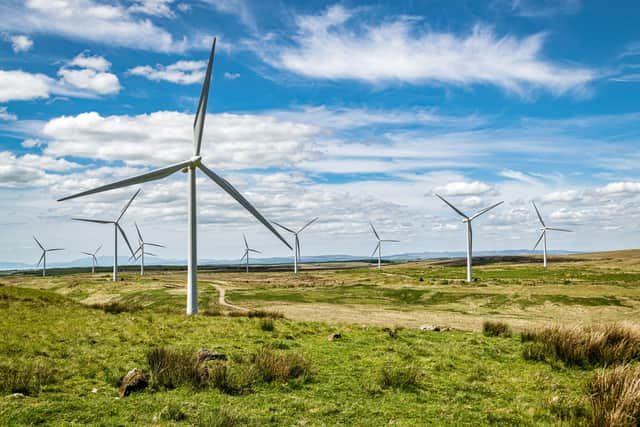
A new poll has showed an overwhelming backing for onshore wind farms, with more than three-quarters of people surveyed in Scotland supporting more development to hit the country’s net-zero targets.
The survey, carried out by the Diffley Partnership, showed support in Scotland for onshore wind farms outstripping opposition to them by 77 per cent to just 8 per cent. A further 12 per cent said they neither supported or opposed, and 4 per cent answered don’t know.
The poll also revealed backing for wind farms in local areas north of the Border, with 75 per cent of respondents either ‘strongly’ or ‘somewhat’ supportive compared to 8 per cent either ‘strongly’ or ‘somewhat’ against. Thirteen per cent were neither supportive nor opposed, and 3 per cent did not know.

And the survey indicated Scots view reducing dependence on imported power (55 per cent) as the greatest benefit from accelerated renewables investment, ahead of creating jobs (53 per cent) and lowering electricity bills (51 per cent).
Results from the poll, conducted on behalf of developer Fred. Olsen Renewables, will be published at the Labour party conference in Liverpool on Monday. A total of 1,012 people were surveyed across the UK during late July, including 523 in Scotland.
The polling results come despite significant local opposition recently registered against some of Scotland’s biggest wind farm projects.
Controversial plans to build the UK’s tallest wind farm on Royal Deeside drew more than 1,100 objections, with plans to build 16 massive turbines measuring up to 656ft - twice the height of Big Ben.
A proposal to build the eight-turbine Wull Muir Wind Farm in the Scottish Borders was separately rejected by the council in July on the grounds of significant landscape and visual impacts.
Under Sir Keir Starmer, the UK government has said it is committed to doubling onshore wind energy by 2030.
Megan Amundson, head of onshore wind and consenting at Scottish Renewables, said: “Not only is onshore wind the cheapest form of renewable energy, this polling shows that more than two-thirds of people across the UK want onshore wind farms to help deliver our clean energy future.
“Scotland’s onshore wind sector is already worth more than £3.4 billion to the Scottish economy and is supporting more than 12,000 jobs, so we are not surprised to see the polling show that an overwhelming majority of people support the continued deployment of clean power technologies like wind and solar.”
A Department for Energy Security and Net Zero spokesperson said: “These results show the strong support there is for making Britain a clean energy superpower – boosting our home-grown supply by radically increasing the deployment of renewables.
“Already we have swept away barriers to onshore wind farms, delivered the most successful renewables auction to date and consented more solar capacity since July than has been installed in the past year. We have also announced plans for Great British Energy, which will also unlock billions of private investment - delivering new energy projects, protecting billpayers and creating thousands of high-quality jobs.”
A Scottish Government spokesperson said: “Scotland's energy sector will play a crucial role in growing the economy and delivering on our net-zero targets. Our potential for renewable energy generation is one of our greatest environmental and economic opportunities.
“Our recently published Green Industrial Strategy and our Programme for Government both set out how we will take action to deliver our clean energy pipeline and its economic benefits.”
Scottish Greens co-leader Lorna Slater said: “The transition to the green economy is needed to protect our environment and climate, but it's also needed to secure the workers and communities that currently rely on fossil fuel industries.
"The world's changing and if we don't take action now, we risk seeing a repeat of the ‘80s when old industries disappeared without anything to replace them, creating many of the problems we still struggle with today.
"This poll shows that not only is transition environmentally and economically important, it's also popular. But it can't be restricted to wind. We must also look at Scotland's promising wave, tidal and solar industries, which risk falling behind under the SNP's current plans.
"All parties must take notice of polls like this and work to speed up our progress in developing the renewables and other green industries that will take Scotland into the rapidly emerging future."
Comments
Want to join the conversation? Please or to comment on this article.