
GB Energy to take Scandinavian inspiration to become power company amid renewable slowdown alarm
GB Energy bosses will learn lessons from Scandi success stories as they draw up plans to transform the flagship project into a publicly-owned power company.

The interim CEO of GB Energy has insisted the flagship UK government project will take inspiration from Scandinavian success stories as it presses ahead with becoming a publicly-owned power company with a “technology-focus”.
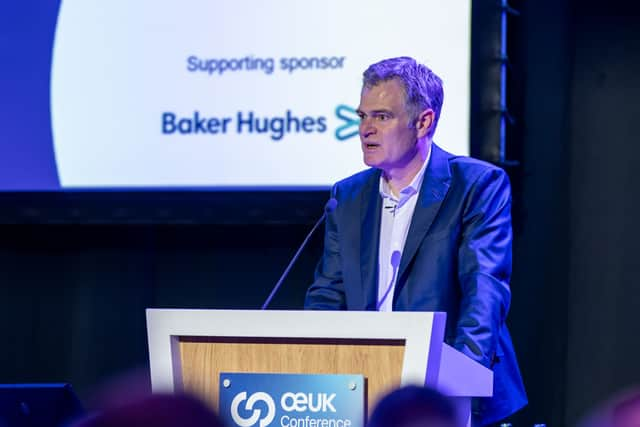
The message was delivered at Offshore Energies UK’s (OEUK) annual conference in Aberdeen, where delegates heard a warning that the ambition of renewable energy has not ramped up at the scale initially promised, alongside an “accelerated decline” of the oil and gas sector - blamed on government decisions.


Opening the conference, OEUK chief executive, David Whitehouse, warned that the UK was once again “a country relying on record levels of imported energy, slow economic growth, concerns over jobs”. But he added that “managed well, the North Sea is an important part of the solution”.
Labour urged to back homegrown energy
He said that the Labour UK government, which is poised to decide whether to follow through with an election vow to end new licensing, was making “the choice between a homegrown dividend over a dependency drain”.
READ MORE: Rosebank and other North Sea oil and gas fields could be given green light under new guidelines
READ MORE: Ed Miliband: We 'owe Scotland' over £200m Acorn project funds and 'unlimited' jobs potential
OEUK has long-warned that the position of Sir Keir Starmer’s government risks the UK having to rely on imported fuels to meet energy demand over the coming decades, while Labour ministers have pointed to scientists and the International Energy Agency warning that no new fossil fuel developments should be approved if global efforts to tackle the climate crisis are to remain intact.
Mr Whitehouse warned that “we are not seeing renewable projects being advanced at the speed originally envisaged”.
He added: “Last month, Orsted announced that the huge Hornsea 4 project would be discontinued in its current form. The speed of the UK’s critical floating wind ambition is under question.
“We are seeing an accelerated decline in one industry and slower build out in another. That risks undermining our supply chain companies who invest across the energy sector. That is economically harmful for industrial communities across the UK.”
The interim CEO of GB Energy, the public company set up by the Labour UK government to be headquartered in Aberdeen, Dan McGrail, highlighted “a number of positive announcements over the last few weeks” and stressed that the “mainstreaming of energy is a really important development over the last few years”.

But he warned: “At the same time, we’ve seen a steady drumbeat of job losses, not isolated to the oil and gas industry but to other industries in the energy sector.”
Mc McGrail, who is also the CEO of RenewableUK, insisted that “the green economy is growing fast”.
He said: “In the UK we are excellent at innovation and we are seeing that in the content of offshore wind. Sometimes we struggle with the alignment of the political and industrial elements to create the real long-term growth and mass commercialisation. That leads to jobs in manufacturing that go on to lead to further long-term employment.
GB Energy determined to mirror Scandi success
“Recent developments in the world have slowed the progress of that industry and have raised questions about some of the projects. There is a legitimate role for us as GB Energy to step into these places and use our role as the activist investor to stimulate that long-term economic vision and to stimulate confidence within the development community.”
READ MORE: Acorn carbon capture: Crunch talks as Scotland wind farm chiefs poised to wrestle over seabed
Amid criticism that GB Energy will simply be used to structure investment, Mr McGrail said he was adamant that “our ambition is to be an energy company”, adding that “we need to have technology-focus at our core”.
Mr McGrail pointed across the North Sea to successful state-owned companies in Norway, Sweden, Denmark and France as a measure of what could be achieved.
He said: “We need to look at some of the great examples of European state-owned energy companies - if you take Vattenfall or Statkraft in hydro, if you take Orsted it’s offshore wind or EDF it’s nuclear.
“We need to build a technology strategy - which isn’t just about one technology, it’s about a combination of technologies that meet that test of do we have high ambition for this country and our supply chains and do we have a need to step in with strong signalling from the public sector.”
Mr McGrail said that alongside floating offshore wind, “there are additional areas where we need to add to that portfolio” in the energy mix.
He added: “Over the coming weeks and months, we are going to be working and developing our first long-term strategic plan. Our intention is to develop that strategic plan collaboratively in a structured engagement.
“We want to work with partners, with industry at a national level, but also at a regional level - particularly with the Aberdeen business community, to make sure that the strategy we develop is as complimentary and as intertwined into the regional strategy of our home city. That is going to be absolutely key.
Workers ‘caught in crossfire’
“We do have an opportunity here to build a lasting British institution. We have an opportunity to reindustrialise large areas of the UK at the hands of the energy transition bringing jobs, growth and prosperity. And we have an opportunity to deliver change to our energy system that will make us more secure, more independent and give everyone a stake in the benefits of state-owned energy.”

Chris Cox, CEO of North Sea oil and gas giant, Serica Energy, told delegates that he found it “deeply frustrating” that workers’ futures “were being caught in the crossfire of opposing ideologies”, adding that “facts have a tendency to be ignored in the debate”.
He added: “The North Sea is a great success and it has been for a long time - and it’s paid a lot of tax and supported a lot of jobs.
“We just need to not have to work against insurmountable obstacles which we seem to have in front of us. The UK North Sea is not in terminal decline, it’s been a choice.”
Comments
Want to join the conversation? Please or to comment on this article.