
A different kind of harvest: Why growing hemp is an opportunity for Scottish farming


The question is not whether hemp can grow in Scotland., it’s whether the industry can build the support needed
Standing in Martin Cessford’s hemp field in Augus, it is hard not to look twice.
At this time of year, harvest across the Scottish landscape is usually a familiar sight: combines moving through fields of wheat, barley or oilseed rape.
Here, things look rather different. Dark green plants stretch tall across the field, with strong, dense stems and distinctive star-shaped leaves. Grown under an extremely strict industrial hemp licence, the variety being grown here is only suitable only for seed and fibre production.
I’ve come to see Martin’s crop with NFU Scotland, joining a group of farmers, crofters and consultants interested in what new crops and technologies could mean for the future of Scottish agriculture.
For Martin, this particular experiment has been years in the making. And despite the trials, setbacks and considerable learning along the way, he believes hemp could have a much bigger role to play in Scottish agriculture.

“It’s taken us six years to get here,” he says. “But I believe there is a real opportunity with this crop if we can get the right varieties and more people growing it.”
Now in his 70s, Martin is no stranger to trying something different. Alongside a mixed arable enterprise growing combinable crops, seed potatoes, carrots, beans and rhubarb, he has spent years exploring regenerative farming practices, developing a natural potato cyst nematode control agent and investing in renewable energy across the business.
He was, it seems, the perfect person to stumble into a conversation with representatives from the Rowett Institute in Aberdeen at the Royal Highland Show many years ago. Here, Wendy and Madie pitched him the idea of growing hemp.
Standing among the crop, I ask Martin about that first attempt.
“It was a complete waste of time,” he says, a slight sparkle in his eye. “I thought that was the end of it.”
But a degree of self-proclaimed stubbornness, along with the promise of new varieties, including hybrid types from America, persuaded him to try again.
The resulting sea of green in front of us speaks for itself, as does Martin’s eagerness to encourage other farmers to give it a go.
“Three years ago, compared with what we have now, it’s chalk and cheese. We’ve got so much more fibre and much better potential.”
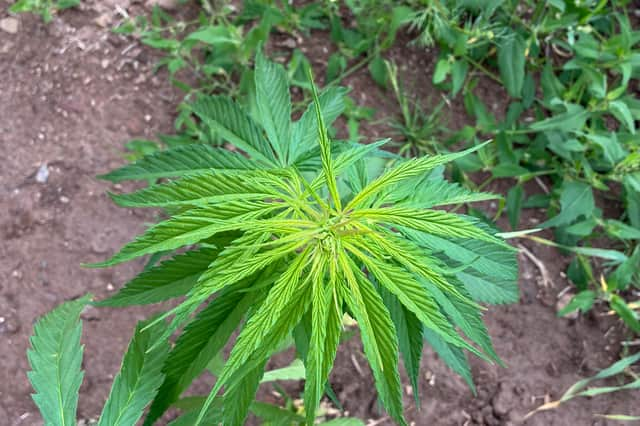
For Martin, part of the excitement surrounding hemp is not simply the quality of the crop. It’s that Scotland already has the infrastructure in place to support greater production. In the Scottish Borders IndiNature operates a processing facility with the capacity to process much more Scottish hemp than is currently being grown.
“At the moment they are importing hemp fibre because they need the product,”
Martin says. “We have a factory there waiting for Scottish production.”
Having farmed all his life, Martin knows that growing a crop is only one part of the chain. There needs to be somewhere to take it, someone willing to buy it and the infrastructure to turn it into something valuable.
One missing link in Scotland’s hemp supply chain is a decortication plant. “Currently this happens in England, where there are three plants, but having one here in Scotland would make the whole operation more efficient and completely standalone,” Martin says.
Once decorticated, hemp has a surprisingly long list of potential uses. The seeds can be cold-pressed into oil for human and animal consumption, while the remaining pressed cake can be processed into high-protein flour or livestock feed. The fibre has applications ranging from textiles and hempcrete to insulation, while samples have even been sent to Germany to explore use in vehicle dashboard manufacture.
Work is also taking place to understand how hemp fibre could be used in horticulture as an alternative to peat and coir.
Martin is also optimistic about what the crop could bring to the wider rotation. Trials on the farm have shown encouraging signs for soil health, including organic matter, soil structure and biological activity, as well as the performance of the crop that follows hemp.
“We’ve seen improvements in the soil microbiome, carbon capture and the crop that follows it,” he says. “It’s got a lot going for it.”
That is, of course, once the challenges that come with trialling something new are overcome. Hemp has a long growing season, requires specialist knowledge and comes with strict licensing requirements. In the early days, harvesting a plant with such strong fibre certainly left its mark on Martin’s combine, something he recalls with that same wry honesty.

But it does feel that the path has now been forged, particularly through the new varieties Martin and a handful of other Scottish farmers are now trialling. So far, it’s proving successful in creating the combination growers need: strong fibre production, easier harvesting and varieties capable of performing well in Scotland’s climate.
For Martin, the biggest question is no longer whether hemp can grow in Scotland. It’s whether the industry can build the support needed to make it a viable part of future rotations.
That means varieties suited to our climate, sensible regulation, reliable markets and enough growers to give processors confidence in Scottish supply.
And as Scottish farmers and crofters look to build more resilient and profitable businesses, perhaps that is a question worth asking more widely: what else could we be growing?
It is also why bringing farmers and crofters together to see new ideas working on the ground matters. Agriculture can be an isolating business, and some of the most useful learning comes from seeing something working on another farm while standing next to the farmer who grew it.
Looking out over a crop that was once little more than an experiment and is now approaching harvest, the possibility certainly feels considerably less theoretical than it once did.
“We’ve got the crop, we’ve got the factory and we’ve got the demand,” Martin concludes. “The opportunity is there. We just need to make sure we don’t miss it.”
Megan Williams is editor of Scottish Farming Leader, NFU Scotland’s membership magazine
Interested in growing hemp? Get in touch with NFU Scotland to find out more about the opportunities and support available.
Comments
Want to join the conversation? Please or to comment on this article.