
Elsa McTaggart: We’ve definitely got great stubbornness in our family tree
Not many people who grew up in Scotland in the 1980s can claim to have had a similar childhood to their great grandfather’s Scottish upbringing in the 1840s


When Elsa McTaggart started primary school in 1981, she would get into trouble with the teachers for playing with light switches.
Her family home had no electricity so they were a novelty to her, and she would switch them on and off constantly. “And I got into trouble for not flushing the toilet because the sound terrified me so much,” she adds, smiling at the memory.
Her parents’ house, on a hillside smallholding near Aberfeldy, had no mains water supply either; there was a chemical toilet outside.
“All of our water came from a spring just up the hill, so my dad was responsible for piping it down and into the house,” she recalls. “We’d often get frogs and tadpoles and all sorts of things in the line.” Encountering a noisy toilet flush for the first time, young Elsa “was convinced I was going to get swallowed”.
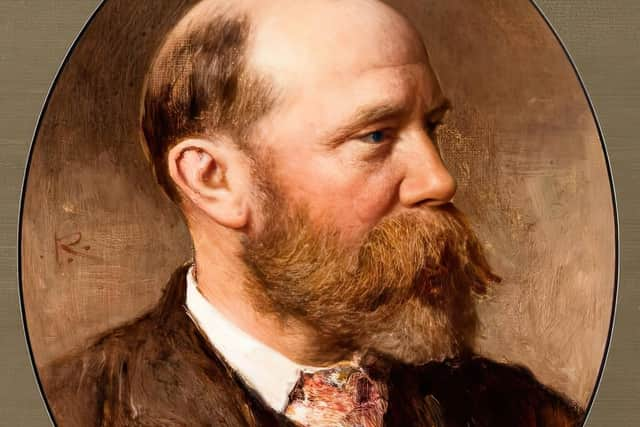
She had started school at the age of four because, she remembers, “my mum decided I was a bit feral. Kate and Irene, the house goats, were my best friends, and she thought that probably I ought to have some more human contact.” Not many people who grew up in Scotland in the 1980s can claim to have had a similar childhood to their great grandfather’s Scottish upbringing in the 1840s. But this is one of the remarkable parallels explored in Capturing the Light, a solo show McTaggart has written about her famous ancestor, the artist William McTaggart.
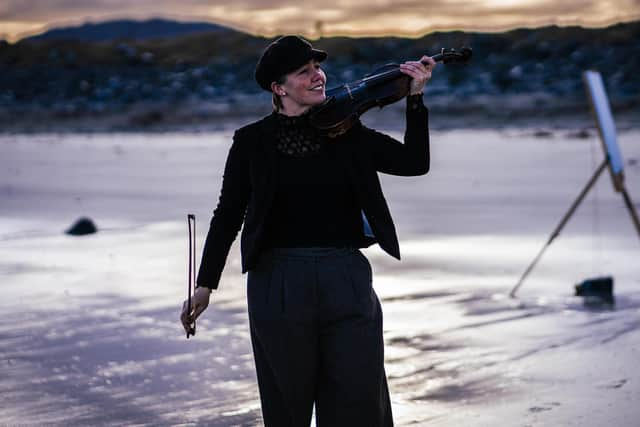
A full-time working musician for almost 30 years, she has been wanting to tell William McTaggart’s story on stage for most of that time. Finally, Capturing the Light is about to make its debut in the Isle of Lewis, where she now lives, followed by a three-week run at the Edinburgh Fringe as part of the Made in Scotland programme.

“As a musician and a performer myself, I think his legacy was in breaking down the fourth wall between himself and those who looked at his paintings,” she says of her great-grandfather’s work. “He was sort of on a quest to make it immersive. When you look at many of his paintings, you feel like you can walk into them. You feel the wind and the atmosphere and the kind of day it is.”
Is it an exaggeration to say these two McTaggarts, born over 140 years apart, had similar childhoods? In some ways, extraordinarily, it is not. William McTaggart grew up to become one of Scotland’s most celebrated painters, known as the “Scottish Impressionist” for his colourful landscapes, now in national collections. But he was born into a family of Gaelic speaking crofters in Aros, a village in Kintyre, far from the centre of the Scottish art world. “He thought he’d invented art when he was young,” says his great granddaughter.
“So he'd possibly never seen paintings. I think he thought he'd invented portraiture, you know, that he could draw people on a slate and you could recognise them.” This mirrors one of her own childhood memories, of seeing a blank sheet of white paper for the first time at school and marvelling at it. “I just couldn't get over how smooth it was and how white it was,” she recalls.
“We got the lumpy wallpaper, with the bits of wood in it.” She searches for the right word for a moment before remembering. “Woodchip.”
“The similarities are amazing,” observes McTaggart as parallels like this continue to emerge during our conversation. William was the third of eight children; Elsa is the fifth of 11.
“He grew up with both his parents on the croft, pretty much self-sufficient.” Some of her own earliest childhood memories, she says, “are of working, helping my dad - not that I was really helping! - with the horse and cart to plough and work the land.”
Sometimes the family would travel to church on Sunday by horse and cart. “My mum loved it, it took her years to realise that some people felt sorry for us, you know, living this backward lifestyle. She was always going down into the valley, thinking, ‘what a shame they can’t experience what we have, we've got this incredible view and this beautiful mountainside surrounded by animals and children.’”
The details of William McTaggart’s early life are important because, his great granddaughter says, they shaped the artist he ultimately became, a determined and resourceful man with a work ethic forged during a rural upbringing. “We've definitely got great stubbornness in our family tree. For him to survive in the art world on next to nothing for as long as he had to, it wasn't a huge deal for him.
He was never going to have less than he had, unless he died of starvation.” He remained devoted to his family and his roots throughout his life. “I think he said somewhere, ‘Remember that an artist must first be a man, and then use his talents as best he can for his fellows.’ He would say this to students. He was so proud of being Scottish, he never wanted to go anywhere else.
And he never wanted his art, particularly, to go anywhere else. In his mind it was for his countrymen.” William McTaggart’s art may never have gone anywhere at all, had it not been for a Glasgow apothecary called Dr John Buchanan. At the age of 12, the boy from the croft became Buchanan’s apprentice, a relationship that changed his life. “One of the most incredible parts of the story is that William was supposed to be a chemist, and yet once the chemist realised that he was very good at art, he just decided to put all his services at William’s behest,” says McTaggart.
“He took him to art exhibitions. He took him on his rounds to see paintings in the big houses. He gave him free use of his library. So, William just continued to learn history and literature and poetry and art, but the chemist also got lots of portraiture work for William amongst all his highfalutin friends, which obviously motivated William and gave him money to put aside for his own savings. Because then I think all his wages went to help the family keep the bailiff from the door. I don't think his dad's wage was ever enough.”
This last detail illustrates a crucial difference between Elsa McTaggart’s childhood and her great grandfather’s. William grew up during the Highland Clearances; his parents soon lost their croft to large scale farming and had to move to Campbeltown for work. Over a century later, Elsa’s parents, Joe and Susan, were on a mission to revive a tradition of self-sufficiency that had been largely destroyed by landlords. Some aspects of their journey are the reverse of William’s.
Aged 16, William moved to Edinburgh to be an artist. Joe and Susan met at Edinburgh College of Art but later left the city in search of a simpler life.
“I believe they were heading to the islands, but they just didn't get that far. My great aunts lent them the money to buy a smallholding overlooking Tay Valley that hadn't been lived in for years.”
William McTaggart’s legacy was a constant presence in her childhood. “We were always aware of his art. For as long as I remember I'd seen his paintings, and it was a common topic of conversation.
Family gatherings would often be around William McTaggart themes, I remember one coincided with a large exhibition in 1989 at the National Gallery. That was a good excuse for the family to come from far and wide, to meet up and to view all the paintings.”
Elsa, though, would take a different creative direction. “My mum always sang, that was a constant. She knows so many folk songs, every weird, wonderful song, back to about the 12th century!” she laughs. “She has no idea where she learned them.”
Elsa’s grandmother on her father’s side was a pianist and mathematician (“She had seven boys and she taught them all the scales”) and Joe enjoyed musical instruments that gradually got passed on to his children. “I remember my brother Malcolm got himself violins and chanters at auctions. Often, he bought them in pieces, fixed them and put them together, and then learned to play them. Music was just like toys. We had a piano, I think there was an accordion, there were guitars lying around. We all got recorders at school. I was never without a mouth organ.
“When I was on the horses, I would just be out on the moor, tootling away, happily so. But I didn't realise until I left home that I couldn't be without an instrument. That's when I realised that, oh, I must like music. I think I was 19 when I realised that’s all I wanted to do.” She describes her life since then as “this weird and wonderful, unplanned journey”, eventually studying a Masters in Irish traditional music in Limerick and playing trad sessions in Scotland, Wales, Ireland and Gran Canaria, where she still travels once a year with musical partner Gary Lister, her husband since 2011.
Every August Elsa and Gary take up residence at theSpace venue in Edinburgh, where they are - true to McTaggart family tradition - among the hardest working acts at the Fringe, performing multiple shows each day to a loyal, often sold-out audience. Capturing The Light is one of three this year.
They will also perform Caledonia, a long-running celebration of Scottish folk and Celtic music, and #SHORN, a new show about “shedding the old and embracing the new” inspired by Elsa’s impulsive decision to shave her head last September. Previous Fringe hits include two tributes to singer-songwriter Eva Cassidy as well as The McTaggart Sisters, a collaboration with Elsa’s younger sister Irenie Rose, also a singer-songwriter. After 15 years though, this may be McTaggart’s final full run at the Fringe. “I find it so stressful.
Your income is on the line every time and it takes up the whole year in my mind, preparing, and then you need another month or two to process it after, because it's such a rat race and a boot camp. On the positive side, you meet everyone again like a big family reunion, see these incredible shows and you're just blown away by the human mind in all its variations. It's very good for making me focus and brings up new concepts and new ideas and new shows.” But she is also keen to spend more time in the Isle of Lewis.
A few years ago, she and Gary bought a run-down cottage on the west side of the island. The years since have sometimes been challenging. As full-time touring musicians, they were instantly deprived of their entire income by Covid-19 lockdown, surviving as best they could by creating online content while turning their new house into a home. They’re currently in the midst of building a fence, with a view to adding animals to the croft, impossible in the past because of travelling commitments.
It was partly the Hebridean preservation of crofting tradition, she says, that drew her to Lewis. “What makes this island so precious is that you still have a window to the past,” she says. Her own family history was also a significant factor. In later life Joe and Susan lived in Arnol, a village not far from where Elsa lives now. This brings up another parallel between generations of McTaggarts, but it’s a heartbreaking one.
William McTaggart, who famously loved Scotland’s coastlines and fishermen and painted them often, lost one of his sons to the sea. He was 26 when his own father died. Elsa was 30 when, in 2007, her father Joe and youngest brother Daniel were on a canoe just off the Lewis coastline and were hit by a freak wave. Both drowned. Daniel was just 12, around the same age William was when he began that life-changing apprenticeship.
“I wonder if there's similarities between William and my youngest brother,” says McTaggart. “He was full of ideas and very mischievous, and yet always ended up kind of leading the pack. He was in a class with all his nephews but even in the village he just seemed to attract people around him to get involved in his projects.
“I think he was great fun. Despite getting up to all these things - fights and mischief - there was never any badness or malice in it.” Daniel, even in his short life, sounds like another remarkable member of the McTaggart clan. The qualities his sister describes certainly mirror those of William McTaggart - charisma, creativity and determination but also decency and devotion to family. His sister’s decision to move to Lewis, it is clear, is deeply rooted in that legacy.
“What inspires me, because it’s what I appreciate so much, is that William never really went for his career,” she says. “I get the feeling that he stoically believed, if he worked hard enough at his craft, he would make enough to provide for his family. And therefore he could do whatever he wanted. You know, if he wanted to be an artist, as long as he had his priorities right and worked hard, it would work itself out.”
Elsa McTaggart: Capturing the Light is at An Lanntair in Stornoway, Saturday 13 June, and Big at theSpace Triplex (Venue 38), Edinburgh, for 12 performances between 7 and 18 August, as part of the Made in Scotland showcase.
Comments
Want to join the conversation? Please or to comment on this article.