
Dance legend Carlos Acosta brings Havana heat to wintry Scotland
The ballet star talks about Nutcracker in Havana, his company of young Cubans dancing their way to a better life and navigating being a father of three girls
If ever a respite from the Scottish winter was needed, it’s now, and global ballet star Carlos Acosta’s unique take on The Nutcracker serves us a slice of Caribbean sunshine, rhythms and music. Tchaikovsky’s score is given a Latin makeover and ballet, contemporary dance and Cuban dance styles are fused in a unique celebration that will transport audiences to a sizzling hot Havana.
Created by the titan of the dance world, Nutcracker in Havana is set in the Cuban capital in the 1950s and is performed by Acosta’s own dance company, Acosta Danza, in Scotland this month and next.
“When it's very cold here, it’s sunny in Havana,” says Acosta. “You see the landscape, the tropics and the colourful production. You're gonna get a laugh and it's great dancing. It's very unique. There are the Cuban rhythms and dances, cha-cha-cha, mambo, calypso and salsa, ballet, contemporary, Tchaikovsky, Havana - you’ll have an amazing time.”


Born in Havana in 1973 in humble circumstances, after training at the Cuban National Ballet School and winning awards including the Prix de Lausanne in 1990, Acosta went on to dance with the world’s biggest companies, including The Royal Ballet, performing classic roles from Spartacus to Romeo. The creator of award-winning shows including Tocororo and choreographer of Royal Ballet productions of Don Quixote and Carmen, as well as a West End production of Guys and Dolls, he has also written a novel, Pig’s Foot, and an autobiography, No Way Home. Awarded a CBE in 2014, after retiring he set up his own dance company, Acosta Danza in 2016 and the following year the Acosta Dance Academy in Havana. In January 2020 he became Director of Birmingham Royal Ballet.
Nutcracker in Havana is the sum of parts that make up Acosta, raised in classical ballet, but Cuban to his roots. With Christmas banned in the country in 1969 and lifted in 1997 ahead of Pope John Paul II’s visit, it was not celebrated in his home when Acosta was growing up and he did not experience the traditions of the season until he began to dance abroad in his twenties.
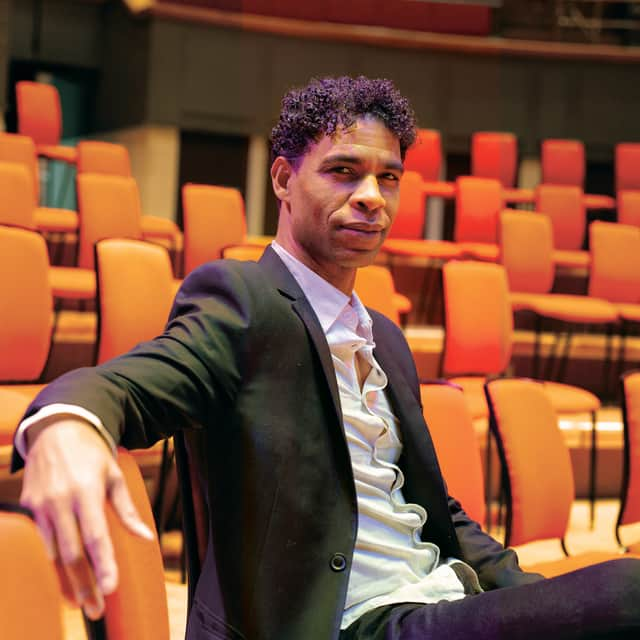
“Religion was kind of taboo growing up and with religion gone, all those traditions disappeared. The Nutcracker is a very popular show but something we didn't grow up with. When I first arrived, at the age of 20, in Houston, Texas, that's when I knew for the first time the magic of Christmas, Rudolf the reindeer and the tree in the middle of the living room and how people come and celebrate. So I wanted to bring as much as possible what the Cuban Christmas would feel and look like and in many ways, give my country the Christmas we never had.
“There are many versions and it’s very much a Eurocentric show set in a big mansion, so I wanted to do my own take on it going the opposite way. I based it in Cuba, and brought in my upbringing which was very humble, using elements I remember from my childhood, an everyday Cuban family and neighbours celebrating in a very humble environment.”
Nina Dunn’s set design has a very Cuban classic car - a ‘57 Corvette - there are wooden sandals, a forest of palm trees, an uncle returning from Miami to Havana to find his birthplace, the Nutcracker doll is a Cuban soldier who fought against the Spanish in the Cuban War of Independence, there’s a wheelbarrow and a tree decorated with discarded drink cans.
“My home was decorated with a lot of empty, luminous beer cans and Coca-Cola cans, anything you could find,” says Acosta.

“So this Nutcracker is distinct because the choreography for the Acosta Danza Company is distinct, a fusion of classic ballet and contemporary and Afro-Cuban rhythms and forms, where dancers break into a conga or start to do folkloric movements.
“We worked with composer Pepe Gavilondo Peón who reworked the orchestration and hired musicians to record the music from scratch in a school in Havana. You will hear Tchaikovsky with Cuban and Latin rhythms, salsa, calypso, ch-cha-cha, and sometimes jazz. You recognize Tchaikovsky's melodies, like the Arabian and Russian dances and the Waltz of the Flowers, but the brass instruments give them a Cuban sound. One of the stars of this show is for sure the music.”
Acosta’s enthusiasm and passion for music and dance is infectious and as someone whose life has been transformed by it, he is evangelical about the power of dance for all.
“I think dance is one of the most natural things that come to us. It's all in your body and your body is your greatest possession. Since the beginning of time it is what we did. We have been dancing since we existed, we've danced for the rain, for the god of fertility, for the environment around us.”

“People seem to think dance is for those who are professionally trained, which is a huge mistake. You can dance for many, many reasons. The stage is one thing, but there’s also dance as a way of being socially active and connected with your neighbours, coming together and doing some dancing and having wine, like a pastime. It's one of the most natural things we have. And I think we should exercise it even more.
“We don't need to be perfect. You just need a body and you give it to others and just listen to the music because dance should be an extension of the music. For your spirit, it's like balsam, oil for your soul. I always encourage people to keep dancing as a way of releasing endorphins and connecting with others.”
Inspiring as this is, if you want to see talented dancers who know what they’re doing giving it their all, Acosta Danza are the ones to watch.

“Every dancer in Acosta Danza has come through our academy. We bring them from the poorest districts in Havana at the age of 15, give them the education, everything, then after three years, they can come into the company. It's a really wonderful and rewarding process to see them all when they came as little kids and now blossom.”
With Acosta’s ability to attract top choreographers from all over the world to work with both the Birmingham Royal Ballet and Acosta Danza in Havana and London, the dancers have opportunities to travel and perform internationally, at venues such as Sadler’s Wells and the Kennedy Center in Washington, and are highly motivated.
“It inspires them, knowing that they invest in the artistry, but also that the company is going to take them to a higher level and broaden their horizons by touring in different countries. This is an environment where they constantly keep learning new things and develop.

“Obviously, you need to be focused, you need to work very hard, but if you are an ambitious dancer, the message in Acosta Danza is that you can race all the way to the top, and also have the benefit of having a great career and a great life.”
“These dancers are so full of life. They are so inspired by having the chance to perform in other countries, for example now coming to Scotland. This is not a job for them, they do it out of love and passion. They're very young, in their early twenties, and full of light.
“I wanted to create a company like no other, one people can recognise as Acosta, that has a solid style and mark. And I came from the perspective that if you really want to be original, the best thing that you can offer is yourself.
“In this case, it's us as a nation. Cuba is a very rich nation. There are a lot of rhythms and cultures that have collided for centuries in this island and as a consequence it is a melting pot of races and culture. I wanted to put that at the forefront of this company. Rather than have it all contemporary or classical, I wanted to fuse a cohesive language as a symbol of who we are which is a very eclectic fusion. We are an ambassador of Cuba.”
At 52, looking back over his career, Acosta struggles to choose highlights from a career of highs.
“There are many,” he says. “To be invited to perform as part of the Bolshoi, that was definitely one of my highlights, to be with a big important company like that.”
Acosta performed with the Bolshoi Ballet many times, with his time in the title role of Spartacus earning praise for his combination of athleticism and emotional depth.

“Being at the Paris Opera Ballet, where I performed the [Rudolf] Nureyev version of Don Quixote and La Bayadere… and also when I did my very first choreography, Tocororo: A Cuban Tale.”
Tocororo saw him blend classical ballet with Cuban dance and music as he led 16 dancers to a hit and a Laurence Olivier Award when it was first staged at Sadler’s Wells in 2003.
“With Tocororo I managed to bring my family over to London for the first time, and we were all living in my flat in London and it was really fantastic to share that experience with my dad, my mother, my sister.”
“Also when I did my very first Romeo and Juliet at the Royal Opera House in London…”
In 2006 Acosta was The Royal Ballet’s first black Romeo.
“I never thought I could play Romeo,” he says. “I always thought royalty roles were not for me. But I managed to perform it for the first time and that was recorded on DVD. I’m very proud of it, with my afro hair, and that was Romeo, so it was a really good feeling.”
“So it's hard to choose one, but these all played a big role in my self-esteem and in me going forward and keeping dreaming higher dreams. Like when I wrote my autobiography that I spent ten years writing, when I published it… Then five years later I managed to publish my novel and those were highlights in my career.”
All this and in his personal life, becoming a father of three daughters with his wife Charlotte and life at their home in Somerset, is something of which he is hugely proud.
“Now my eldest is about to become 14 and wants to go on the stage or do musical theatre. She is very good at drama and has a really great stage presence. But just being a father, just to give them advice in life and try to just see the process of being a teenager and all the insecurities you have. It’s a route to knowing who she really is. That route begins now. Who am I, you know? I think it's just great to give them advice and tell them that we all have done it, that you need to get up and take one day at a time, do your best. Our youngest ones are twins, nine years old, and we don't know what they're going to be doing yet. So all of that is new for me as well and it's just fantastic.”

Acosta is well placed to give career advice to his daughter and it’s something the young dancers in Acosta Danza also benefit from with his decades of experience performing on the world stage. When it comes to performance, what does he consider the more important element to possess, talent or dedication?
“There is this saying, ‘where there is a will, there is a way’. If you really want something and have ambition, if you work hard, you don't have to be the best, the most talented, because I think endurance and perseverance will get you further than you can imagine. You could have a particular skill that god’s given you that sets you apart, but even if you are not the top, you still have an incredible chance to do unimaginable things if you really work and you really want. I think the most important thing is to get out, be present, work very hard, and things will happen.”
With tension increasing in Latin America since the US raid on Venezuela and US President Donald Trump turning his attention to Cuba, Acosta has concerns about his homeland.
“We all are concerned,” he says. “I'm trying to help Acosta Danza and the Cuban dancers by keeping them distracted by doing wonderful art. A very important part of Cuba is culture and art and what I can do is to help my company and by helping them, their families, and just keep them from harm's way. They’re doing wonderful things and that is my contribution. I think we are all following the developments, we're very concerned, of course, the whole world is very concerned and we will see what will happen, but I think the best way is to keep this group of Cubans away from harm.”

Acosta is living proof of dance as a lifeline, his father pushing him into a rigorous routine of ballet study when he was just nine years old in a bid to keep him out of trouble. What does Acosta think he would be doing now if he hadn’t become a dancer?
“Yeah, well, that's a big unknown, because remember that I had a life of petty crime and growing up in Cuba maybe I would have become a delinquent, you never know. Ballet for me was salvation from the streets. And it happened because my stubborn father pushed me and sometimes even beat me up, forced me away from the crowds and away from the streets.
“But if I didn't have a father like that, or an influence to really drag me by the hand and say this is what you're gonna be doing no questions asked, then if you look at a lot of my friends who grew up with me, some are abroad, some are dead. You don’t know, it's a big unknown.”
What is known is that Acosta doesn’t have too much time to sit and think about the past as 2026 will see Birmingham Royal Ballet performing Don Quixote around the UK and he’s about to travel to Dubai where Acosta Danza are due to perform, and he is working on his version of Carmen for Acosta Danza. In a career of many highlights, Acosta is always looking to the future.
Nutcracker in Havana is at Eden Court Inverness 20-21 January and Festival Theatre Edinburgh 3-4 February.
Comments
Want to join the conversation? Please or to comment on this article.