
Exclusive:Crown Office chief warns of Scottish politicians 'undermining rule of law' over Palestine Action protests
Senior prosecutor says service will ‘take a bit of time’ to assess cases.


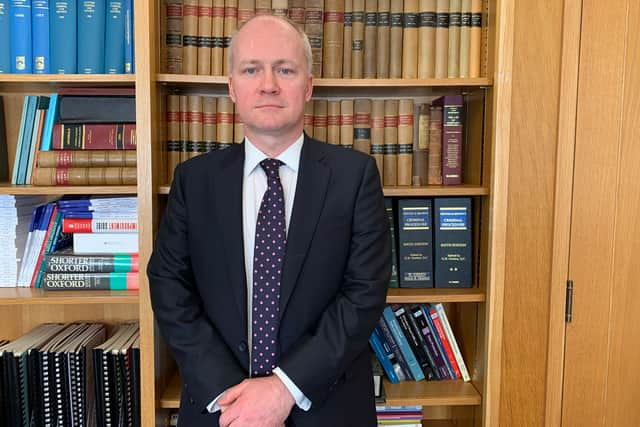
The chief executive of the Crown Office and Procurator Fiscal Service has warned the authority’s independence risks being undermined by politicians who have called for contentious terrorism legislation not to be enforced.
Crown Agent John Logue, one of Scotland’s most experienced prosecutors, stressed that people were still able to protest the events in Gaza.
He said his staff were determined to uphold criminal law while protecting the legally protected right of people to take part in demonstrations concerning Palestine and Israel.
In an exclusive interview with The Scotsman, Mr Logue said it was “perfectly proper” for people to debate whether the UK government was right or not to proscribe the Palestine Action group under the Terrorism Act 2000. And he vehemently rejected suggestions that laws were being applied differently according to the causes of protests.
As the principal legal advisor on prosecution matters to Lord Advocate Dorothy Bain KC, the issue of how to prosecute protest-related offences has become an increasingly high-profile part of Mr Logue’s work in recent weeks.

Amid a backdrop of demonstrations spanning issues such as abortion, climate change and immigration, the decision by Home Secretary Yvette Coope to proscribe Palestine Action has come under fierce scrutiny.
The Scottish Human Rights Commission and Amnesty International are among those organisations to have voiced concern over how the legislation is being enforced, warning there is no public interest in prosecuting people who are not inciting violence.
‘It does not prevent discussion or protest’
With Palestine-related protests ongoing, Mr Logue said the Crown Office shared those groups’ understanding of the importance of human rights, and pointed out that “broader public messages” around the role of prosecutors must not get lost within the debate around the proscription.
He said: “The fundamental point is that what the government has done in legislating to proscribe Palestine Action does not prevent protest in relation to what is happening in Gaza, and it does not prevent discussion or protest about the issues that people who were in Palestine Action were motivated by. Those things are still legitimate and can be subject of public discussion, protest, and debate.
“Debating whether the government was right or not to proscribe Palestine Action is not something I’m going to get into, but for others, it is a legitimate point. People can debate that without breaching the legislation.”
At present, the Crown Office is dealing with around 12 to 20 protest-related cases relating to the proscription of Palestine Action. “We are working through these cases quite carefully,” Mr Logue explained. “We recognise that we need to consider all of the facts and circumstances, and we’re taking a bit of time to ensure that we get the decisions right and that we’ve reviewed the evidence.”
Since the proscription was made, one person has appeared in court on petition on charges under section 12 (1a) of the Terrorism Act 2000. There has been no court activity to date for any reports made under section 13 of the legislation, which covers the wearing of clothing.
Some commentators have claimed the approach in Scotland differs to that taken by the Crown Prosecution Service, which as of last week, had authorised charges against 67 individuals under section 13 of the Act. But Mr Logue cautioned against drawing comparisons with English criminal procedure.
He said: “The police have much wider powers in England and Wales to begin what are essentially criminal proceedings, but in Scotland, that sits with us as prosecutors. It’s a different system, and prosecutors in Scotland also have a broader range of options available to them. The other factor is that the scale of what the police have had to respond to in England and Wales is very different to what has been seen in Scotland.”
Sense of ‘consistency’ around cases
As part of the Crown Office’s response to the proscription, cases involving Palestine Action are being reported to a specialist prosecutor overseen by senior prosecutors. “Our prosecutors know their way around the terrorism legislation, they’ve applied it before and had cases in court, and what we’re trying to achieve is a sense of consistency,” Mr Logue said.
That combined expertise will likely face significant tests in the near future. The Defend Our Juries campaign group is planning what it describes as the first “mass action” protest in Scotland in defiance of the proscription. Organisers said those in attendance outside a UK government building in Edinburgh this Saturday will hold signs stating ‘I oppose genocide. I support Palestine Action’.
Asked if he was concerned the heightened criticism of the proscription’s legitimacy could impact on the legitimacy of the Crown Office and the wider criminal justice system, Mr Logue said: “We recognise there is a debate, and it is not a breach of the terrorism legislation to have that debate, it’s perfectly proper.
“But I am concerned that the debate about what has been done does begin to impact on the perception of how the law is enforced. That’s why it’s important to make it as clear as we can to the public that we have to enforce the law, and that enforcement can look different on a case-to-case basis.”
Ross Greer MSP, the newly elected co-leader of the Scottish Greens, has spoken out over the proscription, condemning it as a “sinister attempt to silence dissent”. He has called on First Minister John Swinney to explore legal mechanisms to stop prosecutions.
‘That is the very definition of undermining the rule of law’
However, Mr Logue said: “There have been some politicians who have called for legislation not to be enforced, and to my mind that is unhelpful, because that risks creating the impression that prosecutors are not independent, and that they do what politicians ask them to do. That’s not what we do, and I have some difficulty with politicians calling for a law enacted by elected politicians not to be enforced. That, to me, is the very definition of undermining the rule of law.”
SNP MSP, Humza Yousaf, a former first minister and justice secretary, also questioned the approach of authorities. In a video shared on X last week, he said people could be charged under terror laws for holding a sign reading ‘We are all Palestine Action’. But he claimed they would not be charged under those laws for brandishing a sign stating ‘Kill ‘em all, let God sort ‘em out’, which was visible during an anti-immigration demo in Falkirk.
But Mr Logue said it was critical the public had confidence that police and prosecutors did not distinguish between causes that were the subject of protests.
He explained: “We’re applying the same criminal law in the same way to all protests, and we’re protecting the same human rights in every protest. But because of the proscription of Palestine Action, different laws have to be applied in cases.
“I do have a concern that politicians who may perhaps understandably feel a natural affinity to one of the underlying causes for the protests, in seeking to try and argue or persuade in a public forum that police and prosecutors should be taking a particular approach, I worry that inadvertently, what they are doing is creating the impression that there is a different way of the law being applied to different circumstances. It is not.”