
Birds learn language like babies, Scots researchers say


Both humans and songbirds pass on their communication through culture, study finds
It has long been cherished as a pleasant and harmonious sound in nature, but researchers at a leading Scottish university have identified a clear structure to some complex birdsongs which use the same mathematical formula found in human speech.
Academics at the University of Edinburgh and their international peers in Japan and Israel said the previously undetected structure in songs of Bengalese fiches share statistical patterns found in human languages.
The trait, the researchers said, has been developed over time, helping the birds to pass on the complex song information to subsequent generations.
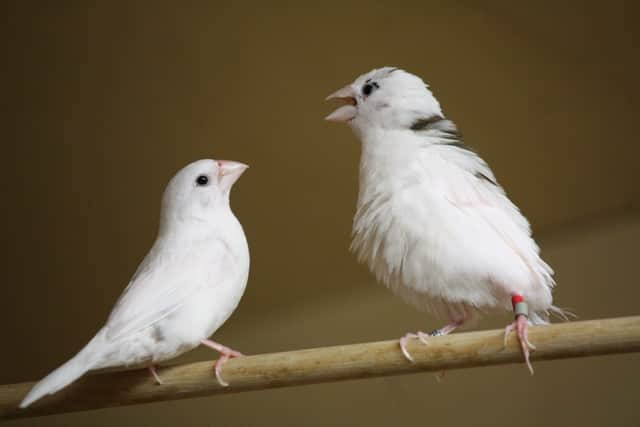
While language has long been considered a uniquely human trait, with features that mark it out as distinct from the communication of all other species, the findings suggest that some of language's fundamental building blocks may not be uniquely human after all.
The team, led by researchers from the University of Edinburgh, the Hebrew University of Jerusalem and Teikyo University in Japan used methods inspired by how babies discover words in speech, and applied them to song data collected from the finches in Japan.
The team observed the finch songs contained statistically coherent note sequences, the avian equivalent of words, with the same patterns observed in human language, where a few words are used very frequently and others are used more rarely, known as a Zipfian distribution.
Data was collected across the various stages of development of the birds and the patterns were already found to be present during the birds' earliest attempts at singing, suggesting they emerge naturally as part of the learning process.
The young songbirds listen to the sounds around them to unconsciously learn statistical patterns of sounds and organise their songs, similar to how babies figure out where one word ends and the next begins by recognising which sounds frequently occur together, according to the study, published in the journal, Science Advances.

This statistical process is thought to make language easier to learn, helping infants identify recurring chunks of speech within the continuous stream of sounds they hear daily.
Recently, the lead researchers of this study, together with Dr Ellen Garland from the University of St Andrews, found similar statistical patterns in the songs of humpback whales.
Professor Simon Kirby from the University of Edinburgh’s school of philosophy, psychology and language sciences, who co-led the research said: “We have become used to the idea that language is unique in the natural world. But by using insights from how babies learn language we’ve been able to take a closer look at birdsong, and have discovered a surprising commonality between these species separated by more than 300 million years of evolution.
“Both humans and songbirds pass on their communication through culture, and this is what creates the patterns that language and birdsong share. We humans are the only species with language, but we share the planet with several others who also have culturally evolving communication, and this may make us more similar to one another than we previously thought.”
Professor Inbal Arnon, a Leverhulme Trust visiting professor at the University of Edinburgh and of the Hebrew University of Jerusalem, said: “Our findings suggest that some of the fundamental properties that make language what it is can emerge wherever communication is learned and passed from one generation to the next – and that this happens across evolutionarily distant species.”
Comments
Want to join the conversation? Please or to comment on this article.