
Arooj Aftab turns superhero with a big, badass sound for her Scottish show
The Grammy-winning singer known for her genre-blending sound is turning up the volume with an orchestra at her Edinburgh gig


When an artist is known for haunting vocals and a hypnotic blend of jazz, minimalism and South Asian sounds, critically acclaimed albums and rare live performances in which the stage is filled with instrumentalists playing the harp, double bass, violin, guitar and Moog synthesizer, you don’t expect her response to what she most likes about performing in Edinburgh to be:
“Edinburgh’s ruckus bars. We love it! It's always unfortunate that you land, you play, then you leave. But I've definitely seen the inside of some really ruckus bars. And the inside of many a Guinness glass,” she says, followed by a big laugh.
“Oh yeah, Edinburgh's beautiful. We definitely have walked around between sound checks because I try to be outside in the city we're in. So I've seen it, but not in a way that would be considered sightseeing.”
But the Grammy-winning Pakistani singer and composer is used to confounding expectations and attempts to define her genre and impose boundaries or put her in a box. While her music has been described as a blend of jazz fusion, electronica, new Sufi, folk, hindustani classical, classical music, indie pop, minimalism and acoustic, Aftab prefers to transcend boundaries.

“I'm just waiting for the list to be every single genre,” she laughs. “Man, you guys can just keep going. There’s Scottish folk music in there, Maeve Gilchrist is in there too,” she says referencing the Celtic harp player who is a frequent collaborator.
“I think it's fun that it's so like water, it can be anything. And it's still surprising. It feels like something you've never heard, even though it has all your favorite genres in it. I think that's a unique place to be. And it'll keep changing.
“The stuff I'm writing now, I don't think it's minimal at all. I don't think it's really jazz-oriented either, it hasn't been Sufi in a long time, and it's never been Hindustani classical, since I haven't trained. But of course, that's all just technicalities. It's called whatever you want, as long as you like it and come to the show.”
Normally touring with a chamber-folk/jazz ensemble, this time round her 2026 European headline dates, including the Edinburgh Usher Hall gig, see her partner with the London Contemporary Orchestra, conducted by Robert Ames.
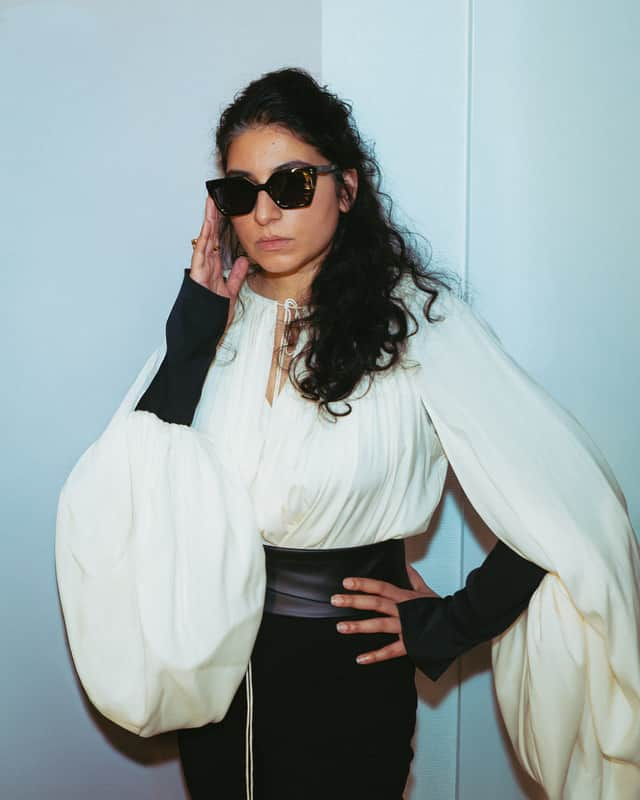
Performing music from across her catalogue, the collaboration with the LCO brings a grand-scale orchestral sound to her intimate, emotionally rich music. Alongside her will also be band members drummer Engin Kaan Gunaydin and bassist Petros Klampanis.
“I love playing in Edinburgh,” says Aftab. “This is the third time. It's gonna be spectacular, really grand, with the London Contemporary Orchestra at the Usher Hall. There will be songs from Night Reign and Vulture Prince and the music itself complements a cinematic, dramatic setting.”
“And I think the fans and folks who like music and Edinburgh are a different breed. They're not not purists about music. They don't really have any social bias. They just love music and they're kind of loose and fun, the way we like it. I'm looking forward to the audience as well as the performance itself.”
Aftab has orchestra experience from her collaborations last year with the world-renowned Metropole Orkest, with whom she toured, and the BBC Symphony Orchestra at the BBC Proms in the Royal Albert Hall. After initially finding it daunting, she now revels in the experience.
“BBC Proms was the first ever orchestra performance I did and that was the most nerve-racking show I've ever done. But once I overcame that and it went so well, and then the Metropole run, it's become this extremely powerful thing.
“Who doesn't feel badass if you have 80 musicians behind you playing your song? You feel like a superhero. Your cape is really big. It's absolutely exhilarating. I'm kind of addicted to it.”

Born to Pakistani parents expatriated in Riyadh, Saudi Arabia, Aftab returned with her family to Lahore when she was 11 years old and moved to the United States at the age of 19 to study music production and engineering at Boston’s Berklee College of Music, after that moving to New York.
From a musical family, the way she tells it “from the very beginning, I was singing. My family was really big into the celebration of music in the house so it was normal then I realised other people don't treat music the same way and care about other things a lot more than music. That made me realise maybe this is something that I want to pursue because this is the only thing I care about. After my A-Levels I was like, ‘well, I just wanna do music.’
“Music has the reputation of not being something you can bank your career or life on, but that also gave me a sense of if you're going to do this, you really have to believe, make sure you think you're really good at it and once you do it, you really have to make it worth it.”
As a teenager Aftab taught herself guitar and soaked up the sounds of various musicians from a variety of influences, including Billie Holiday, Mariah Carey, Jeff Buckley, Billie Eilish, Anoushka Shankar, and Hariprasad Chaurasia (classical flautist and bansuri player and Begum Akhtar, from the classical Hindustani traditions.
“I don't think it's surprising I'm naming Mariah Carey or Billie Holiday or Begum Akhtar or any of them because these are the greatest musicians from all eras and places. I just have been listening to them and think my music and disposition towards music is a mixture of those and that's it.”
“Who I am is always hard to describe because I was born in Saudi Arabia, moved to Lahore, then Boston and along the way I listened to all kinds of music without any prejudice towards it. I was never classically trained, so any Pakistani-ism is just from being Pakistani and from having it in my ear. When I went to Boston I studied jazz theory and started to understand how music is written and communicated in a more precise manner, so the decoding occurred from study. And then the rest of my life I've lived in New York.
“So I guess it's a unique combination of how I've allowed everything that has happened to me in my life to be the source of my musical inspiration and I haven't overthought the blending or separation. To me it just felt organic. I'm just living and music-ing, you know?”
Her first album, Bird Under Water, with acoustic jazz instrumentation blended with qawwali music, was released independently in 2014, followed by Siren Islands in 2018, where modular synthesisers create an ambient soundscape punctuated by Urdu lyricism, and her third album Vulture Prince, dedicated to the memory of her younger brother Maher, dealt with loss and grief. Following its success in 2021 she left her audio engineer day job to pursue music full-time, becoming the first Pakistani artist to win a Grammy in 2022 with Best Global Music Performance for her track "Mohabbat", a favourite of Barack Obama’s.
“The Grammy was amazing. You do so much that's so non-tangible and the reward is scattered and vague. Musicians are not directly linked to praise, validation or recognition so when someone hands you a statue and it’s like, you are doing good, it's the one moment that feels pretty clear in this giant sea of not so much clarity.”
“But the most astonishing thing to this day is when, unexpectedly, people say they know who I am or they've heard my music. You meet someone in the street randomly and they tell you that they're your fans and I'm always a little bit shocked. Really? I'm still surprised by that.”
Aftab went on to blend her signature folk jazz sound with ambient pop and experimental elements in the Urdu and English songs themed around romance, renewal, and the beauty of the nighttime in her fourth album Night Reign. She is currently working on a fifth album.
“The albums are all different,” she says. “Once I do something I need to ask what's next and where we go now and what are the new things I can incorporate?
“I feel very uncomfortable just being comfortable. If I've cracked a certain code I'm not going to do it again. I'm gonna go and put my life on the line and be a heavy risk taker and change everything.”
What about the new album, what direction does that take?
“It’s early to say. I'm in the writing phase and pieces are floating around, some fitting together, some not. It's definitely coming out different from previous ones. I want to explore. I’m very curious as an artist.
“I'm bored with the whole meditative, minimalist, being so careful route. That has been amazing and it's part of who I am, but I want to be a little more playful.
“There's another side of me who's a whisky slugger, cursing and rowdy, and I want to be not just a rowdy person, but a playful being. I feel there are sides of me that haven't come out in the music yet and I really owe it to myself to explore them.”
On the 75th independence day of Pakistan in 2023 President Arif Alvi awarded Aftab the Pride of Performance Award, Pakistan's most prestigious, for excellence in the field of art and music. Does being the first Pakistani artist to win a Grammy come with expectations?
“I'm definitely proud. We Pakistanis didn't have a Grammy, and now we do, and that's amazing. It's a really musically rich culture and I'm happy to be the first person, hopefully of many.
“But otherwise, like representing Pakistan, I'm doing that just by being Pakistani. I don't wear nationalism on my sleeve, but it shouldn't be mistaken for not feeling a great sense of pride in the accomplishment for everybody else too. It really breathed an insane amount of new energy and gave a lot of Pakistani musicians a new fervor to do more.
“So the impact it had is incredible for the Pakistani community of musicians who sometimes, I think, get a little worn out by all the social bias and prejudice against them, and the lack of access. When they saw me, I think it created a wave of new energy.”
Aftab has sung to highlight issues of poverty, human rights and gender equality. In 2026 she contributed a track to the compilation album Help in support of War Child to raise funds for humanitarian and medical aid in war-torn territories, she has supported Artists4Ceasefire in Gaza and Pakistani animal rights organisation the Ayesha Chundrigar Foundation. Is it important to her to use her voice in that way?
“Yeah, I do use my voice for all these things. I think my mere existence is a point of activism anyway. Being a Pakistani woman in music already feels like a defiant act in a sense, but not anymore, the world is no longer stuck on those things, thank God. But I do think it's important.
“I don't know, sometimes it feels like... in recent incidents we saw a lot of musicians, actors and artists who ‘had a voice’ get penalised for speaking out. There was a pushback which ultimately harmed a lot of artists' careers, who were already struggling. No one out here is Taylor Swift or Michael Jackson. We're all trying to work hard to maintain a basic life. And in the last few years speaking out did not bode well for a lot of us and that was really disheartening and absolutely gross and terrible. And nothing really changed either on a seismic level; we weren't able to really stop any atrocity. So that's something people don't see. They're just ‘this person has a platform and needs to say stuff’ but we have to juggle a lot of different elements here, you know?
“But having said that, that has never stopped me from standing up for what I feel is the truth.”

What would she say she sings about?
“My themes are always love and the failure of love, longing, desire. These have always been in my music, the only themes that reoccur. There are a lot of secrets, a lot of phrasing entendres in the air and it can be perceived a little deeper. But mostly that.”
Does she think that's why she’s so popular, because that longing is universal?
“I think people love to see the mirror, see themselves in what they like, or like something they see themselves in. I don't really think about the people while I'm making the song. I'm mostly thinking about how I'm feeling and how close I can get to that. But I guess that means that my feelings are very basic!” she laughs.
“I think love is not just about finding a partner. It's a state of being, about feeling, about time passing and what did we accomplish? What are we going to be? What do I do in these moments where I miss my family? There are lovers, love, longing and desire and it's about people, of course, and relationships and failed relationships or relationships that never happened or haven't happened yet.
“It's a giant web of all of these things, but in the end it's about this core feeling. So I try to tap into that, into memory, conversations, how things have made me feel, and because of that I have to be a very sensitive person and that can be really hard when I'm in the world because people say crazy shit all the time. They do! So it's not about one particular thing, which is good I think.”
For Aftab the ‘music-ing’ will continue.
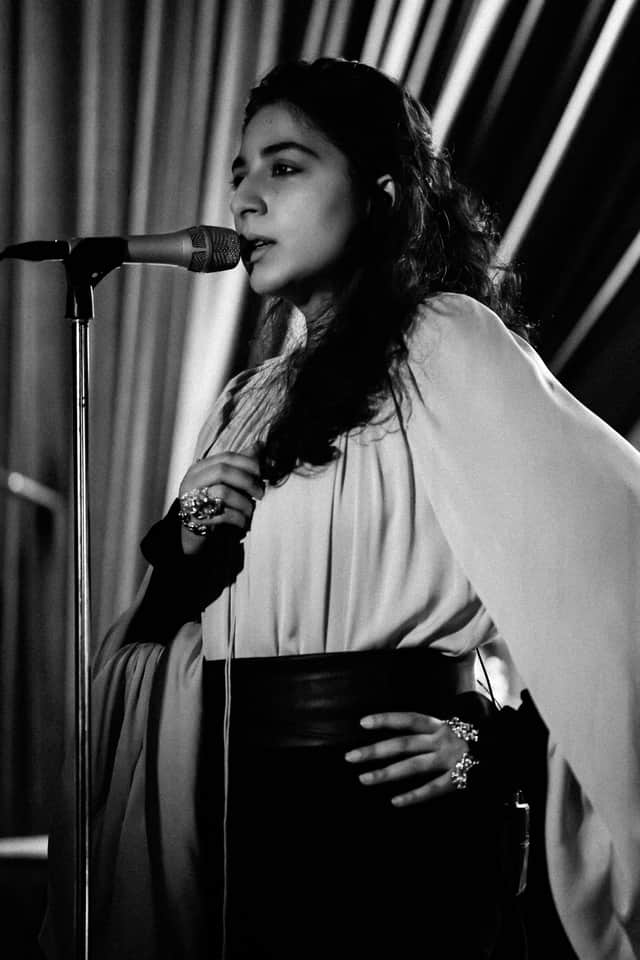
“I feel there's no way for me to not do it. I was having a conversation with my older brother and he mentioned retiring and I was like, ‘are you serious? Do you not understand who we are?’ Musicians don't retire. We just die at some point.
“The Indian vocalist Asha Bhosle just died at 93, and the last thing she released was two weeks before her death, a song with The Gorillaz. We don't stop.”
Finally, given that she’s embracing her playful side, what was the last thing she laughed at?
“Probably myself in the mirror because I just dyed my hair. I was bored and did it at home and had an allergic reaction. My forehead got really swollen and I look like someone from Star Trek. It’s fine! I’m OK. It’s really funny. Everybody's like, ‘Oh my god, why did you do that?’ and… I don't know!
“The thing is, I've done it before and it happened before. They said you know you're allergic to hair dye, why would you do it again? Well, I just thought… maybe…”
Arooj Aftab, the risk taker.
Arooj Aftab with London Contemporary Orchestra conducted by Robert Ames, Wednesday, 24 June 2026, 7pm, Usher Hall, Lothian Road, Edinburgh EH1 2EA (0131 228 1155) Tickets from: [email protected]
Comments
Want to join the conversation? Please or to comment on this article.