
Want to know what happens if you get sucked into a black hole? Ask Catherine Heymans, Astronomer Royal
Black holes, dark matter, stars and galaxies are all in a day’s work for the King’s astronomer in Scotland, who wants to tell us how it all works with her new book How to Design a Universe
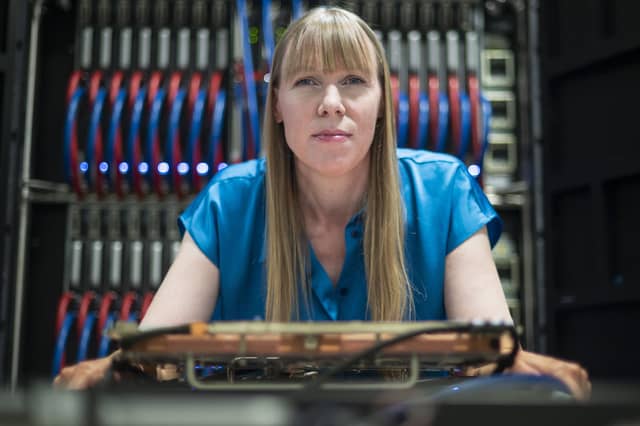

Tall, blonde, smiling, holding a takeaway coffee on Edinburgh’s seaside prom at Portobello as dogs and ice-cream sticky children abound and the waves lap the sandy shore, astrophysicist and Scotland’s Astronomer Royal Professor Catherine Heymans is as far from the stereotypical physicist with Einstein hair and lab coat as you can get.

You’ll know this if you’ve seen the Edinburgh University Professor of Astrophysics on TV recently talking about the eclipse or the government’s science cuts in funding to the likes of Jodrell Bank, the radio astronomy observatory in Cheshire with 76 metre dish and telescope catching signals from distant stars, galaxies, and black holes.
Want the latest Scottish headlines sent directly to your phone? Sign up to our WhatsApp Channel
We’re here to talk about the astrophysicist’s jobs as Astronomer Royal and professor at the University of Edinburgh based at the city’s Royal Observatory, and her new book How to Design a Universe: The Science of Real and Virtual Worlds, prompted in response to her son’s question: could we be living in a computer simulation?

Fortunately for me, a science simpleton, Heymans’ favourite thing about being Astronomer Royal, is answering questions from children - what she calls ‘Ask The Astronomer Royal Anything’ - in person and online.
Heymans is also a mother of three and used to the questions all parents face, along with an encouraging conviction that there’s ‘no such thing as a stupid question’. Encouraging and empathetic, she’s an enthusiastic advocate for science and her book is peppered with anecdotes and asides about her travels and family life, interspersed with what she calls ’the physics bits’.
“People want to know how things work. It’s part of being a human. And the answers are in physics, but somehow we've got to this place where ‘physics is Einstein, physics is the geeky people you can't approach at school’ and they have that immediate fear.

“What I want to do is share the cool stuff in a way people can enjoy. But also not dumb it down. I didn't want to ‘blonde’ it. I can say that because I’m blonde,” she says and laughs her infectious laugh, which erupts at many points in our conversation.
It’s important to say that non-scientists will enjoy the book but Heymans has not dumbed it down and there are footnotes intended for the people who have done some physics before.
We’re sitting on a bench gazing north over the Firth of Forth, a great spot for skygazing, with less light pollution and a chance of sometimes seeing the Aurora and as she lives nearby, one of Heymans’ favourite patches of sky. Six years on from the pandemic she is living with long Covid and has found that swimming in the sea helps and is often down at the beach first thing.
The Astronomer Royal turns out to be fun, and as well as being a serious, award-winning astrophysicist, is happy to admit she wishes on stars, talks about crossing her fingers, about clouds having silver linings and is not averse to speculating on what an Astronomer Royal’s official outfit should be, although today it’s leggings, trainers and sunglasses.
“What would it look like though? A hat with a giant telescope on the top of it! A velvet cloak, purple maybe,” she laughs.

Heymans was selected by a panel who liked her idea of taking telescopes to outdoor centres where children are enjoying school trips, already running in Edinburgh and planned for Aberdeen and Glasgow schools and the destination for royalties from her book.
So what sort of questions do children want to Ask The Astronomer Royal?
“What's inside a black hole? Well, we don't know. So a wee girl said we need to send someone inside one and they can phone us to tell us. So we talked about how they would be killed going in because their feet would be pulled in faster than their head and they would turn into a big string like spaghetti. But say a mythical spaceship made it in, how would they telephone us? We talked about how your smartphone sends messages through a form of light and they learned how the phone works, from the question about black holes.
“It’s important for me as a scientist to know what people are interested in and what inspires them because I'm funded by taxpayers’ money.”
“My kids are too old to ask me questions now,” says the 48 year old, “and Ask The Astronomer Royal is the extension of that with children across Scotland.”
“Often it’s something we don't know the answer to and we talk about how you would go about finding the answer.
“I don't like it when scientists say these are the facts, this is the truth, because that's not how science works. So Einstein, ‘greatest mind, had this revolutionary new theory about gravity’, and he did, but he’s an incredibly rare and unique person. For the majority of scientists, it's about being a toddler and asking why. It's not giving up.”
Failing is OK in science I learn, in fact it’s encouraged. An experiment ‘fails’ but the success is finding out why and gaining new knowledge.
“Science is the one thing where failure is a success and that's important because you learn something. Why it didn’t work? You're curious and keep pushing and prodding until you learn more.”
And has King Charles been on the phone to the Astronomer Royal?
“Not yet, but if he ever wants to, I am ready.” She laughs. “I understand he’s a keen stargazer, so I am at his beck and call if he needs me.”
Heymans has done a lot of work with the government though, particularly on the current funding cuts, and works with select committees, advising and providing briefing documents.
“When they're talking about astronomy or getting kids interested in science, things like that.”

Recent TV appearances have included talking about the August eclipse and the threatened closure of Jodrell Bank Observatory in Cheshire, something that along with the voyages to Jupiter have got everyone talking.
“If we were rubbish at what we were doing, nobody was interested or we'd failed to transform our technology into useful things like wifi and the internet, cut us, but that's not the case.
“The cost is £2.8 million a year which is half what Nigel Farage got donated from cryptobillionaires and less than the Houses of Parliament spend on stationery. It's making advances every day and now developing the ability to map space debris.
“The European Southern Observatory in Chile is our main observatory and for every £1 the UK government invests in that we get £6 back in economic return. That's nothing to do with the science we do, that's the pure technological innovation that comes out of it.”
“We have amazing facilities and cutting-edge engineering developed to do this science and it flows straight into industry and the economy, but unless you've got that inner toddler asking why, that curious driving force that pushes people to think big and create solutions to engineering challenges that a normal company would never invest in, you don't get breakthroughs that then turn into transformative technology for society.”
“People love what we do. I’m on the Today programme, Radio Scotland and Radio 4, because people are interested in what's out there.”
Does she like TV appearances?
“Oh God, every time I’m terrified. It doesn’t come naturally. But you can't aspire to be something if you can't see someone like you doing it, so I'm happy to be on TV.”

Besides being Astronomer Royal, Heymans works at Edinburgh University’s school of physics and astronomy and is based in the city’s Royal Observatory.
“The two things are beautifully intertwined,” she says. “I’m working on a new telescope in Chile at the Vera C Rubin Observatory, named after my hero. It’s very cool, a big light collecting bucket, gathering light from the distant universe. It’s one of the world's biggest telescopes fitted with the world's biggest camera, the size of a Fiat Punto.
“Now we can image the entire sky every night for the next 10 years. Anything not moving we'll be able to see in absolutely exquisite detail and also things that do move go flash, boom - stars exploding, asteroids moving. We'll be able to categorise everything in our solar system, know their paths and work out if one of them's going to crash into us with plenty of time to divert it. Which is very good!
“We’ve found all sorts of strange things like the WTF star…”
The WTF star?
“Yes, it was called the WTF star for the reasons you think, but you can't swear in an academic journal so it's now called ‘What The Flux’ because its flux was changing rapidly.
“I'm really excited about what we're going to discover. We’re looking 12 billion light years back in time to see how the universe, galaxies and dark matter have been changing. That's what I'm working on at the moment, along with a massive team of 1,000 people.”

It’s time for a stupid question.
“There's no such thing as a stupid question!”
OK, does she ever wish on a star?
“Of course I do! I still find everything very magical. It's very beautiful. You should have seen me on Portobello beach when there was the Aurora. There have been some really spectacular Aurora right here over the last few years. The first was May 2021 and I was really ill, but we still got me out here and oh my god! It was so beautiful.
“I did astrophysics rather than physics because it’s the beautiful side of physics. I feel connected with everything that's out there. When I see the Aurora I'm thinking about the chemical reactions in the atmosphere and the sun that barfed out all the high energy particles that flew through the solar system and crashed into our magnetic field. At the same time, I’m thinking ‘this is really gorgeous and just Wow!’”
She also points out that if you don’t have a telescope to look at the moon and stars at night - a pair of binoculars is a good start.
So why start the book with her child's question: could we be living in a computer simulation?
“He asked me that right before I was heading off to Chile and it was whirring around my head the whole time I was there, then fairly soon after that I got very ill with Covid.
“I was lying in a darkened room, because I couldn't tolerate light or sound. I was absolutely delirious, thinking this is a simulation and I need rebooted. I wanted to prove to myself that no, I really was real, I was just ill.”
“I didn't want to write a physics book, because people would go that's not for me, but they do want to hear the answer to the question, so we have to talk about how things work.”

Back to whether Portobello beach, the dogs, children, Heymans and I are all in a vast computer simulation. How would we know?
“With all scientific endeavour, you can only ever disprove something. So I was trying to disprove it because I want things to be real, and wanted to tell my son we can’t be in a simulation. I don’t think we're in a computer game. We are real because I certainly feel like I have free will and I don't think that would be true in a computer game.
“Could everything be simulated, everything here on earth and everything I see through my telescope? No, you would require an inordinate amount of energy, at least the total amount of energy there is in a giant galaxy.”
Would it matter if we’re in a simulation since all around us as we talk there’s ice-cream that will still need to be washed off toddlers, dogs walked, bills paid?
“What I've learned from four years of chronic illness is that your life is on this precipice between things going brilliantly and suddenly taking a very dark turn. It doesn't matter whether this is simulated or not. Feel real life now. Experience reality. And it's exciting that we can understand why and how things work.”

Keeping Heymans very grounded are a partner she’s been with since she was 17, and who she admits asked her to stop talking about the quantum physics chapter once when they were on a stroll, and their three children aged 20, 17 and 13, who participate in tea table discussions ranging from science to why Marmite rules and brussels sprouts don’t.
“Everyone told me not to have children until I had a permanent job, but I’m so glad we did,” she says. “They are my best critics and informants on what’s interesting. And they’re not bothered about my job. But I was dead chuffed that Middle Child fact checked the book for me and so proud. He’s very into his physics.”
Would she like her children to follow her into science?
“They can do whatever they want so long as they're happy. The eldest one is studying languages and the youngest is currently a comedian. Maybe he'll take up my stand up comedy route.”
Standup? There’s humour in the book but this was not mentioned. Tell us more.
“I do it with my friend Joe Zuntz”, an astrophysicist at the University of Edinburgh.
“People think scientists are boffins and learn facts and are set in our ways. But not at all. There is no such thing as a fact in science. We just have ideas and try to find out more. So we're very creative and have a lot of fun.
“We started the stand-up in the Fringe did the Dark Sky Festival and The Stand in Edinburgh and Porty Comedy Club. That was before I got ill, but we will get back to it. It was all part of my mission to talk to people who think science isn’t for them.”
“You get people on a beautiful moment where they wish on the star and tell them about the physics of our atmosphere, what's happening out in our solar system, that the comet is made up of bits of our universe from five billion years ago, and you can expand their minds and make them feel there is beauty in that science.”

Right now Heymans is very focused on the Vera Rubin telescope and what it reveals, and has multiple paths open ahead of her.
“I’m on the advisory board of Dynamic Earth, patron of the Scottish Sky Observatory and have just become patron of the Aberdeen Science Centre, and love working with children and community groups. It’s also been fascinating working with government and realising how little science literacy there is there, then there's a whole world of new science we can do with new technology. Is there life out there? We’ve got a new telescope we're building partly in Edinburgh, the Habitable Worlds Observatory, which is going to look for bio signatures from distant planets.
“There are so many exciting questions out there, and somehow I have to guide my inner toddler to focus on one.”
She’s a very busy woman with a universe of questions to answer, but if she had the chance to leave Earth behind and head out into space, would she?
“Hell yes, get me on a rocket tomorrow!”
Catherine Heymans is the author of How to Design a Universe: The Science of Real and Virtual Worlds, published by Bloomsbury Sigma, hardback £20.
CATHERINE HEYMANS’ FAVOURITE FILM AND BOOKS ABOUT SPACE
What are your favourite books and films about space?
Interstellar is my favourite and is an absolutely brilliant movie about space. It is scientifically very accurate in the way it deals with the way that gravity warps space and time.
You know the bit where they go down to the planet that's near a black hole and they're down there for maybe 20 minutes? They land and there's no water and then suddenly the water comes back and they go back to the spaceship and the person that they left there has aged 30 years.
That's the way that time dilation works because time slows down as you get closer to a big mass, like the back hole they were getting close to, but the person who is further away on the ship aged because time was running faster for him.
Time dilation and your experience of time is so hard to get your head around and I thought Interstellar did that spectacularly and in a very beautiful way. It was very human story.
My favourite book? I do like The Martian but also Project Hail Mary's very good. I haven't seen the film yet but Mark Weir is good - a scientist first before an author.
And The Three-Body Problem is a 2008 novel by the Chinese hard science fiction author Liu Cixin. That’s a book where the science really comes into it but not to the point that ruins a good story. Because obviously if you confine yourself to the physics of our reality then there are a lot of plot twists you can’t have - but ones that bend it I like.
And non-science book?
That's a tough question - I like so many books. But I really like historical thrillers - those are reading a book for joy where I step away from the science. Science books are constrained to some extent by the physics of reality.
I like Pat Barker books, crime and historical crime like the Robert Harris ones set in Rome. They’re not about space and it’s completely different. I like that it’s historically accurate but with fiction on top of it.
Comments
Want to join the conversation? Please or to comment on this article.