
Walking in James Hutton’s footsteps is about to get easier

With the tercentenary of ‘the founder of modern geology’ just months away, plans are afoot to improve access to the places where he made his most significant discoveries, writes Roger Cox
Given the magnitude of what he achieved as one of the true intellectual giants of the Enlightenment, it’s incredible that James Hutton isn’t better known and more widely celebrated. You’d think being hailed as the “founder of modern geology”, figuring out the mysteries of the earth’s crust through a combination of careful observation and logical thinking, and coming up with the concept we now call Deep Time in the process would at least be enough to get you onto a few “ten most famous Scots” lists. But no – Hutton probably wouldn’t make most people’s top 50, and perhaps only a handful of top 100s.

How to explain his lack of profile? Part of the issue may have been his unwillingness to seek fame. As his friend John Playfair put it, even once he’d cracked the secrets of geology Hutton “was in no haste to publish his theory; for he was one of those who are much more delighted with the contemplation of truth, than with the praise of having discovered it.” As a result, it took him some 25 years to get around to going public with his Theory of the Earth, first presented to the Royal Society of Edinburgh in 1785.
There are also those who blame the density of his writing for his lack of recognition – and, true enough, reading Hutton can sometimes feel like the literary equivalent of trying to eat a sofa. Then again, the last line of his Theory of the Earth is unarguably a belter: “The result, therefore, of our present enquiry is that we find no vestige of a beginning, no prospect of an end.”
My own theory, for what it’s worth, is that we find Hutton hard to love because he gives us a kind of vertigo. There’s not much comfort to be found in the idea that – in geological terms, at least – we’re all just tiny, insignificant specks of dust, each occupying a precariously brief sliver of time, with one yawning chasm of eternity behind us and another one in front of us. Much easier to get excited about the guy who invented the telly.
Anyway, whatever the reasons for Hutton’s lack of fame relative to the scale of his achievements, with the 300th anniversary of his birth coming up on 3 June this year, and various events planned to mark the occasion, we’ll all be hearing at a bit more about him in the months ahead, whether we like it or not – plus, walking in his footsteps looks set to become a bit easier, too.
Down at Siccar Point in the Scottish Borders, following a successful Crowdfunder campaign, the Scottish Geology Trust has now received planning permission for the James Hutton Deep Time Trail, which they hope will make it easier for visitors to both reach and understand a landform of central importance to Hutton’s work.
A dramatic spur of rock jutting out into the North Sea, Siccar Point was where Hutton predicted and then found an unconformity – a feature that represents a gap in the geological record. Long story short: it has a layer of sedimentary rocks full of marine fossils created at the bottom of the ocean some 425 million years ago directly abutting another layer of sedimentary rocks laid down in a desert some 345 million years ago. The fact that there’s nothing between these two layers shows that the intervening 80 million years must either have been a period of non-deposition or a period of erosion. Either way, for Hutton it proved that the Earth’s surface is not static, but continually being regenerated and recycled by natural processes.
The planned 1.3km trail will begin with a new welcome point, and a series of information posts along its length will relate the landscape to Hutton’s work, with additional audio content available by scanning QR codes. There are also plans for a new “Discovery Hub” above Siccar Point itself, offering shelter and somewhere to sit as well as multimedia explainers and information panels. Further development phases are planned, and there are various perks for those who contribute to the Crowdfunders for these, the coolest by far being a special Hutton beanie, knitted in different coloured layers that look like rock strata.
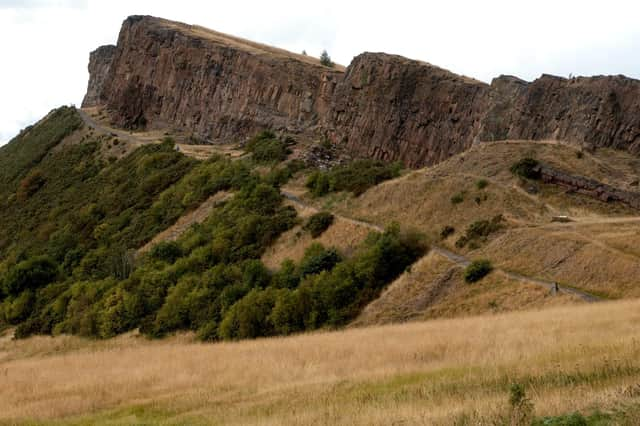
In Edinburgh, meanwhile, it seems likely that another key landform that informed Hutton’s thinking – one that has been off limits to the public since 2018 due to the risk of rockfall – should be accessible again in time for the tricentenary.
Accessed via the still-closed Radical Road, the so-called Hutton’s Section of Salisbury Crags shows molten magma (dolerite) injecting into sedimentary rock – something that confirmed to Hutton that his theory that igneous rocks were formed from melting and cooling was correct.
There has been much criticism of Historic Environment Scotland (HES), the body which administers the site, for keeping the Radical Road closed for so long. However, according to an HES spokesperson, the reopening is now looking likely.
“Given the significance of Hutton’s Section,” they said, “we have been working to prioritise access to this area for the 300th anniversary of James Hutton’s birth in June, including gorse cutting and other precursor works. We are on track to provide access at this time, subject to planning permission which was submitted at the end of last year and await confirmation of next steps from City of Edinburgh Council.”
For more on the Deep Time Trail, see www.crowdfunder.co.uk/p/siccar-point
Want the latest Scottish headlines sent directly to your phone? Sign up to our new WhatsApp channel here
Comments
Want to join the conversation? Please or to comment on this article.