
Surfing: Phoebe Strachan on leading Team Scotland to their best ever result at Eurosurf

Phoebe Strachan’s willingness to compete on both long and shortboards helped the team to a record tenth-place finish. Interview by Roger Cox
When Scotland’s surf team competed in the European Surfing Championships in Santa Cruz in Portugal last month, they achieved their best ever result – a tenth place finish out of 18 competing nations. Key to their success was six-time national shortboard champion Phoebe Strachan, who contributed the most points to the team’s total, not only surfing her way into the third round of the women’s shortboard division but also making it into the last eight in the women’s longboard.


What makes her achievement so remarkable is that shortboarding and longboarding are radically different disciplines. This isn’t like a middle-distance runner doing well at both the 800m and 1500m – more like the same athlete excelling in both judo and rhythmic gymnastics. Shortboarding, usually on boards between six and seven feet in length, requires fast, powerful turns in the critical part of the wave, whereas longboarding – riding boards nine feet long and over – is all about effortless style and poise. Most surfers specialise in one discipline or the other; it’s rare to find someone who can do well at both. As her five national shortboard titles attest, Strachan is a shortboarder first and foremost; however, this isn’t the first time she’s done her country proud on a longboard. At Eurosurf in 2023, she also made the last eight in the women’s longboard after agreeing to “take one for the team” when nobody else stepped forward. I ask her if she’s in fact a secret longboarder?

“I try really hard not to be a longboarder,” she laughs. “Since the last Euros I think I’ve picked up a longboard about three times. Also, I tell you what, I am never travelling with a longboard again. My journey home from Portugal was a nightmare. I was carrying my boardbag with all three of my shortboards, plus my longboard and a suitcase of clothes. My plane was delayed, so I missed my connection in Amsterdam, sat in Amsterdam for eight hours, finally got back home, but then as they opened the doors to baggage reclaim this boy picked up the longboard and just threw it – like, absolutely launched it – and it just made this huge clatter on the ground. I was like ‘WHAT ARE YOU DOING?!’ So the longboard’s got holes all over it now – it’s just mashed.”
The fact that her longboard had made it back to Scotland in one piece was already something of a miracle – as in 2023, conditions at Santa Cruz were far from longboard-friendly, with the waves in board-snapping mode for much of the contest.
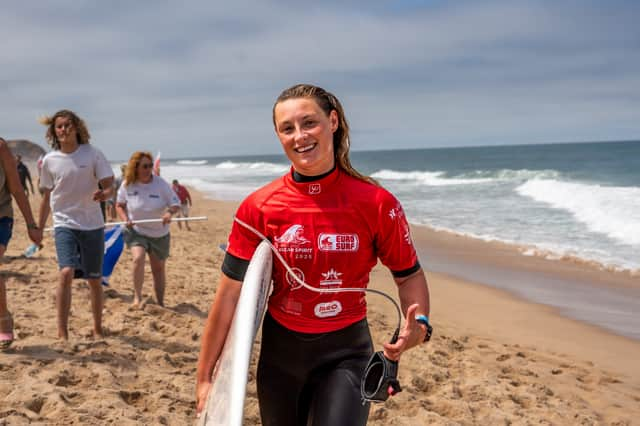
“The first day was OK for longboarding,” says Strachan, “it was quite small and clean, but I ended up in a heat with two girls who made the final, so I was never going to make it through that one. But then in the repechage 1 heat it was super ugly – just massive closeouts. I only had one board as well, so I was like ‘Er, I could really do with not snapping this...’ There were actually a couple of snapped longboards in the heats, but most people had back-up boards because they were actual, proper longboarders. I just had the one though, so I was like ‘I just need to try and keep mine in one piece and hope for the best.’”
Strachan was eventually eliminated by Julieta Rodriguez-Villamil of Spain, who finished second in the final, and Mare Robroch, who only missed out on a place in the final by the slenderest of margins. Still, if she manages to get a bit more practice on the longboard before Eurosurf 2027 you’d have to fancy her chances.

Speaking of practice, Strachan believes that the training sessions Team Scotland are now able to get on the artificial waves at Lost Shore have the potential to be a game-changer.
“I’m the person on the team who’s surfed the pool the least,” she says, “but I definitely think it’s helped. Say there’s a turn you’ve been working on for years, you can go into the pool and do a few sessions on it and it properly becomes muscle memory and part of your repertoire, so then when you go out to Portugal you’re not even thinking about that anymore because you know you can do it already. It’s like with any sport – if you increase the amount of time you’re doing it then of course you’re going to improve. If you think about a typical surf, how long are you standing on the board for? Most of it’s paddling and duck-diving. In the pool you can practice the same thing over and over.”
What form does a typical Team Scotland training session take? “We usually go in with an idea of what we want to work on,” she says, “and then quite often we’ll have someone standing on the wall giving live feedback. They’ll be like: ‘right, try shifting your back foot further back on your next turn.’ Then afterwards, when you get out of the water, you’re looking at video of the session, so you get an idea of it in your own head. It’s just the best way to improve, and we’ve seen it with so many of the juniors and even with the staff at Lost Shore – some of them were non-surfers when they started, and now they can really surf.
“It’s an amazing facility, but it’s also important to put that together with surfing in the sea, because there’s so much you need to know for that too. I love the pool, but it’ll definitely not take away surfing in the sea for me.”
For more on the Scottish surf team, see scottishsurfing.scot
Comments
Want to join the conversation? Please or to comment on this article.