
Inside Scotland's wetsuit testing lab: shivering in the name of science


The Lost Shore artificial wave park at Ratho was the trigger for a collaboration between surfers and scientists at Edinburgh Napier University, writes Roger Cox
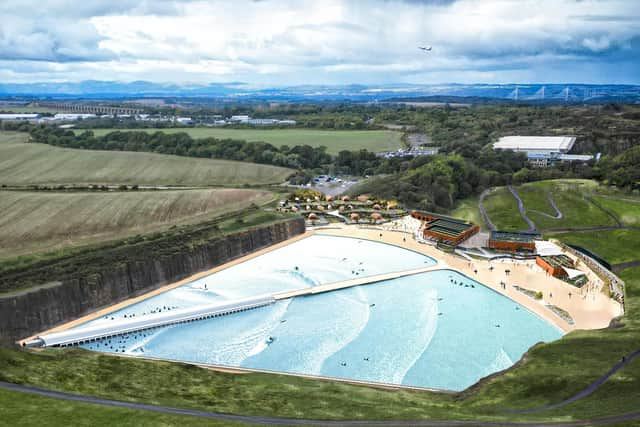
This September, Scotland’s surfing landscape will be utterly transformed when the £55 million Lost Shore surf resort opens at Ratho just outside Edinburgh – an artificial wave pool serving up as many as 1,000 perfect waves every hour. The concept of a flat spell – a period of calm when there are no waves to surf – will effectively disappear overnight. As of September, Scotland will become a flat-spell free zone. The surf will be up all day, every day, for as long as the folks at Lost Shore keep their state-of-the-art Wavegarden Cove machine running.
Clearly, this is a dream-come-true development for Scotland’s existing surfing community, but such a modestly-sized group alone (no matter how enthusiastic) would never be enough to sustain a facility on this scale. No, in order for the numbers to stack up, new converts will need to be found, new initiates inducted into the tribe, and in order for these newcomers to get hooked on the Sport of Kings, they will need to remain as warm as possible for as long as possible while splashing around and finding their surf legs in the new (unheated) facility.
Which is where Dr Brendon Ferrier, head of the newly formed Surf Lab at Edinburgh's Napier University, comes in. A million miles away from the stereotype of the tweedy academic, when he meets me in the reception area at Napier's Sighthill Campus he's wearing jeans, flip-flops and a freshly-minted Surf Lab polo shirt. He and Lost Shore founder Andy Hadden first cooked up the idea for Surf Lab seven years ago, and now their concept of a multi-disciplinary surf research centre, able to draw in expertise from departments right across the university, is starting to bear fruit. Exhibit A: a recently completed piece of work analysing the heat-retaining properties of different wetsuits.
“Andy and the Lost Shore team want to put people who have never tried surfing before in the warmest environment they can,” Ferrier explains, “so then they'll enjoy it and then they'll come back.”
And in order for an outdoor wave pool to thrive all year round in Scotland, the quality of the wetsuits available to hire will be critical . “They could have gone down the route of ‘Oh, we’ll get that wetsuit because it’s the cheapest,’” says Ferrier, “but then you’re not going to get your return business.”
To ensure their hire suits are as warm as possible, Lost Shore commissioned Ferrier and the Surf Lab team to test the most suitable products from five leading surf brands. Lost Shore’s own operations assistant Alejandro Padro was offered as a guinea pig, and he stoically sat in a bath of iced water measuring just one degree celsius for half an hour wearing each of the suits, while thermometers attached to various parts of his body measured changes in skin temperature.
The winner? Gul’s 5/4mm Yulex wetsuit, which gave particularly high temperature readings around the lower back area, thanks in part to its high-performance zip. As an added bonus, in contrast to synthetic rubbers commonly used in wetsuits, such as neoprene (made from petrochemicals) and geoprene (made from mined limestone), Yulex is harvested from natural rubber plantations, reducing carbon emissions by around 80 per cent, so these suits are both warm and green. Lost Shore have now ordered some 700 of them, giving them the largest plant-based rental wetsuit offering anywhere in the world.

The wetsuit test is an impressive example of the way in which the Surf Lab can act as a conduit between academia and the surfing world, and the way Ferrier sees it it’s just the beginning.
“My philosophy is that, as a university, we should be here to support the community and help people,” he says. “So small businesses that don’t have the money to do their own R&D, we should be enabled to do that or support them in that – that’s the whole idea of Surf Lab.”
Ferrier, 52, is an Australian by birth and a kneeboarder by choice. He gained a PhD in Biomechanics from Edith Cowan University in his home city of Perth, Western Australia, where he also studied as an undergraduate. His thesis was titled "Characteristics and Determinants of Aerial Surfing with Implications for Representative Task Design" and in order to complete it, he tells me, he had to watch and analyse every heat of every contest on surfing’s World Championship Tour for a period of three years. As such, he has a deep understanding of the biomechanics behind surfing, and this is something he’s now putting to use.
Beside the pool area where he carried out the wetsuit testing, he shows me a machine with a surfboard attached designed to analyse muscle activation during paddling; another nearby machine, he believes – a commonly-found piece of gym equipment – might just prove the ideal bit of kit for strengthening these critical muscles. Other Surf Lab projects currently in the pipeline cover everything from performance psychology to the efficacy of surf therapy.
“The idea is to support anyone who wants to do research around surfing,” he says, “and [I can] approach colleagues throughout the university, so it can be to do with tourism, engineering, psychology... I just try to match people up.”
For more on the Lost Shore surf resort, see www.lostshore.com