
How pioneering board builder Pat Kieran helped shape Thurso's surfing community


From shaping surfboards to running surfing lessons, Pat Kieran played a key role in the development of Thurso’s now burgeoning surf scene, writes Roger Cox
It’s now a full five decades since Pat Kieran first travelled from Liverpool to Thurso as an electrical engineering student, in the summer of 1976, becoming one of the pioneers of north coast surfing in the process. Inevitably perhaps, some of his most vivid memories from a life spent in and around the water concern the remarkable, machine-like wave at Thurso East, which he first surfed in 1978, a couple of years after his first visit.
“I’m 72 now,” he says, “but when I talk to you about the first time me and the boys from Castletown looked at Thurso East, I can still see myself at the end of the pier, it’s very very clear in my mind – not like a photograph so much as I can feel myself there.”

Other, chiller memories of Thurso East also come flooding back. “I can remember blocks of ice being thrown over by the peak [of the wave] too,” he chuckles, "ice that’d come down the River Thurso. I remember seeing one block of ice the size of a car roof pitching out in front of me and thinking f*** this, I’m going in.”
Kieran’s story may be intimately tied up with that of Scotland’s most famous surf spot, but he doesn’t claim to have been the first to surf it – that, he thinks, was probably either a somewhat mysterious Kiwi called Bob Treeby, who taught locals to surf in the beachbreak waves at Dunnet Bay in the mid-70s while keeping his own preferred spots close to his chest, or a Welshman, Paul Gill, who first gave Thurso East a try in 1975 while touring around Scotland in a split-windscreen VW camper.
“I definitely wasn’t the first person to surf Thurso East,” Kieran says, “Paul Gill surfed it before me. If there are any firsts I’d be likely to defend, though, it might be that I was the first person to build boards up here. The boards that were up here when I arrived were built by a guy called Bob Treeby, who worked in the design office at Dounreay [nuclear power plant], which is where I started out. Whether he came for the surfing or just discovered it when he arrived I don’t know, but he had boards which I don’t think he’d built up here, so the boards that I built were, I think, the first.”
Surfboard building may sound like an idyllic activity, even a romantic one, but the reality is anything but. Firstly, cutting and then sanding a polyurethane foam blank into the shape you want creates so much fine white dust that most shapers opt to wear a face-mask while they work. Then there’s the small matter of sealing the board with a layer of fibreglass cloth and epoxy resin – a job so fiddly and so difficult to get right that professional glassers have been called “the unsung heroes of the surf industry.”
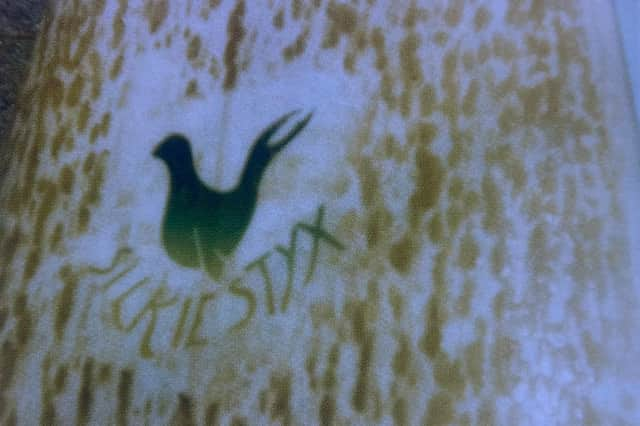
In spite of all these difficulties, however, from the late 1970s Kieran was both shaping and glassing boards in the spare room of Farmhouse Cottage, the house he rented from Lord Thurso due to its proximity to the waves at Thurso East. His boards all bore his “Silkie Stix” brand name, and a distinctive seal logo.
“The first one I built was kind of egg-shaped,” he says, “I built that for Joyce Huxley who was the first ladies champion in Scotland. There’s a couple of those early boards I’ve been able to re-obtain after many years down at Lost Shore [wave pool near Edinburgh] now, they’ve got them on display. They’re pretty shit boards, to be honest with you, they’re pretty low quality, but there was no YouTube and all that to learn from back then.
“Having said that though, a mate of mine, Kev Rankin, he stayed with me for a while and he built a board in the same conditions and it worked a damn sight better than mine did. But he was fussy – I wasn’t fussy, and I didn’t enjoy the glassing. I enjoyed the shaping more than I enjoyed the glassing, but I’d say the glassing was better than the shaping. The glassing of the boards is too heavy – I used too much resin.”
Kieran’s boards may have been somewhat rudimentary by the standards of today, but there’s no doubt that the presence of a local shaper would have made life much easier for Thurso’s early surf community, particularly as they began to leave the gentle beachbreak waves of Dunnet Bay behind and test their mettle against some of the board-snapping reef waves in the vicinity. And that wasn’t Kieran’s only contribution to the nascent north coast surf scene: he also set up the North Coast Surf Club, which he modestly describes as “just borrowing the council minibus and taking kids out to Dunnet on Saturdays, that kind of thing.” Eventually family life meant he had to give up the club, however, he’s delighted with how it’s flourishing in the present-day, even if it does mean the waves at Thurso East can sometimes get crowded these days.
“I’ve had a health scare or two,” says Kieran. “The last one, I had a triple bypass in 2016, and that’s kept me out of the water. If I still went surfing though, even if I could transport myself back to being 18 or 19 or whatever, if I went out at Thurso East with all those people I don’t think I’d be able to get a wave. I know people get frustrated [by the crowds] but look, the sport’s moved on. I’m very very pleased that it’s gone the way that it’s gone – it’s very healthy and it’s good for the kids. I think there’s even a waiting list, now, to get into the surf club.”
“And the thing is,” he reflects, “there are still so many waves to ride. If you really want to go for a surf you don’t have to surf Thurso East – there’s plenty of other places to go surfing.”
Want the latest Scottish headlines sent directly to your phone? Sign up to our new WhatsApp channel here
Comments
Want to join the conversation? Please or to comment on this article.