
Go green in 2026 to boost health and happiness


Connecting with nature – whether in the countryside or city park – is the cornerstone to better wellbeing, writes Tracy Griffen.
We are all connected to nature, whether we’re consciously aware of it or not. As the days get longer, we emerge from our winter torpor and embrace more sunlight. Everyone is affected differently by a Scottish winter, however we all appreciate verdant spring growth. Recently there have been numerous scientific studies that prove this. Emami et al. (2018) conducted a study of hospital patients admitted to a room with a view of either a garden, or a street, and measured anxiety and pain. They found that most patients with a garden view reported reductions in pain scores and reductions in anxiety. (LINK https://pmc.ncbi.nlm.nih.gov/articles/PMC11080386/). So even just seeing a tree can help.
Biophilia is love of nature, literally translated as bio = life, philia = love. Biophilic design incorporates elements of the natural world in interior and exterior features (e.g. green walls). Humans love life and we are attracted to nature. Good urban design recognises this fact. To thrive, we need nature near us. Instead, we are offered identikit boxy buildings, obliterating sunlight, with the minimum amount of low maintenance factor-tended landscaping. And with the Planning and Infrastructure Bill recently being pushed through Westminster, there’s even less protection for wildlife. It’s not optimal conditions for nature, or human happiness. But it’s the way of the world as it is. So what can we personally do about it?
We can, to a certain extent, take things into our own hands. Let’s look at three ways you can engage more with nature. We start with Forest Bathing. Shinrin yoku originated in Japan in the eighties when stressed out business executives discovered peace in many of Japan’s beautiful forests. Forest bathing is now a ‘thing’ and you can experience it for yourself. An experienced guide will take you through a nature spot helping you become aware of your senses and surroundings. In Midlothian, Jean from Woodlands Breathing can help you connect with your natural surroundings and help you attain a state of Zen https://www.woodlandsbreathing.co.uk/
Please don’t do what hoardes of Instagrammers are doing, and park your car next to a beauty spot, trampling the undergrowth to find the perfect selfie. A recent visit to the Hermitage near Dunkeld highlighted this phenomenon, where it was impossible to walk without photobombing someone’s selfie. There’s also the issue of people parking their cars inconsiderately on verges and blocking up narrow lanes. If you’re going to escape the big smoke for a day trip, please remember the residents who live year-round in these beauty spots. Take your litter home with you (there may not be bins or toilets), keep dogs within eyesight and be a friendly adventurer. Leave no trace.
We all like to escape, but you don’t need to drive miles to find nature. We are lucky to have many excellent municipal parks, for many people just a walk or bike ride away. Explore your local green space and see if you can spot birds and spring bulbs starting to come up. Spring starts with bright yellow winter aconites, then snowdrops, crocii, wood anemones and daffodils. These urban pockets of nature need love and attention, and many parks now have their own ‘Friends of’ group. For instance, the Friends of Pilrig Park in Edinburgh has a clean-up and gardening session on the last Saturday of each month. You can meet local people and learn new gardening skills.
There’s nothing more satisfying than planting bulbs in a local park and being able to enjoy them when they come up. Litterpicking is more fun than it sounds, honestly. It’s easy and satisfying with a ‘grabby stick’ (litterpicker) and bin bag. Rather than harumph “someone should do something about this mess”, be the person that spends ten minutes sorting it out, and feel good about your surroundings, and yourself. The fact of the matter is that we’re all making more rubbish than we used to, so we all need to help keep our green spaces looking good. It’s not just someone else’s problem.
If you’d prefer to do good from the comfort of home, you might like Sowing Our Horizons, an Edinburgh-based charity that invests in local food solutions. Visit www.sowingourhorizons.org/ and donate to help local communities grow food. That leads on nicely to…
The final way you can engage with nature is my favourite – grow something yourself. Rather than visiting a woods far away, create your own mini-woods. It may seem impossible, but if you start small, soon you can be surrounded by greenery. Tomatoes are surprisingly easy to grow, and you can propagate them from seed right now. Get a packet of tomato seeds, and plant two per small pot. You can use old yogurt pots (put some holes in the bottom for drainage), and apply bottom heat. All that means is to keep the pots warm, so pop them on top of a radiator. If you’re keen you can even get a heat mat for this purpose. Once they start growing, pot them on into slightly bigger and then even bigger pots. Within six months you’ll have massive tomato plants, and soon after homegrown tomatoes, that taste better than supermarket produce.
The act of gardening is hopeful – you sow a seed and wait for it to germinate. You needn’t have outdoor space, you can grow plenty of plants on a sunny windowsill. There is honestly nothing more satisfying than growing some of your own food – it is good for you in all sorts of ways. A couple of window boxes on a balcony or communal area can provide you with lettuce and herbs. Use your imagination, and look online for ideas and tutorials.
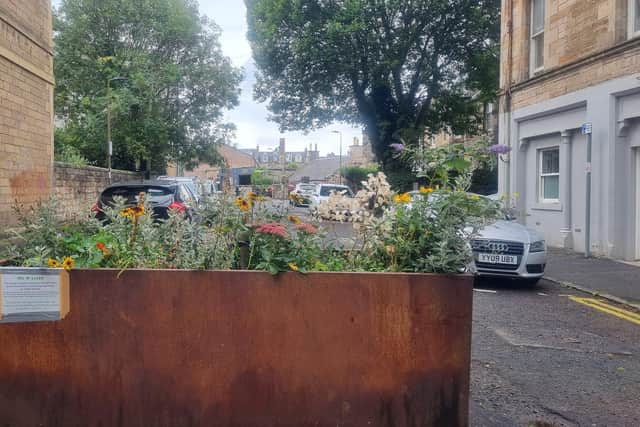
So it’s apparent that we all need greenery to thrive in a city. An integral part of the Leith Walk tram project was landscaping. Sadly the rusty corten steel planters were distributed with little thought or maintenance. Most of the planters have now been removed, but there’s not been any replacement offered. Thankfully, we rescued the Arthur Street planter and are creating a biodiverse environment. It’s not much, but it is seen by many neighbours who thank us for maintaining it. We’ve spotted bees, ladybirds, spiders and hoverflies amongst the 20 types of plants. It’s officially a place on Google maps, so you can even navigate to it.
Street trees need to come back into urban design. Good, well looked after trees not only offer flood mitigation, but also shade on our increasingly hot summer days and a home for wildlife. The are schemes for increasing urban trees, for example charity Trees for Cities https://www.treesforcities.org/
When you remove nature from a built environment, you remove hope. We are hard-wired to seek life, both green and blue (water, the sea). We need to demand better from new buildings and developments, as well as taking matters into our own hands. Let’s get growing!
Personal Trainer and author Tracy Griffen has been running Griffen Fitness for over 20 years. Contact her directly through the website www.griffenfitness.com. Tracy is RHS horticulture qualified and offers gardening advice, homegrown vegetables and recipes to her clients. Tracy is head gardener of the Arthur Street planter.